
As a claims defense law firm, you may be facing increased pressure to automate your record processing workflows. This is likely coming from both the influx of more AI-assisted demand packages from plaintiffs and insurance carriers who want to outsource claims litigation to law firms using AI to optimize their systems.
You may also understand that you need an AI tool that is able to keep up with the increasing rate of claims, because outsourcing to BPO or paralegals is no longer fast enough.
But finding medical chronology software that meets the specific needs of attorneys, not just adjusters, can be challenging. A platform should:
- Summarize records for non-medical practitioners to easily understand
- Prioritize litigation risk and fraud risk factors
- Provide evidence of accuracy across all outputs
In this article, we’re exploring how law firms can use AI-powered medical chronology software to increase efficiency and accuracy, and the best tools on the market for attorneys, including Wisedocs.
We’re covering:
- Why using a generalized AI tool isn’t enough for litigation teams processing claims records
- What to look for in medical chronology software for law firms
- A list of medical chronology software for law firms
- Wisedocs
- InPractice
- Verisk Discovery Navigator
- DigitalOwl
Note: Wisedocs is an AI-powered and human-validated claims analytics platform that helps insurers, legal teams, and medical evaluators turn complex, unstructured records into structured, defensible outputs. Schedule a demo to learn more.
Why using a generalized AI tool isn’t enough for litigation teams processing claims records
When it comes to claims litigation, a “high” accuracy of 95% is not enough. By using a non-specialized LLM for processing medical records, you’re risking not just inaccuracies, but also hallucinations, mistakes, and missing information.
Medical claims cases can often require the processing of thousands of documents, with complex cases like mass tort or asbestos reaching half a million pages.
Medical chronology software needs to be able to process this volume of pages quickly, and without “chunking”. This is when the context limit of a general-purpose AI causes it to break (“chunk”) files into manageable pieces, instead of individually scanning each page. As a result, important data can get omitted, and you’re left with only a partial picture of the full situation.
The AI may then step in to fill information gaps, but without medical long-context reasoning, it can be prone to hallucinations and unsupported claims. There have already been 2,000+ cases of AI hallucinations appearing in court decisions, with many resulting in fines, warnings, or even case dismissals.
General AI tools are also trained to generate a coherent output. This may sound like a positive, but in many cases this can lead to the LLM skipping over contradictions or issues for the sake of a final resolution. This can become a further issue, as non-purpose-trained AIs do not understand what to look for within medical or insurance-specific records in order to reach accurate outputs.
As a lawyer, you are actively searching for any inconsistencies in a case, and so you need a specialized tool that surfaces these findings, instead of hiding them.
Medical chronology software for law firms should therefore be trained on insurance claims documents and built to understand the greater context and nuances of these cases. It also needs to provide full source traceability and citations across all outputs, so you know exactly where each claim, insight, or piece of data came from.
The goal of easily accessible open LLM chatbots like Claude or ChatGPT is to provide faster answers for fewer tokens. The goal, however, of a specialized medical record AI is accuracy.
What to look for in medical chronology software for law firms
More and more often, insurance carriers are expecting law firms to be implementing AI into their claims workflows. That can mean mounting pressure to find a solution quickly.
But you don’t want to risk investing in the wrong choice.
The strongest AI claims solutions will be purpose-built for insurance claims defense teams and go beyond just automated medical chronologies. For instance, they may also offer features like AI insights, multi-level summaries, and ML-enabled pattern detection.
These are the most important features to look out for.
Provable and repeatable outputs that are defensible in court
As we shared earlier, AI hallucinations are already posing a major problem in courtrooms across the US. For law firms, accuracy is non-negotiable, and it should be provable within AI medical chronology software through auditable outputs that are defensible in court.
On a basic level, this looks like all outputs being accompanied by citations in order for attorneys to track sources and defend any AI-assisted decisions. Every point in a summary should be traceable to the exact page and line of the source record, with hyperlinks to the document.
If an AI-assisted finding is challenged during litigation, attorneys need to be able to show exactly how a source record became an insight, and prove that the same records would produce the same result every time. This means choosing a medical chronology tool that keeps a full audit trail of each processing step.
The software’s processing workflow also matters. For instance, medical chronology software for law firms that employs entity extraction at indexing can typically provide higher levels of accuracy. This is because all data is taken from the raw incoming records, instead of after AI processing, which can omit information or pages.
AI medical chronologies may also follow guidelines and regulations such as the NAIC model bulletin, which outlines how insurance carriers should use AI and has been adopted in 25+ states.
AI insights that automatically detect and highlight the risk of fraud and litigation
When it comes to using AI, plaintiff firms aren’t bound by carrier requirements, so they’re free to use AI tools very differently from defense teams. The attorneys can make files as messy and convoluted as possible so the defense side has a harder time reviewing records and piecing together a medical picture. Demand packets are also being stretched as far as legally allowed, with last-minute submissions and immediate response deadlines.
For medical chronology software to solve this issue for defense teams, it needs to be able to cut through the noise and flag fraud and litigation risks immediately. This enables attorneys to identify potential fraud more quickly and avoid wasting time on illegitimate claims. For example, it can provide instant analysis of attorney demand letters.
Other fraud risks that the software should be able to identify are:
- Gaps in treatment
- Inconsistencies across reports
- Conflicting diagnoses
- Missing records
A list of medical chronology software for law firms
Wisedocs
Starting with ourselves, Wisedocs was designed as an end-to-end claims platform that integrates AI with machine learning to review, process, and structure insurance claims records.
This includes automating medical chronologies and medical summaries, but also extends to AI insights and case analyzers. Together, the tools help your litigation team make faster in-platform decisions without sacrificing accuracy.
Wisedocs can handle up to 500,000 pages uploaded at lightning speed, creating structured and searchable medical chronologies within 24-48 hours, instead of days or weeks.
These are the key features you might want to know about.
100% of findings are trace-linked to the source of proof, with expert-in-the-loop review workflows
We know that when it comes to litigation, there is no room for error, especially when medical insurance claims can put hundreds of thousands of dollars on the line. That’s why Wisedocs prioritizes accuracy.
We’re able to achieve this through several methods, including undergoing full entity extraction across the entire scope of records before any AI processing takes place. We then categorize, store, and analyze that data across both individual cases and your entire book of business in order to provide the most accurate and detailed AI insights.
Many medical chronology software options for law firms opt to do entity extraction after processing, as it is cheaper. However, we know the importance of collecting as much data as possible to ensure nothing is missed.
Not only that, but our platform is also in line with the NAIC AI guidelines; for example, we implement expert-in-the-loop reviews that mean our AI insights workflows are never without human oversight.
All outputs are also fully cited, with hyperlinks per summary line to the original document.
Reach first-touch 60-80% faster to double your page processing capacity with purpose-trained AI and ML capabilities
Increasing plaintiff activity is leaving defense teams drowning in a torrent of growing demand packets with immediate response deadlines. And as lawyers, not doctors, it can take even more time to decode the growing number of difficult-to-decipher records like handwritten medical notes or X-ray images.
To get through this incoming flow of records, manual review is no longer enough.
Instead, Wisedocs automates the document processing workflow through AI-powered medical chronologies and medical record summaries. We are able to provide swift turnaround times thanks to our combination of target-trained intelligence and purpose-built ML pattern recognition.
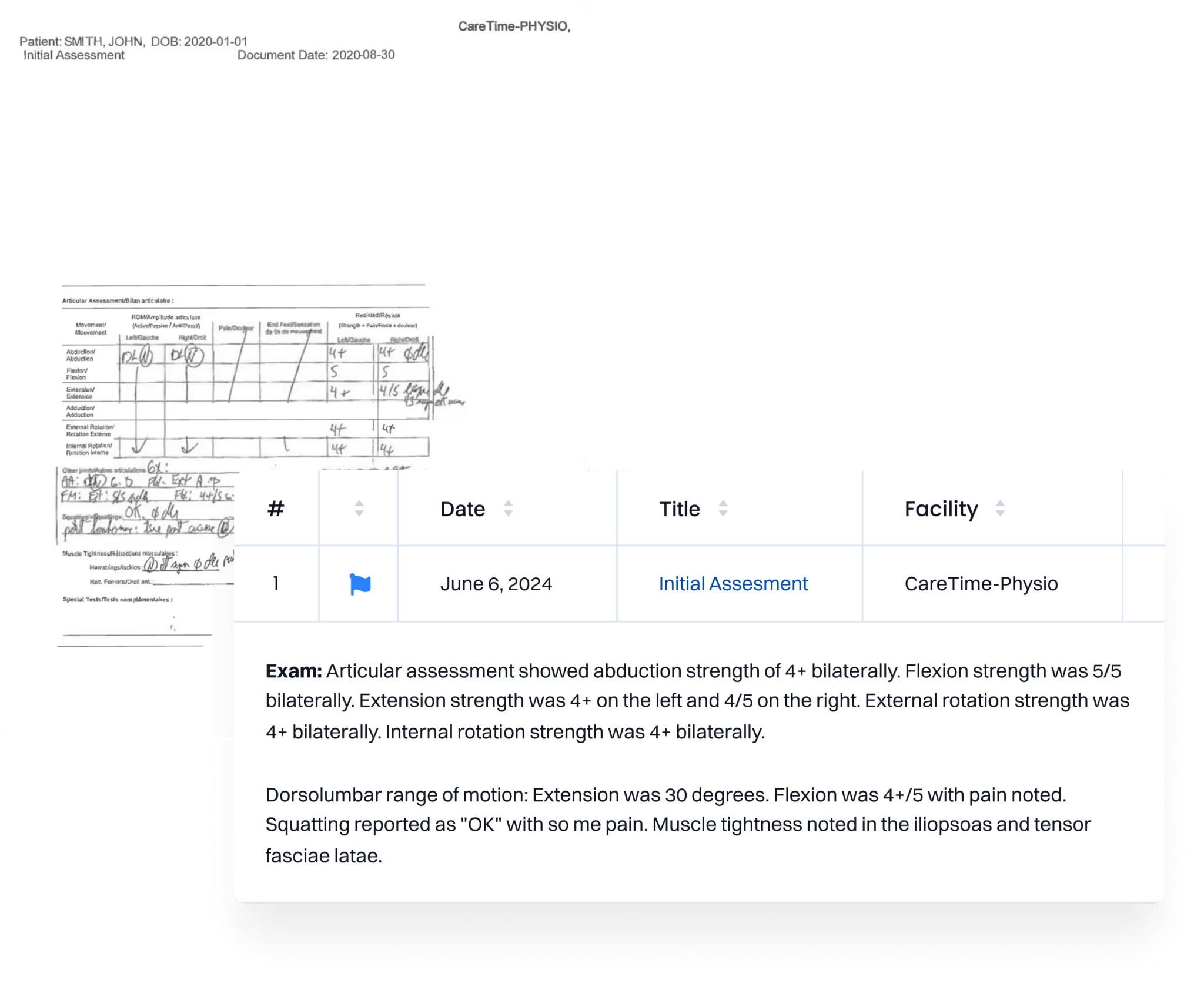
We trained our AI on 150 million medical records and designed an ML workflow that recognizes 1,500+ insurance document templates. That means that no matter where on the page data can be found, and however it is presented, our platform can analyze it and turn it into data you understand.
The summaries are then designed to prioritize the information that lawyers need. For example, a medical summary can break down cases into the key components so that your team can hit the ground running.
Use pre-made case analyzers to instantly identify inconsistencies and weak spots in the claimant’s case
Even the best attorneys could easily miss a small detail that changes a case completely, particularly if that detail is hidden halfway down the 800th document of a 15,000-page claims packet.
Wisedocs counteracts this risk by analyzing the full scope of data sourced at indexing, then using AI to connect the dots.
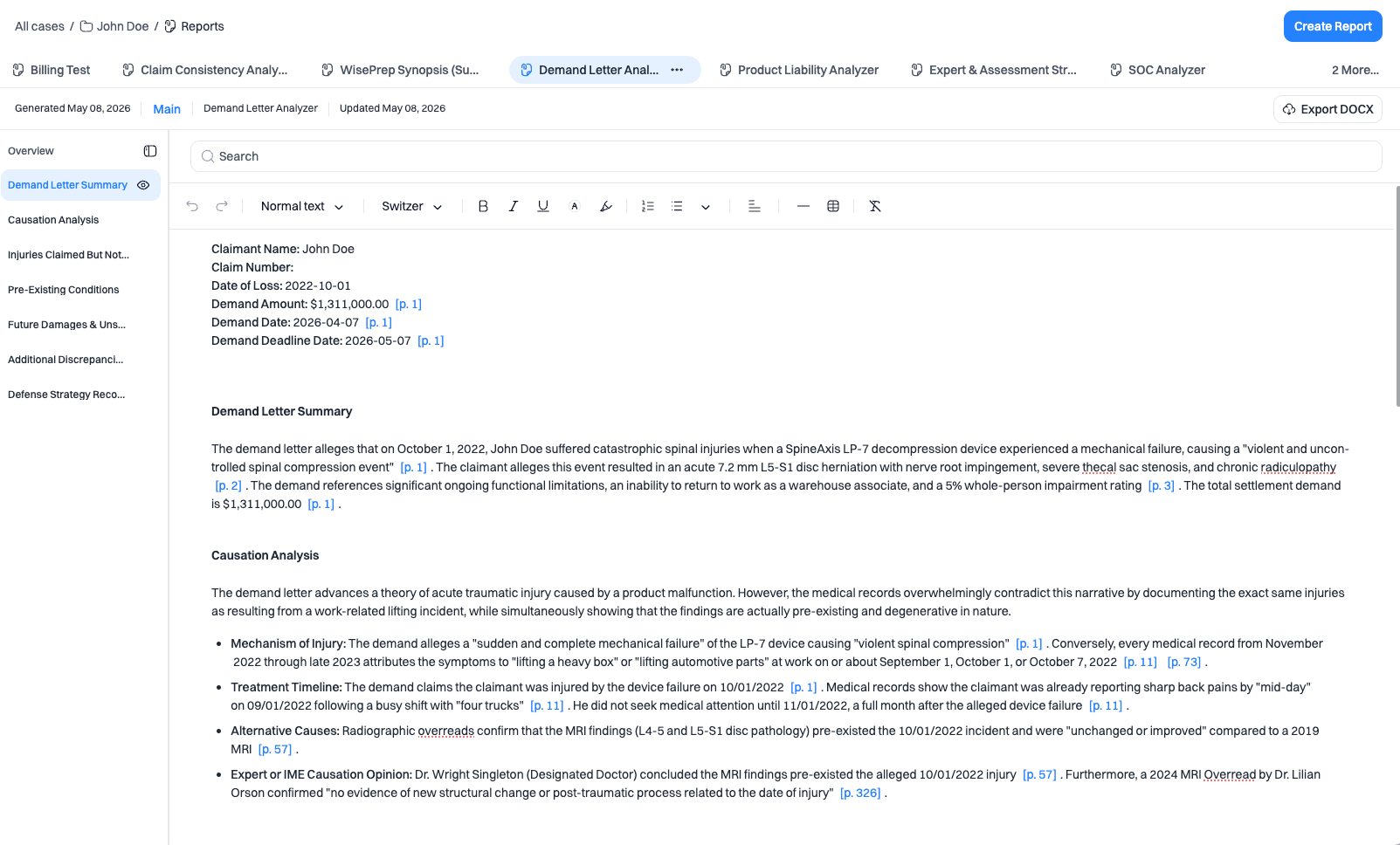
This information is then presented through our AI-enabled case analyzers. These configurable reports instantly surface the most critical information, with every point cited back to its original source.
For instance, our demand letter analyzer compares a demand letter to the reality presented across all the case records to act as an unbiased source of truth. The report surfaces insights such as:
- If there are injuries claimed but not supported by the records
- Any potential pre-existing conditions
- Unsupported diagnoses that don’t match the medical records
- Other discrepancies between the demand letter and records
Wisedocs’ claims decision intelligence platform also has a claims consistency analyzer which details any missing records or inconsistencies across a case. For example, if a claimant describes being incapacitated by pain, but went six to eight weeks without seeking treatment. Or if they told a paramedic that they did not lose consciousness, but that story then changed after meeting with a lawyer several weeks later.
How this workers’ compensation legal defense firm increased its daily page processing capacity from 8,000 to 20,000+ with Wisedocs
A leading regional defense firm specializing in workers’ compensation represents some of the largest insurance groups in its jurisdiction. Its case files ranged from a few dozen pages to more than 1,000, with some raw files reaching 10,000 to 30,000 pages and requiring up to eight reviewers and several days to brief manually.
The firm wanted to decrease the resource drain of manual document processing, so it partnered with Wisedocs. The platform was able to automate file review, deduplication, and the production of auto-sorted, indexed medical chronologies. Working with our team, it also configured outputs to match its existing review process, so attorneys could quickly find each piece of evidence by document type, date, or claimant.
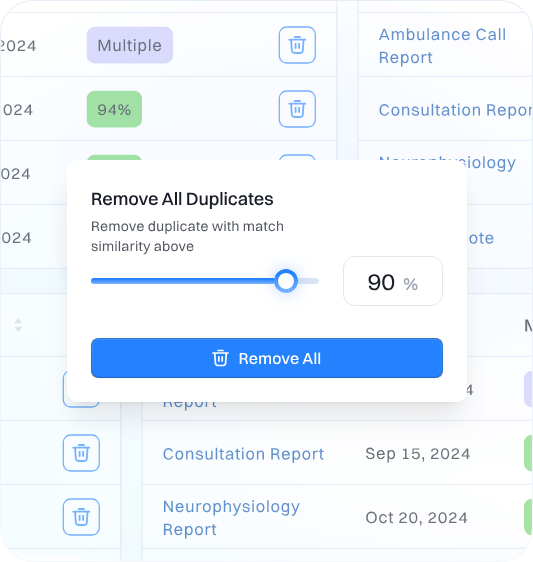
As a result, the firm has cut document processing time by 66% and now runs 80% of incoming case files through Wisedocs. Large files are handled by two staff members instead of eight, and files that were once completed just one to three days before deadlines are now returned two weeks or more in advance.
With less time spent sorting records, the firm’s attorneys have the time they need to prepare, strategize, and build defensible positions for their clients.
Read the full case study: Workers’ Compensation Legal Defense Firm Automates 80% of Legal File Review—Without Compromising on Accuracy or Oversight.
InPractice
InPractice works as an AI medical record review tool that has worked with 500+ law firms to provide fast and automated medical chronologies. The software was built specifically for attorneys practicing in personal injury, workers’ comp, medical malpractice, and other medical record-intensive cases.
It can also handle more complex cases, for instance, mass tort. The tool uses pay-per-page pricing and can be set up and running in less than 10 minutes.
Key features include:
- Automatic AI chronologies: Timelines with customizable views, search features, and filters
- Narrative summaries: Page summary overviews of key information that can be downloaded to a Word document
- Duplicate detection: Automated deduplication to reduce the size of the record package
- Mass tort chronologies: Dedicated timelines for mass tort cases
Verisk Discovery Navigator
Discovery Navigator by Verisk is a medical record review platform that claims to process documents 90% faster than manual handling. The tool is part of Verisk’s wider suite of claims solutions, so it draws on a large set of legal, medical, and data science expertise.
The platform was designed for insurance claims teams to be able to adjust and negotiate claims faster, with accuracy rates of up to 95%. Verisk’s clinical experts spent eight years reviewing records to help train the model, which was tested on millions of medical and claim-specific data points.
Key features include:
- Record organization: Automates deduplication, then sorts documents into visual chronological treatment timelines
- Medical term extraction: Surfaces and summarizes the most important medical information like pre-existing conditions, prescriptions, and surgical procedures
- AI summaries and reports: Creates summaries and reports to present deeper analysis of key insights
- Demand package review: Integrates directly with Verisk Liability Navigator to surface pre-existing conditions, gaps in care, and other issues in demand packages
DigitalOwl (now ChartSwap Insights)
DigitalOwl is an AI-powered platform for insurance and legal professionals that works with both the plaintiff and defense side of insurance claims. Legal practitioners in personal injury, mass tort, and medical malpractice use DigitalOwl, as well as those in the P&C insurance sectors.
The software states it has 97% accuracy rates, as well as click-to-evidence sourcing across outputs. It also claims to produce up to 72% time savings on medical record reviews.
Key features include:
- Trial-ready chronologies: Produce medical record timelines that users can sort, search, and export
- Case timelines: A structured timeline that highlights conditions, procedures, and outcomes
- Same-day turnaround: Chronologies can be ready the same day as records are uploaded
- AI case notes: Get actionable AI insights that help claim adjusters and attorneys make case decisions
Choose medical chronology software like Wisedocs that goes beyond just record processing
Looking for medical chronology software for law firms is often the first step in optimizing a claims lifecycle using AI. Wisedocs goes beyond just medical record review, also offering additional benefits like AI insights and case analyzers to provide a true end-to-end claims analytics platform.
Book a demo to learn how this could improve the accuracy and efficiency of your law firm.
FAQs
What does medical chronology software do?
Medical chronology software organizes thousands of raw medical records into ordered, interactive medical timelines. It automatically strips out duplicate pages, extracts clinical details like dates, treatment facilities, diagnoses, and body parts, and links every entry back to its exact source page.
That lets adjusters and defense counsel review a claimant's medical history in hours instead of days. Legal and claims teams can immediately spot treatment gaps, pre-existing conditions, and conflicting statements without reading thousands of pages by hand.
How is AI used in medical record reviews?
Artificial intelligence automates the initial extraction and structuring of messy medical files. Domain-trained models process incoming PDFs, run optical character recognition (OCR) on handwritten notes, and categorize dates, provider names, and billing codes.
The most effective platforms pair artificial intelligence with human-in-the-loop review. That approach uses algorithms for rapid document sorting while human clinical experts verify low-confidence extractions, protecting defensibility and catching errors before output reaches a claims file.
Can attorneys use AI for insurance claims processing?
Defense attorneys and claims litigation teams can use artificial intelligence to review demand packages, prepare for depositions, and evaluate case risk. By processing thousands of pages automatically, counsel can instantly pinpoint discrepancies between a plaintiff's demand letter and their documented treatment history.
Using domain-specific platforms gives defense counsel page-level citations for cross-examination and court filings. It shifts attorney time away from manual record assembly and into building targeted defense strategies.
How accurate is AI for creating medical chronologies?
Accuracy depends heavily on whether you're using off-the-shelf language models or specialized claims software. Generic tools often miss clinical context or hallucinate facts because they summarize text without verifying structured data against original documents.
Purpose-built platforms reach higher accuracy rates by extracting specific data points before generating summaries. When paired with human expert quality assurance, these systems can produce page-cited medical chronologies that stand up in court.
Sources:
- https://www.inpractice.ai/medical-chronology-reports-inpractice
- https://www.inpractice.ai/medical-record-review-for-attorneys
- https://www.inpractice.ai/mass-tort-medical-record-review-inpractice
- https://www.inpractice.ai/medical-record-review-services
- https://www.inpractice.ai/ai-info-page
- https://www.verisk.com/products/discovery-navigator/
- https://www.verisk.com/company/newsroom/verisk-launches-generative-ai-tool-to-support-faster-insurance-claim-processing/
- https://www.verisk.com/blog/harnessing-ai-and-ml-through-discovery-navigator-to-save-time-and-money-on-medical-records-review/
- https://www.verisk.com/blog/how-ai-powered-medical-record-review-helps-insurers-evaluate-injury-claim-demand-packages/
- https://www.digitalowl.com/
- https://www.digitalowl.com/lp/ai-medical-chronologies-for-attorneys
- https://www.digitalowl.com/products/view
- https://www.digitalowl.com/blog/ai-medical-chronologies-for-law-firms
- https://www.digitalowl.com/press-releases/digitalowl-moves-beyond-summaries-using-ai-agents
- https://www.digitalowl.com/use-cases/disability-claims

