
Processing workers’ compensation claims is time-consuming and labor-intensive. And when claimants are using AI to significantly increase the volume and scope of their claims, you’re likely facing more pressure than ever before to streamline your defense workflows.
Manually sorting treatment notes, removing duplicate pages, and tracking changes in a worker’s condition can consume days of time, all before your team even begins assessing the claim itself.
Scale that across a full caseload, and you’re losing valuable time and money just to keep up with the increased plaintiff activity, let alone have adequate time for detailed review and adjudication.
And business process outsourcing (BPO) isn’t always a perfect solution either. It is expensive, and often results in static PDFs that leave reviewers still needing to locate the original treatment notes to verify a diagnosis or compare two providers’ opinions.
This work calls for an AI claims decision intelligence platform built specifically for managing workers’ comp claims to process record packages quickly, efficiently, and with a high degree of accuracy.
In this article, we’ll explain:
- How you can use AI to improve workers’ compensation processes
- Why a generalist AI tool like ChatGPT is not enough
- What you should look for in a workers’ compensation AI platform
- How Wisedocs helps your team review workers’ compensation claims faster
- How a leading state workers’ compensation fund used AI to reduce the administrative burden on its claims staff
Looking to reduce the work behind your claims backlog? Book a Wisedocs demo to see how organized records, medical summaries, and source-linked findings can support your review process.
How you can use AI to improve workers’ compensation processes
Workers’ compensation claims are incredibly time-sensitive while also involving sometimes thousands of pages that need to be individually reviewed, analyzed, and sorted.
When done manually, this can take days or even weeks. That time costs you money, as well as potentially delaying an injured worker from receiving support or returning to work.
A specialized claims AI platform designed for medical insurance carriers and litigation teams can cut that processing time down to a fraction, without sacrificing accuracy or defensibility. This happens through several features.
Analyzing incoming records automatically across many document types
Using an AI tool built for workers’ compensation claims, you can upload entire packets of records for hands-off processing. This means recognizing the document type, extracting all relevant data, and automatically storing it for later analysis.
These platforms work with not only PDFs or typed text, but also more difficult-to-understand documents like handwritten notes or diagnostic imaging reports. These are typically then turned into easy-to-digest medical record summaries to ensure all information is accessible to your claims management team.
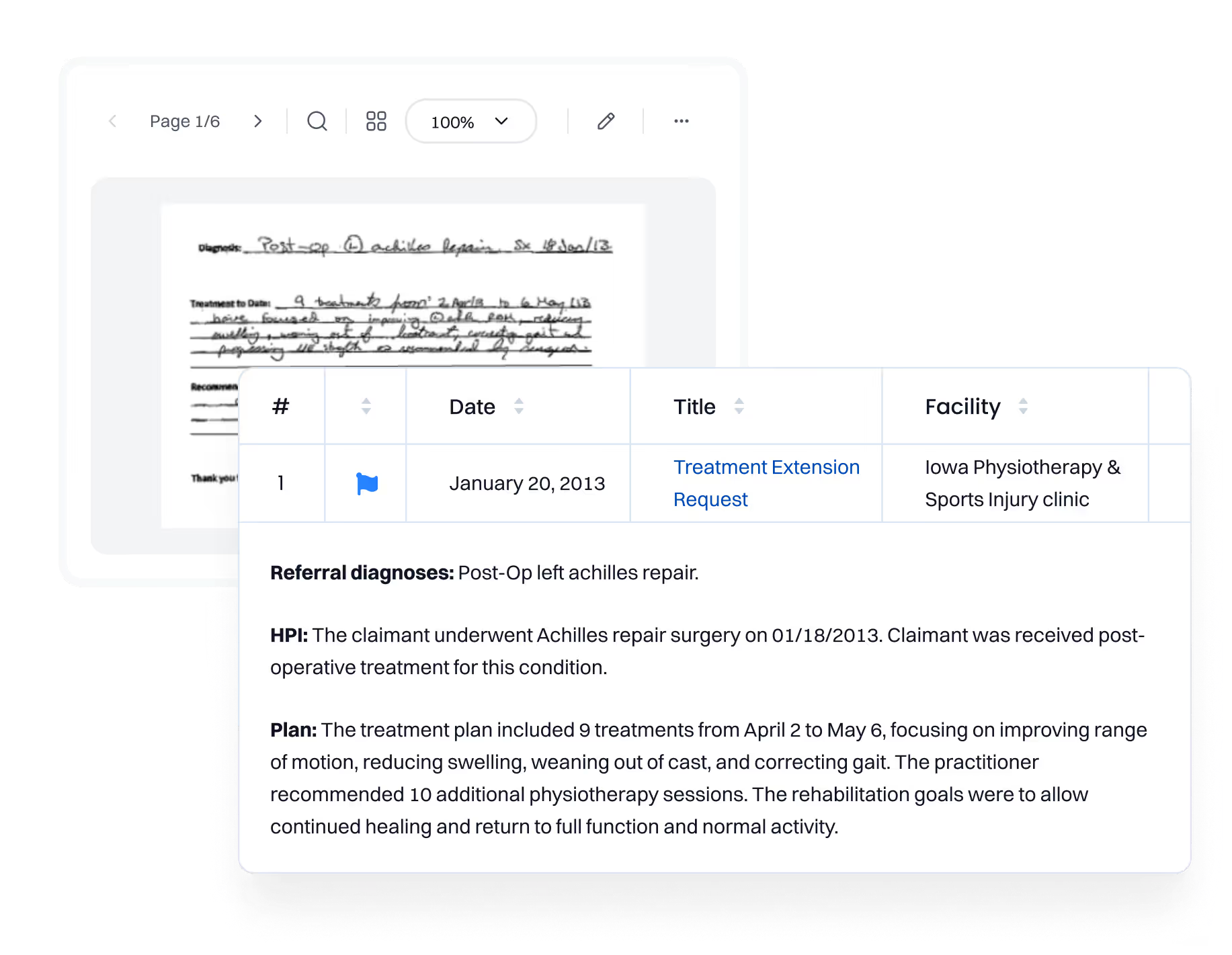
This process also works to shorten manual review time later in the claim lifecycle through deduplication and the separation of commingled documents. By removing these redundant pages, document files can be reduced by as much as 40%.
Quickly organize documents according to timelines, providers, costs, and more
An AI claims processing solution can take the thousands of unorganized documents and turn them into structured medical chronologies and summaries. The extracted information, like dates, providers, diagnoses, and treatment details, becomes searchable filters, meaning you can find all information instantly within just a few clicks.
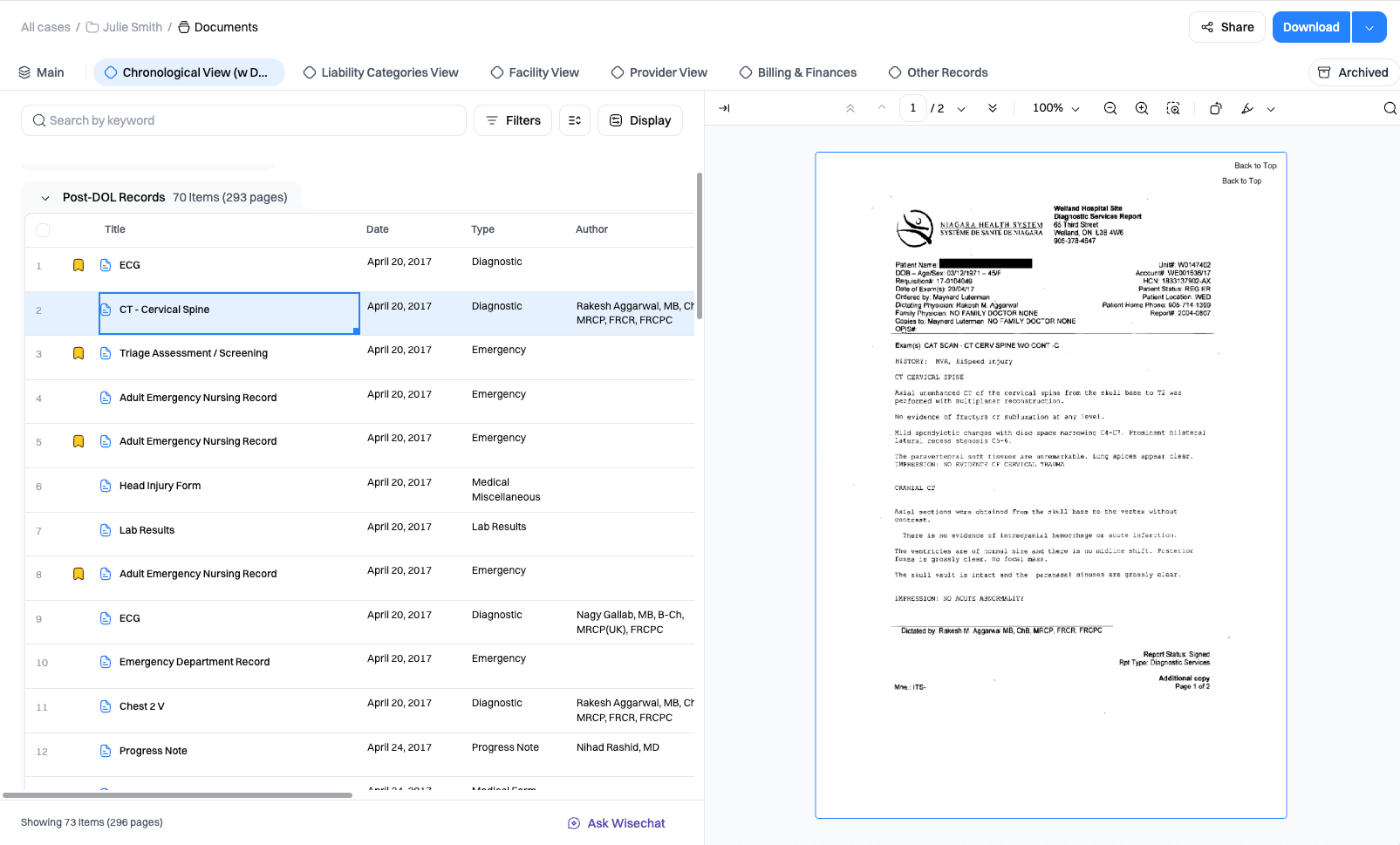
Adjusters, attorneys, and medical practitioners can follow a worker’s care from the first injury assessment through treatments and specialist appointments without having to assemble the timeline themselves. Or, your team can find a particular appointment or imaging report without manually reading through every document.
That means spending less time transcribing information and sorting uploads, and more time making decisions.
Identifying key insights on your book of business for faster decision-making
In a claims analytics platform, the data extracted during processing can also then be used to generate AI-powered insights that further support accurate and faster decisions.
These might be:
- Surfacing an inconsistency within the claim
- Highlighting the fraud or litigation risk
- Flagging treatment gaps or delayed care
- Identifying pre-existing conditions or prior injuries that may be relevant
- Detecting missing records, so adjusters can request them early instead of discovering the gap at the IME or QME stage
For example, suppose you’re reviewing a back injury claim and a specialist’s note says they reviewed an MRI. You need the original MRI report to compare the radiologist’s findings with the specialist’s interpretation, but that report isn’t in the documents you received.
A general AI summary could repeat the specialist’s account without drawing attention to the missing report. A specialized claims decision intelligence platform with checks for missing records can flag that gap and link you to the note referencing the MRI. You then know which report to request and which appointment it relates to.
Why a generalist AI tool like ChatGPT is not enough
Despite the number of generalized LLMs on the market today, these non-specialized tools are not appropriate when it comes to handling insurance claims processing. That’s because they lack the training and context to be able to understand workers’ comp claims on a meaningful level and were not built to process data at the volume you likely need.
A complex workers’ compensation case can involve records from 15 to 30 providers over several years, often totaling 5,000+ pages. However, as general models have context limits, they are likely to “chunk” your large files and omit critical information instead of deeply analyzing every page.
A specialized AI claims processing solution, on the other hand, will be purpose-trained on insurance claims records. It will understand long-context reasoning: the ability to follow a claimant’s story across hundreds of visits and dozens of providers, then reconstruct what happened, in what order, and what it means for the claim.
They are designed to help defense lawyers, adjusters, and independent medical examiners process large volumes of pages quickly and efficiently. Every finding is then linked back to the exact source page, so reviewers can verify it in seconds, and expert human oversight catches the errors that general tools might confidently present as fact.
What you should look for in a workers’ compensation AI platform
Although there are many AI tools on the market, finding one that is able to meet the specific needs of workers’ compensation cases is difficult. The stakes are incredibly high, with both people’s well-being and potentially millions of dollars on the line, depending on your claims teams to produce fast and accurate decisions.
With that in mind, these are the capabilities to look for when comparing providers.
AI outputs that are fully defensible in court
Using a generalized LLM tool can leave you vulnerable to hallucinations, mistakes, and decisions that do not hold up in the courtroom. Instead, you need to look for an AI model that produces outputs that are both defensible and auditable.
This means not only selecting a specialized tool built for insurance claims, but also looking for additional safeguards designed to ensure accurate and defensible decisions. These include:
- Compliance with the latest AI guidelines, such as the NAIC model bulletin
- Human-in-the-loop workflows and review cycles
- Full source traceability and citations for every insight and output
We built our platform, Wisedocs 2.0, around these concepts so that attorneys, adjusters, and IMEs could trust the AI outputs for faster and more accurate decisions. For instance, when we paired AI agents with human quality auditors, we saw audits completed 50% faster, with 30% more mistakes caught than human auditors working alone. Book a demo to learn more.
A tool that is compliant across differing state legislation
When it comes to using AI to improve workers’ compensation claims processes, there are three regulatory areas to consider:
- Evolving AI rules and laws
- Workers’ comp laws that are regulated at the state level
- Compliance with relevant security protocols and laws, such as HIPAA or SOC 2 Type II attestation
The right AI claims processing tool should be able to prove that it meets all of these requirements, as well as staying up-to-date on rules and regulations that are changing in real time.
For instance, a model trained on insurance documents knows that a New York C-9 form is a request for treatment authorization, not a clinical note. Another example is that in California, a utilization reviewer has just five working days to act on a prospective treatment request, and that clock starts when the request arrives, not when the supporting medical records do.
A UX that is easy to use and fits with your existing review process
A medical chronology should make it easy to follow how a worker’s condition and treatment changed over time. By accessing an interactive and searchable timeline, you’re better able to explore and review that information.
For instance, you can add filters for data groups like dates, providers, and clinical details, so you can compare appointments and find the records relevant to your question.
An interactive medical timeline can also highlight gaps and conflicting information within that history. If a note references a follow-up assessment that isn’t included in the file, the finding should identify the appointment and link to the record mentioning it. That way, you can then check whether the report needs to be requested before sending the file for evaluation.
Configurable reports should then let you organize that information without rebuilding the document for each person. That means that an independent medical evaluator could access the treatment timeline and documented physical limitations, whereas counsel would need the dated medical opinions relevant to a disputed restriction.
How Wisedocs helps your team review workers’ compensation claims faster
Claimant activity is on the rise, and so is the size of demand packages insurance carriers, law firms, and IMEs are facing. All with strict workers' compensation deadlines that leave you spending days manually reviewing documents, or thousands of dollars per day on BPO, if not both.
Wisedocs offers a different solution. Our end-to-end claims documentation platform brings claim record preparation, medical analysis, and secure collaboration into one AI-powered workflow.
Our claims decision intelligence turns incoming records into organized information your team can use to assess the claim and investigate what needs attention.
Here’s what that looks like in action:
Start reviewing medical records 60-80% faster with automated file preparation
New records keep arriving as a claim progresses, and each batch needs to be organized and placed within the existing medical history so reviewers can understand how the worker’s condition and treatment have changed.
Wisedocs automates this process of sorting, indexing, and deduplicating uploaded records, with expert checks built into the claims processing. Your team can start reviewing medical records 60-80% faster than with manual preparation, leaving more time to investigate gaps, compare findings, and assess what the evidence means for the claim.
We do this using:
- Configurable workflows that organize documents around your review requirements, including categories like progress notes, claim forms, imaging, and evaluation reports.
- Medical chronologies to bring the records into a searchable timeline organized by date, provider, and event
- Medical summaries that condense clinical information with references to the underlying records, such as progress notes, examination findings, the provider’s assessment, and the treatment plan.
For ease of analysis, the Wisedocs platform interface displays the medical record summary beside the original source document, keeping both in view as your team examines the evidence. An adjuster checking a change in the worker’s condition can read the provider’s wording without switching between a separate summary and the record packet.
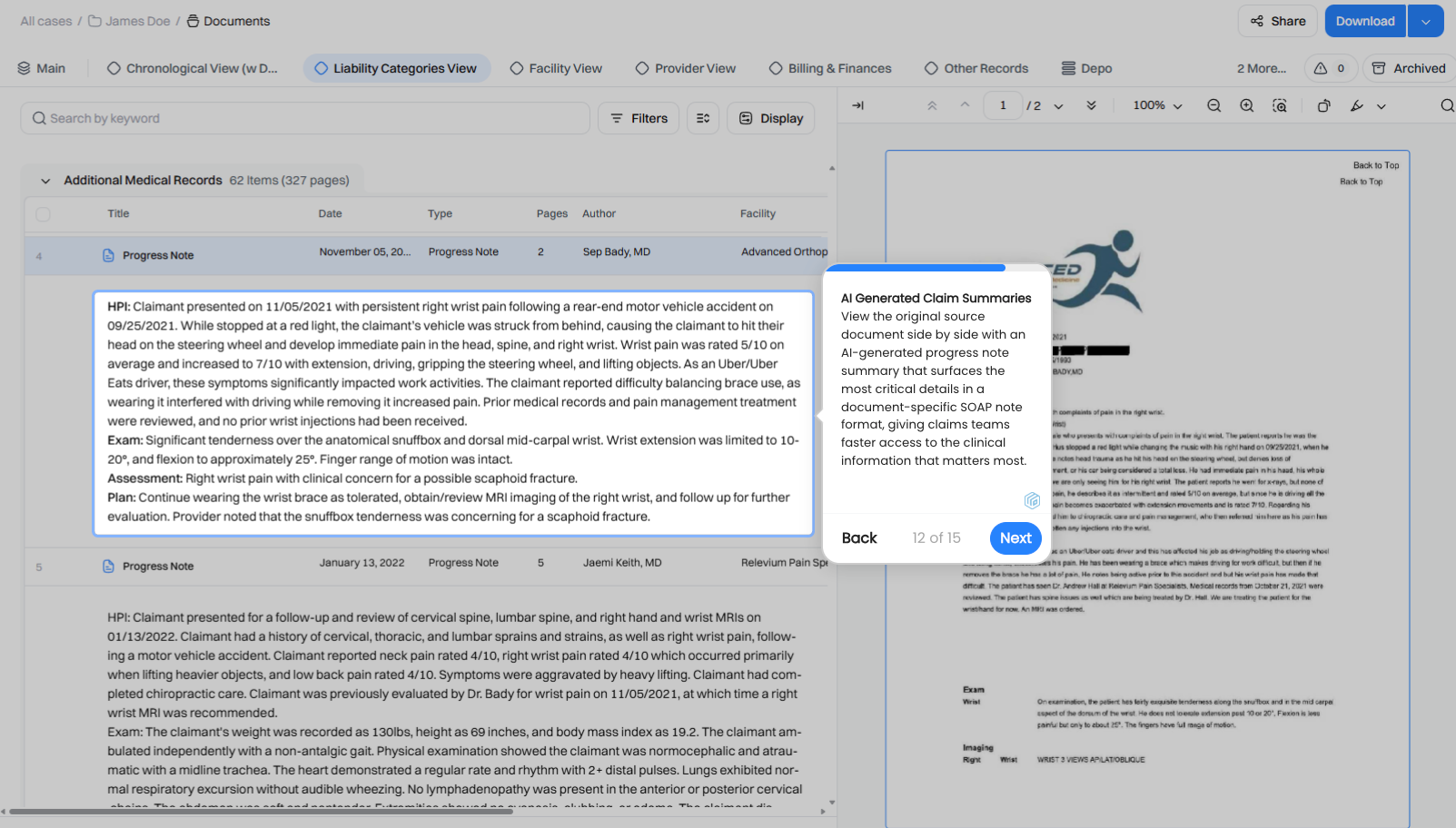
Example of a medical progress note summary in Wisedocs, displayed beside the original record so reviewers can examine the clinical details and their source in one view.
Unlike general AI tools, Wisedocs’ machine learning engine is also trained on more than 150 million industry-specific documents and built to capture the nuances of complex claim files. Before generating AI medical summaries, Wisedocs extracts and classifies dates, providers, diagnoses, and treatment details. That structured information supports searches, comparisons across records, and checks against the source documentation.
Our expert-in-the-loop process then adds a built-in review from Wisedocs’ team of medical industry specialists in line with the NAIC model bulletin.
After records are processed into summaries and chronologies, documents that fall below the AI confidence threshold are flagged for our in-house medical experts. They check the information against the claim’s medical documentation, giving your team an additional accuracy check before using it to assess the claim.
Identify and investigate gaps and inconsistencies to more easily make a claims decision
If a treating physician’s notes don’t line up with the findings in an independent medical evaluation (IME) report, your team needs to compare the findings and understand what each opinion is based on. When those reports are buried among years of treatment records, locating the relevant passages can take hours before you begin that comparison.
You might turn to a general AI tool to compare the records for you. However, these tools can blend the findings into a coherent summary that still overlooks the contradiction you need to investigate because they’re built to deliver consistent responses.
Wisedocs’ WiseInsights is designed to flag inconsistencies within claim records for your team to investigate. Its analyzers surface findings, including conflicting provider accounts, treatment outliers, and billing anomalies, to provide insights with sources and create confidence scores.
For instance, if there is a disagreement about the worker’s ability to return to their usual duties, you can open the records behind the flag, compare the providers’ findings, and determine what needs clarification before making a claims decision.
Our claim consistency analyzer also identifies potentially missing records, gaps in care, scheduling inconsistencies, and conflicting information across providers. For example, it can flag when a case file references a follow-up evaluation, but there’s no corresponding report in the record.
Your team then has a specific document to locate or request before continuing that part of the assessment.
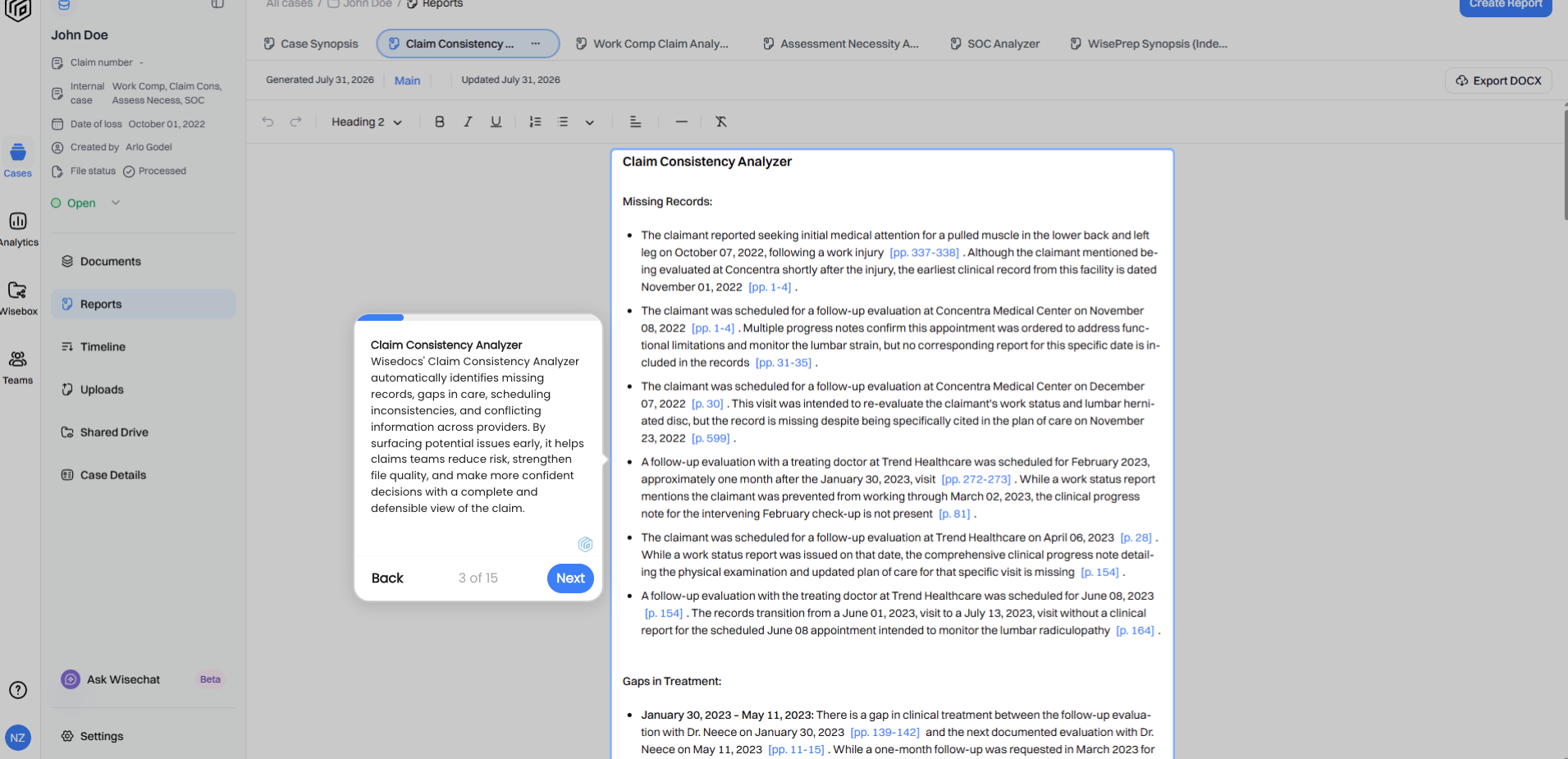
Example of Wisedocs’ Claim Consistency Analyzer identifying potentially missing records and gaps in treatment, with citations that let reviewers examine the information behind each finding.
When a finding raises another question, WiseChat lets you query the uploaded records directly. For a back injury claim, a reviewer could ask, “What back symptoms and treatment were documented before the reported workplace injury?”
The response includes citations to the records behind the answer. These tools make it easier for your team to find the evidence they need with less time spent searching through the case file.
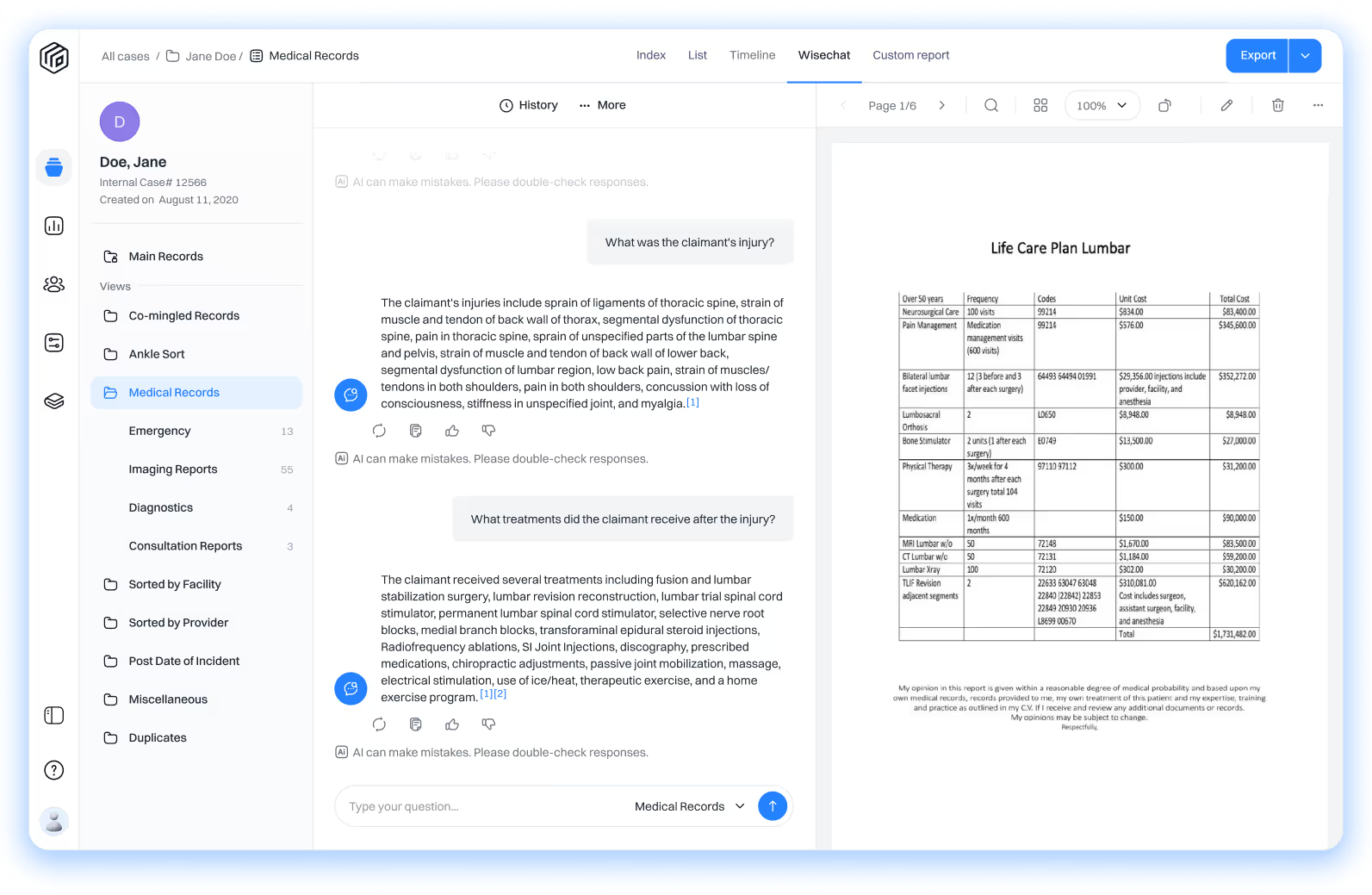
Every WiseChat answer is hyperlinked and highlighted in the source claims document, giving you context you can trust.
Share supporting records securely with fewer back-and-forth requests for additional documents
When an adjuster refers a question to counsel or a medical expert, collaboration needs to happen. But this can cause HIPAA or other security risks, or create separate copies that make it harder to track who has received or accessed the information.
Wisedocs’ custom reports let your team tailor the output to your workers’ comp needs and the person reviewing it, whether they’re a claims adjuster, functional capacity evaluator, or defense attorney.
Templates can be configured for your line of business and reporting requirements, including claim overviews and IME reports, for a clear view of relevant information across the claim. This reduces the work of assembling and formatting information for each reviewer before sharing the supporting records.
WiseShare provides encrypted document sharing, with permissions controlling access for colleagues and external reviewers. Your team can share case documents or an entire file, track access and downloads, and revoke access when it is no longer needed.
That means an adjuster seeking clarification about different medical opinions can give the evaluator access to the relevant reports and surrounding treatment history. The evaluator has the supporting documents available as they examine the question, reducing requests for individual attachments and repeat searches by the adjuster.
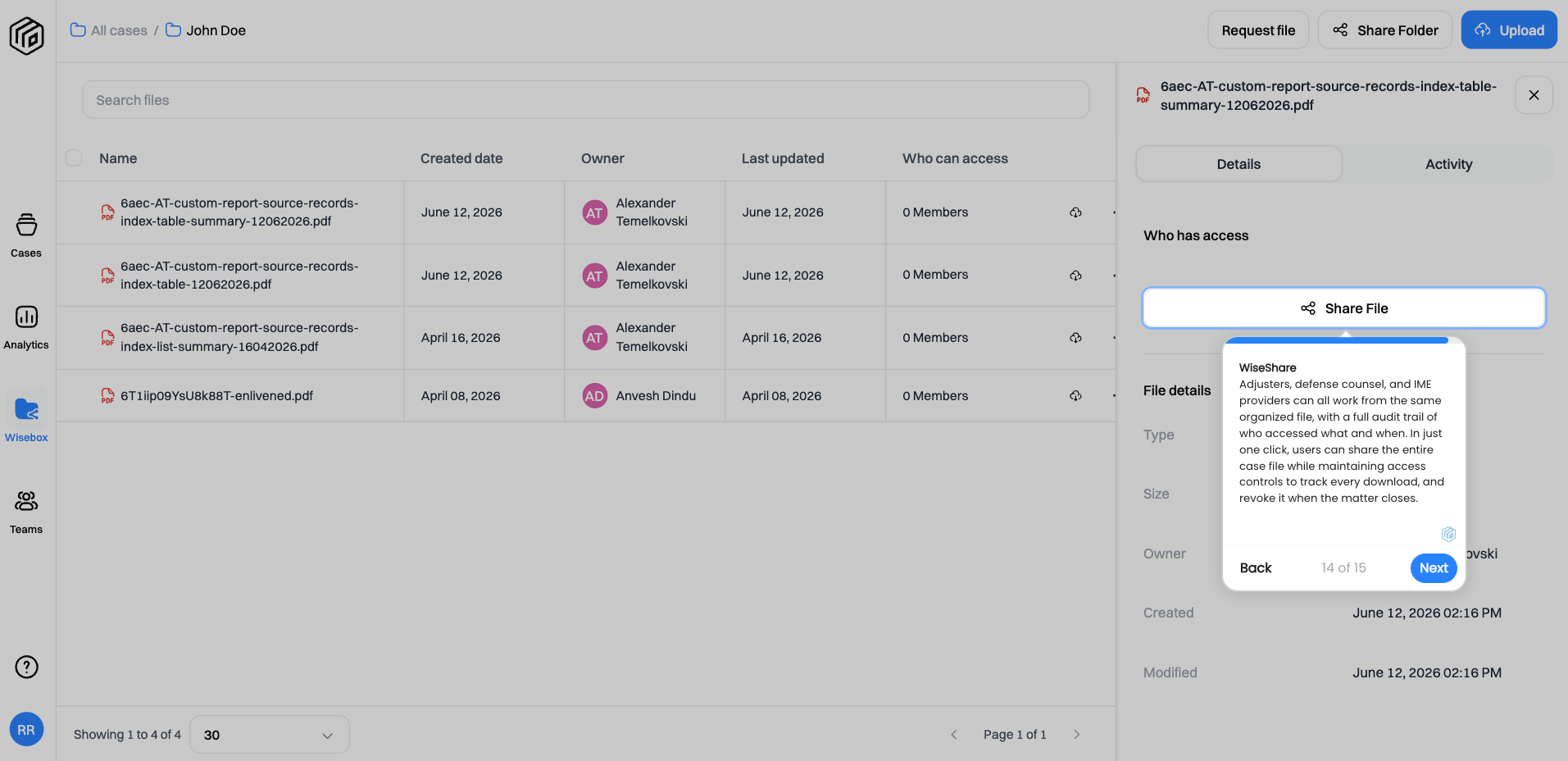
WiseShare’s document access controls let claims teams provide supporting records to other reviewers and track access as the review progresses.
Activity records show which users accessed or downloaded documents, making the handoff easier to trace. Counsel and medical experts can continue the review with the supporting material already available.
How a leading state workers’ compensation fund used AI to reduce the administrative burden on its claims staff
Kentucky Employers’ Mutual Insurance (KEMI) is the largest provider of workers’ compensation insurance in Kentucky. Like many workers’ comp insurers, KEMI faced growing complexity in claims documentation. Claim files with records from multiple providers took significant staff time to process, which meant less time for the work that matters most: supporting policyholders and helping injured workers recover.
For them, speed, reliability, and ease of use were central to finding a solution. In the end, they chose Wisedocs to power its Artificial Intelligence Medical Records Review program, making it one of the first state funds to launch a program of this kind.
The program focuses on reducing administrative work and making claim information easier to act on, giving staff more time to serve employers and injured workers across all 120 Kentucky counties.
Read the full case study here: KEMI Expands Commitment to Excellence with Wisedocs’ AI-Powered Claims Document Reviews.
Reduce the preparation behind your claims backlog
Every hour spent reconstructing a file is time your team could spend resolving a question, coordinating an evaluation, or assessing the evidence needed for a claims decision.
Wisedocs organizes the records, connects findings to evidence, and makes the supporting information available to the people reviewing it. Your team can begin their assessment sooner and spend less time searching for documents or preparing them for another reviewer.
Book a Wisedocs demo to see how our workers’ compensation AI platform can reduce the preparation behind your claims backlog.
FAQs
What AI do insurance companies use for workers’ compensation?
Insurance companies use different types of AI for different tasks. Document processing tools extract and summarize claim information, workflow tools automate intake and administrative tasks, and predictive models analyze claims data for risk management or performance patterns.
Wisedocs organizes and analyzes claim documents so teams can review the medical evidence and investigate findings more efficiently.
Can a workers’ compensation AI platform work with an existing claims system?
That depends on the platform and the integration required. Wisedocs is designed to support existing claims workflows. During evaluation, the provider should clarify which documents and outputs will move between systems, how access will be managed, and what implementation work is involved.
What is the best AI platform for workers’ compensation?
The best fit depends on the work slowing your team down. For medical record review, look for a platform trained on claims documents that combines automation of summaries and chronologies with source references, expert oversight, and secure sharing. A demonstration using a representative file can show how well those capabilities fit your review process.
How should you measure the return on an AI platform?
Compare the time and cost of the same review tasks before and after adoption: preparing the file, locating evidence, correcting outputs, and sharing documents. If the provider offers a trial, you can begin that comparison during evaluation.
Your team can then calculate staff time saved, changes in outsourcing costs, and any increase in processing capacity. Include subscription, implementation, and ongoing review costs when assessing the return.

