
If you work as a claims professional in the casualty space, you’ve likely already been experimenting with artificial intelligence to help speed up a lot of document review. You may currently be in one of the following scenarios:
- You’ve been using a tool like ChatGPT to do some of the document review, but you find that it frequently hallucinates, misses key information and makes it hard to ensure your review is accurate.
- You’re spending days reviewing demand letters that are getting bigger by the week due to plaintiffs using AI when submitting a claim. It’s becoming unsustainable and you know implementing AI into your own processes is the only way to overcome this.
- You want to implement AI into your claims management workflow but are unsure what is the safest, most secure and efficient way to do so.
When implemented correctly, using the right AI tool can vastly reduce your workload. A 5,000+ page document that used to take 3 - 4 weeks can take 24 - 48 hours, freeing you up to do what you really want to do: make decisions rather than review documents.
AI medical record review tools also control and dramatically reduce third-party review costs by providing organized and deduplicated claim files, ensuring experts are only required to review what's relevant to their area of expertise. This means less time is spent sorting through redundant records and more time is focused on clinical analysis, faster decisions, and higher-value work.
In this article, we’ll give you guidance on how AI can be best implemented into your claims process, including:
- The limitations of tools like ChatGPT for casualty claims
- 3 ways a dedicated AI tool can have a huge impact on casualty claims processing
- Why choose Wisedocs to manage your casualty claims
- How this regional legal defense firm increased their processing capacity from 8,000 to 20,000 pages per day
Looking for a dedicated AI tool to speed up document review? Wisedocs enables teams to handle 3x more case volume and turnaround documents 60 - 80% faster. Book a demo to learn more about how it can streamline your claims workflows.
The limitations of tools like ChatGPT for casualty claims
It can’t process high volumes of pages and miss key information
One of the main limitations with ChatGPT and other generative AI tools which you may have already encountered is that it cannot process large volumes of claims data adequately.
A complex casualty claim can often run into 10,000 pages or more, and asbestos or mass tort claims can hit 500,000 pages. General purpose chatbots have context limits, which means that if you feed it hundreds of thousands of pages, it will “chunk” the file, likely omitting important information. For example, you may find that information on page 40 that contradicts an assessment on page 8,000 will get missed, because the AI is trained to share a consistent narrative rather than highlight contradictions.
Another issue with the limited context window is a general LLM only works off the data you feed it, and will only reflect patterns in the file you added. Without access to your entire claims portfolio, a general LLM won’t be able to compare the data to other claims, other carriers, other jurisdictions. This makes it harder for it to flag an emerging comorbidity trend, a new pattern in plaintiff firm behavior, or a shift in how a particular jurisdiction is handling a claim type, which could be crucial in deciding whether to pay out a claim or not.
It’s not secure
Claims files are full of PHI, social security numbers, health identifiers, and other sensitive claimant data.
Pasting that into an open consumer AI tool, even an enterprise-licensed one, raises HIPAA, GDPR and data governance issues. A general chatbot won’t have the architecture in place (data residency, access controls, audit logging), to handle that information securely, whereas a purpose-built platform will.
With new regulations in AI such as California's Physicians Make Decisions Act to SB 574, a dedicated tool will ensure you’re compliant.
There are no audit trails or reliable source links
You’ve likely already experienced how confidently ChatGPT will generate an answer, but then offer no links or sources to back up a claim. This is a huge issue as a claims professional, as you need to be able to source every claim, analysis and conclusion so it’s defensible in court.
In fact, there have already been 120+ court cases where AI has produced fabricated or unsupported citations, which have often led to fines.
The lack of audit trail and explainability means general chatbots are risky to use when it comes to sensitive cases like casualty claims. This is the opposite of what regulators and internal audit processes are asking for.
3 ways a dedicated AI claims documentation solution can have a huge impact on casualty claims processing
Using a general purpose AI tool can be good for small tasks that don’t include sensitive information, but when it comes to processes that are crucial and time-consuming, this is where it makes sense to use a dedicated AI tool.
We’ll explain later how Wisedocs, the claims decision intelligence platform, is specifically designed for claims professionals, lawyers and IMEs handling this very issue. But we’ll first go through some of the main use cases you can implement with AI:
1. Medical document review: review 100+ page documents in hours rather than days
You’re probably already receiving 150+ page demand packets that are a mix of IME reports, diagnostic imaging, prescription records, demographics forms and more. It currently likely takes you anywhere between days to weeks to process all this information accurately – and with plaintiffs using AI, the number of documents is only increasing.
A dedicated AI tool turns all these documents into searchable text, identifies and sorts each page by type, and uses optical character recognition (OCR) and computer vision to read handwriting and scanned images. It also deduplicates files and separates incorrect claimant documents automatically, scoring similarity across pages and flagging exact and near-duplicates for removal or review, which directly cuts the volume a human has to touch.
If you’re outsourcing document review to third parties, the sheer number of documents is where costs start to rise. If they are reviewing every single document, including duplicates and information that is not relevant to the case, with providers charging as much as $5 per page, the costs start to increase quickly.
The same logic applies from first notice of loss (FNOL) onward: sorting claims documents correctly the moment they arrive means less rework later, and it frees up the claims adjuster to spend time on decisions instead of paperwork.
A dedicated AI tool purpose built for the nuances of complex claim files will be able to handle context for 10,000+ page reviews, remove duplicates accurately and make the file searchable, all within 24 - 48 hours rather than days.
2. Medical chronology: transform unstructured records into structured timelines
A complex workers' comp or long-term disability claim can pull in unstructured data from 15 to 30 different providers, spanning years: primary care, specialists, ER visits, imaging centers, physical therapy, pharmacy records, IME reports.
A dedicated AI tool will gather all this information, extract document type, date of service, provider and facility regardless of format. It will then allow you to organize by user, date, claimant, claim number and more.
It’ll also extract key clinical data such as diagnoses, medication changes, functional limitations, work status changes, and treatment gaps, which are also searchable and easy for the user to use.
Without an AI tool, every person who touches the file across the claims lifecycle (adjuster, defense counsel, IME physician, nurse case manager) has to re-read the raw record from scratch. By having a dedicated AI claims documentation platform build the timeline, it allows all adjusters and claims reviewers working on the document to see the same version without any inconsistencies. This vastly speeds up the process of a claim as well since everyone is working from one defined version of the clinical timeline.
3. Hidden exposures: Find patterns and contradictions that the naked eye might miss
When an adjuster is reviewing a 5,000 page document, it’s so easy to miss any inconsistencies or contradictions. For example, a diagnosis referenced in a later note with no record of the initial evaluation that would have produced it. When it’s buried in page 400 of a 1,000 page file, it’s easy to miss.
A dedicated claims documentation platform will identify what’s missing that should logically exist given the rest of the timeline (e.g. a claimed treated date with no appointment record attached). It then cross references the information across different document types, validates key details, such as the amount in a demand letter against the medical records, to quickly surface inconsistencies and missing context. Essentially, it checks whether the claimant's deposition testimony matches the medical record's version of events. This is exactly the kind of leakage carriers lose money to without ever knowing it, and catching it is a core part of risk management in casualty claims.
Here’s a real life example of this happening: A regional carrier was working on a 700 page claim file and was about to settle for $300,000. Nothing in their own review had surfaced anything that gave them grounds to challenge the claim, and they were running out of time to respond.
But the team used Wisedocs to review the documentation, and surfaced unreported pre-existing medical conditions buried in the file, ones that were directly relevant to the claim and that undermined its legitimacy.
Based on the evidence, the carrier challenged the claim instead of settling, and the demand was subsequently dropped, saving the carrier the full $300,000.
The right AI tool can not only save you time on document review, but actually save you hundreds of thousands by finding exposures that a human reviewer could not beforehand.
Why choose Wisedocs to manage your casualty claims
Wisedocs was built to solve this exact problem: automate claims handling, find exposures to reduce claim payouts and generate insights to improve a claims professional book of business. Whether you're a P&C carrier, a TPA or a legal defense firm, the document problem looks the same whether the file is property claims, casualty or workers' compensation claims.
With Wisedocs, claims professionals, TPAs, lawyers and IMEs can handle 3x more case volume and increase first-touch turnaround for documents by 60-80%. At 3x lower cost than BPO vendors, Wisedocs pays for itself within the first quarter.
Here’s why companies like WCF Insurance, Island Insurance and an HHS government claims program use Wisedocs:
Review, organize and share medical documents securely in 24 - 48 hours rather than weeks
As we’ve mentioned above, general purpose AI tools don’t have the context windows or capabilities to process the thousands of pages that claims professionals often have to process. They often compress the information, losing a lot of key data and details in the process.
Wisedocs is an AI-enabled claims documentation platform that was purpose built for the insurance, legal and IME use case. Our platform can process documents that are 500,000+ pages long, including PDFs, TIFFs, handwritten notes or direct EHR exports.
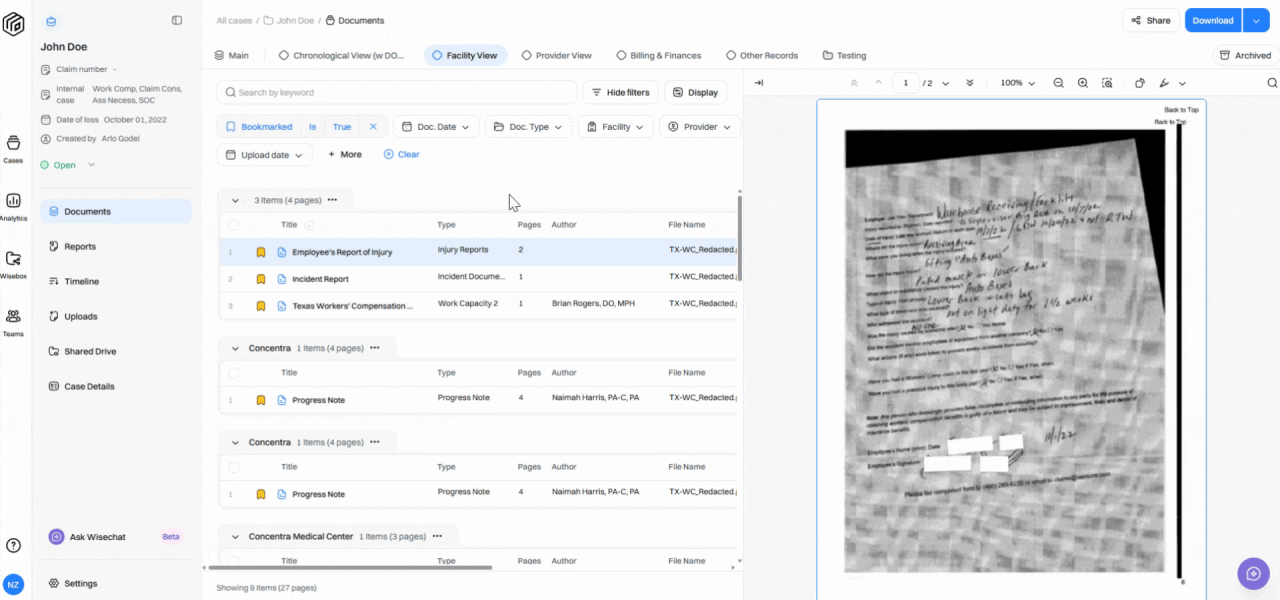
Our platform also has a unique way of processing documents that allow us to gather insights across your book of business. Before processing any documents through our proprietary AI, Wisedocs does careful entity extraction and classification: each document is extracted with date, author, provider, claim number, and a lot more. Only after that is complete, does our AI and ML engine process the data.
Most AI tools built for the medical industry do extraction after the documents are processed by AI, as it’s a lot cheaper and doesn’t require storing as much data. The issue with that is anything the AI medical summary left out never becomes structured, queryable data. By extracting beforehand, our documents are more accurate and it’s easier to gather insights afterwards. This way claims teams can identify the information that matters without having to manually sift through the entire file.
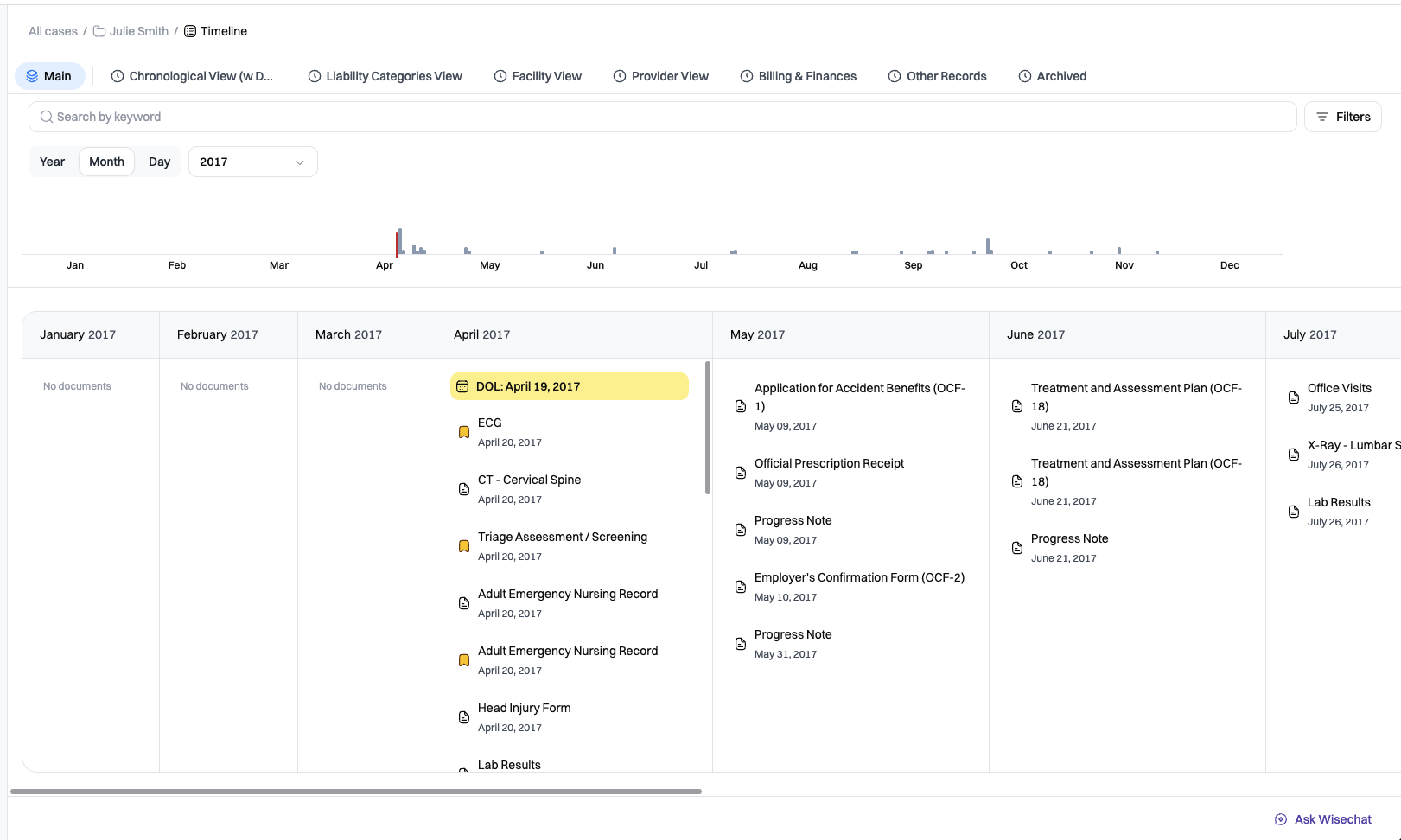
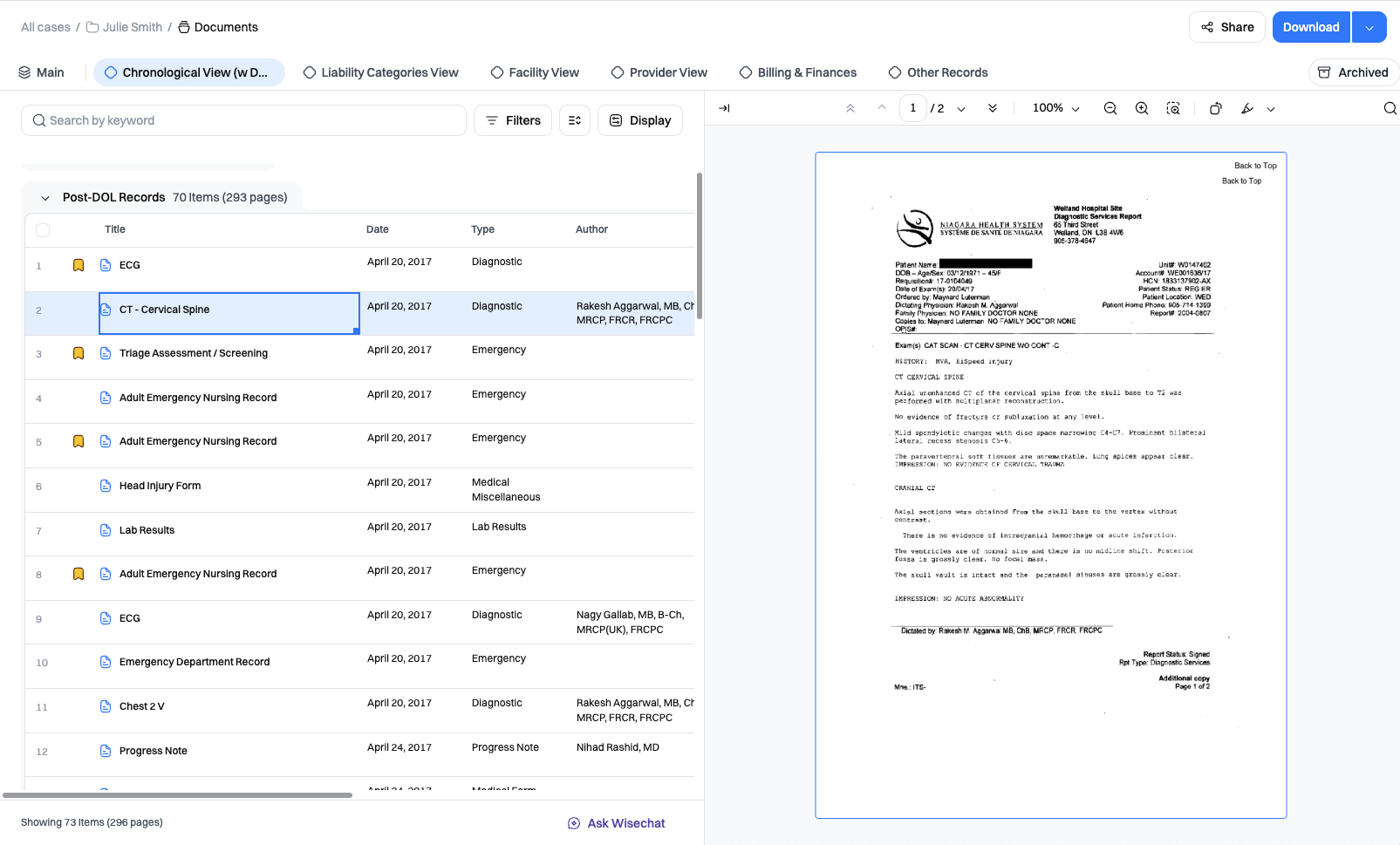
Once a document is extracted and classified, it is then sorted by provider, date, and treatment episode. Duplicate pages are flagged and a complete, navigable case timeline is generated in minutes.
Wisedocs’ AI analyzers will scan for pre-existing conditions, treatment gaps, inconsistencies between provider accounts, and indicators of claim inflation. They then turn those into custom reports which you can review, edit and share with the relevant parties. This allows the reviewer to surface key findings 30% earlier than manual review, and record reviews can be completed up to 70% faster.
Our platform has been built specifically for the insurance industry, and has been trained on over 150M documents that cuts across most verticals and jurisdictions. This is what allows the Wisedocs platform to more quickly see patterns that a closed loop LLM might not see.
Once it’s been processed, you can use various other features to navigate the documents:
- WiseChat: This allows you to ask any question about a case in plain language, using natural language processing to pull answers straight from the source records with citations, allowing you to make faster, more confident decisions. Every summary is hyperlinked to its original document, giving you a reliable, traceable output. No need to jump between systems.
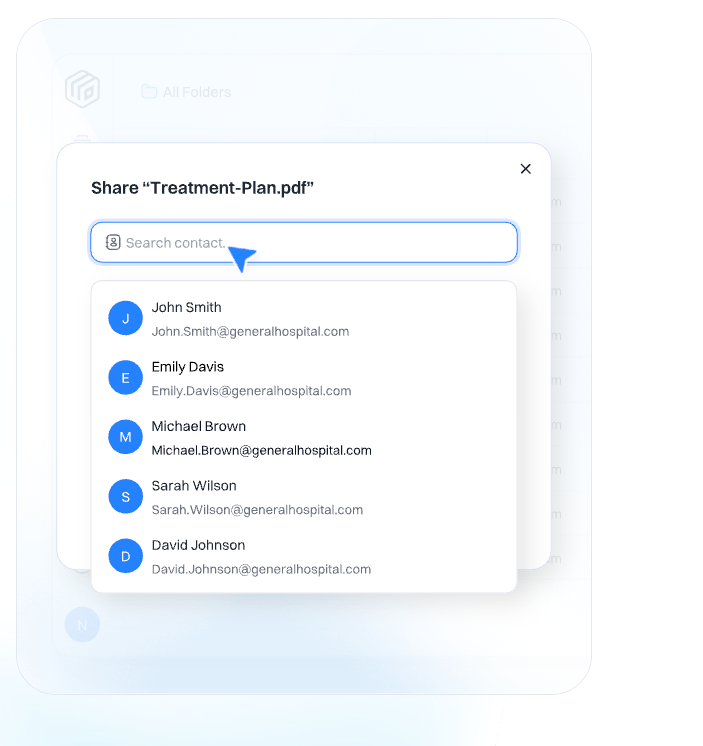
- WiseShare: Access a single source of truth file which allows you to share organized, redacted case files with internal teams, external counsel, or IME physicians through a PIPEDA and HIPAA-ready collaboration portal. No need to use email attachments or fax.
Get deeper insights into what can improve your overall book of business
Being able to process and organize thousands of documents is one thing, but what if you could get much deeper insights? What if you could get a bird’s eye overview of your whole book of business to understand trends, identify which claims could be processed faster and the types of claims you need to spend deeper analysis on?
With WiseInsights, you can ask and get answers to questions like:
- How is my book of business performing, both overall and by adjuster?
- What are my open-to-close ratios, and are they trending the wrong way anywhere?
- Where am I seeing an increase in litigated claims by jurisdiction?
- Are certain plaintiff firms or treatment providers showing up together often enough to suggest a pattern?
- Are we seeing an increase in fraud in a particular region or from a specific provider, and would earlier fraud detection have caught it?
Because every document across every claim gets classified the same way from day one, it builds a structured dataset that accumulates across the whole book of business, not just within one claim file.
The solution uses predictive analytics, flagging which open files are likely to escalate before they do, allowing claims teams to surface information about fraud earlier, and feed sharper underwriting models instead of just closing out claims that are already open.
You can view key insights as an interactive, filterable timeline that tracks the full claims lifecycle and pinpoints key timestamps and critical flags. Our analyzers are trained on insurance and medico-legal data patterns, not generic clinical datasets, so they will surface the risk signals that matter for claims outcomes.
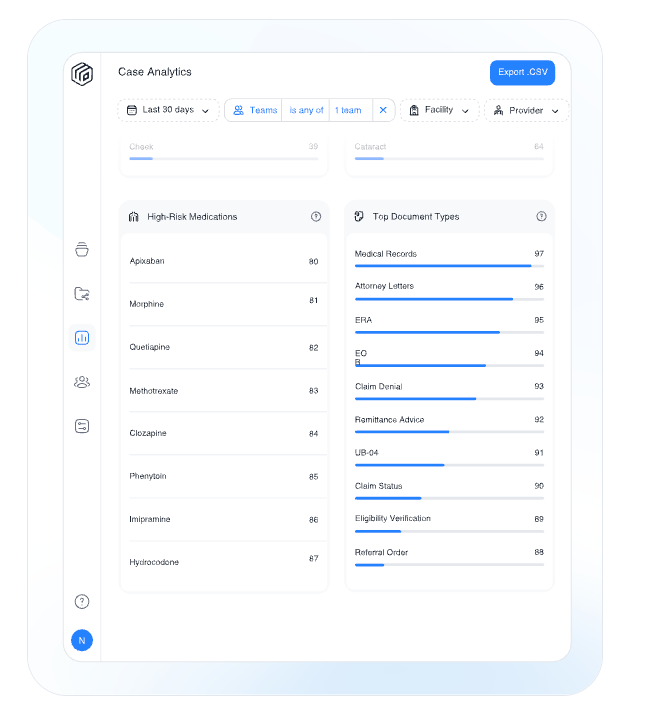
You can also generate customized claim reports, trend analyses, and provider breakdowns that align with each claim’s unique requirements.
Get the most accurate, defensible documentation through our human in the loop process
In casualty claims, someone needs to be accountable for every output. This is a key part of the legal process so any findings can be defended in court.
Some AI tools (including the general ones), make this very hard because there isn’t a clear audit trail or explanation as to how they came to a specific conclusion. In court, this can be disastrous as it’s not defensible.
This is why having a human in the loop is so important. Here’s how the process works at Wisedocs:
- A document is uploaded / processed
- Documents are extracted and classified
- Documents are processed through AI to generate summaries and chronologies
- Documents that fall below our AI confidence threshold are automatically flagged and routed to a team of in-house medical experts for further review.
- You and your team are notified when verified documents are ready for final review
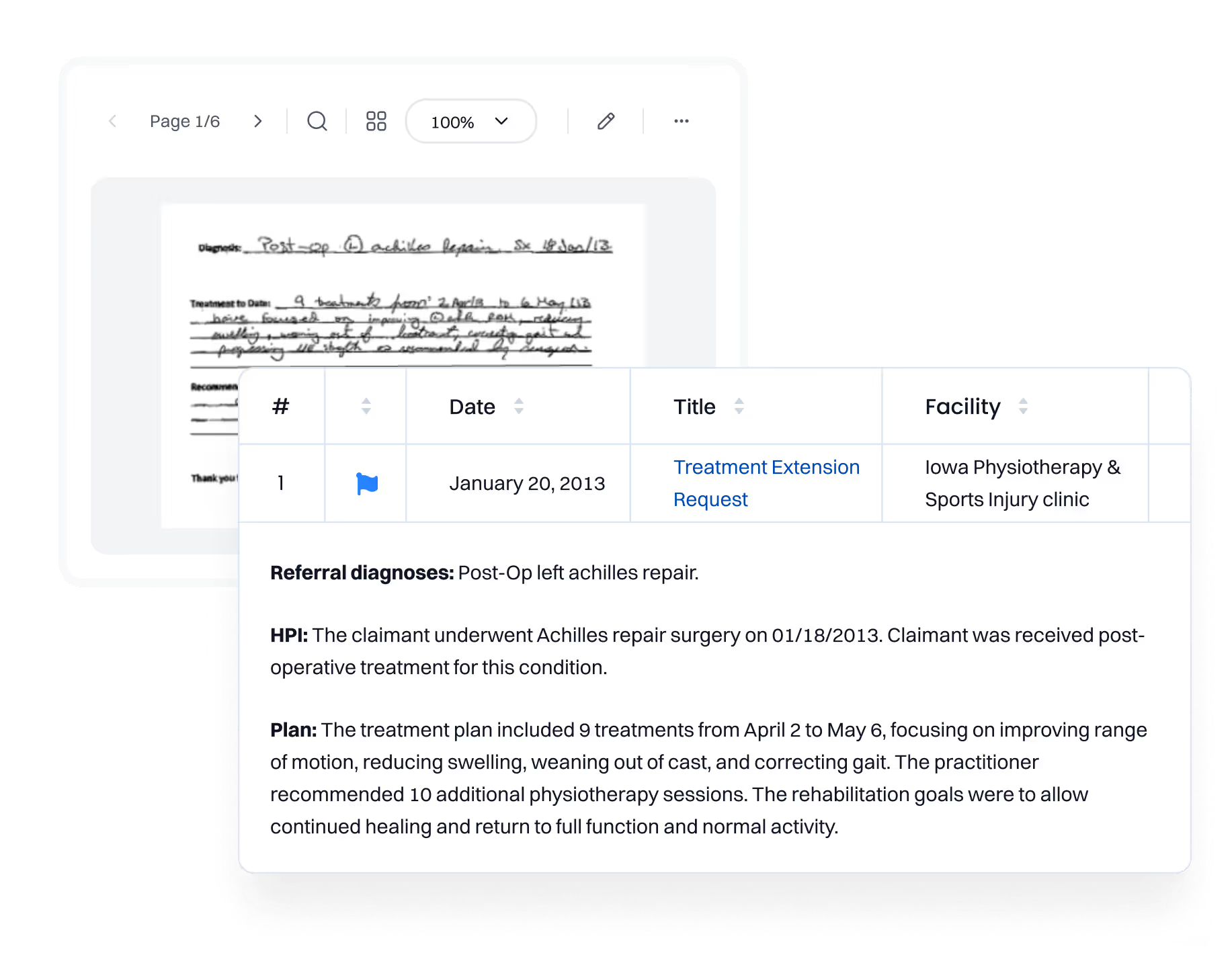
Our expert team are clinicians verify the information based on the full context of the claim & medical documentation, further refining our ML and AI algorithms and validating the relevant information for claims teams to make claims decisions faster.
Not only is this key for defensibility in court, but it’s also key from a regulatory standpoint. New regulations are likely to be introduced, with 29 states already adopting the NAIC model bulletin. By having every AI output validated by a clinician, you can ensure that it’s defensible in disputed claims, legal proceedings and any new regulation.
How this regional legal defense firm increased their processing capacity from 8,000 to 20,000 pages per day
With Wisedocs, a regional legal defense firm specializing in workers’ compensation operates under tight timelines with high-volume case files that require huge attention to detail. Processing files usually means sorting through thousands of pages, sometimes exceeding 30,000 pages, which often required multiple days and 8 legal reviewers to complete manually.
Their approach was simply not sustainable under their staffing levels, and they started looking for a dedicated AI solution.
They decided to work with Wisedocs and embrace AI with expert human oversight, focusing on speed (how quickly are turnarounds, given their legal deadlines), and quality (they needed custom solutions considering their reputation).
Wisedocs’ configurable claims document automation allowed them to customize the workflows as they needed, allowing teams across different industries to tailor outputs to their specific workflows and lines of business. For example, using automated workflows and AI medical chronologies the firm was able to generate auto-sorted and indexed claim case chronologies that align with their workers’ compensation legal case reviews, meeting client expectations and deadlines.
Through a combination of automation and expert human oversight, they were able to improve accuracy while also maintaining consistency across teams.
With Wisedocs, the workers’ compensation legal defense firm was able to achieve the following results:
- Processing time for manual document briefing dropped by over 70%
- Large files that had previously required a team of 8 staff can now be completed by only 2.
- Whereas before files were submitted 1 - 3 days before the deadline, now they were consistently returned 2 weeks or more in advance
- Whereas before a team member might manually brief up to 8,000 pages a day, now they can handle 20,000 pages a day, a 150% increase in document processing capacity
Read the full case study here: Workers’ Compensation Legal Defense Firm Automates 80% of Legal File Review—Without Compromising on Accuracy or Oversight
Use an AI solution like Wisedocs to speed up casualty claims processing
Demand packages are piling up, plaintiffs' attorneys are using AI to build them faster, and experienced adjusters are retiring faster than firms can replace them. For carriers and anyone managing casualty claims, AI is instrumental to keeping up with the industry and keeping the workload manageable.
General tools like ChatGPT are a reasonable starting point, but they won't get you the rest of the way. With Wisedocs, you can process thousands of documents a day without losing accuracy, share files securely, surface insights you couldn't get before and stand up to scrutiny in court.
Book a demo to learn more about how Wisedocs can help you.
FAQs
What's the difference between using ChatGPT and a dedicated AI tool like Wisedocs for casualty claims?
ChatGPT and other gen AI chatbots works off whatever you feed it in that single conversation and won't catch patterns across other claims, carriers or jurisdictions. Wisedocs is trained on over 150 million documents across the insurance industry, extracts and structures every document before AI touches it, and routes findings through a clinician review step before they reach you, so the output is both more accurate and defensible.
The NAIC model bulletin isn't adopted the same way in every state. What should a multi-state carrier actually do about that right now?
Build to the strictest state you operate in, not the average. A carrier writing policies in California, Colorado or New York already has to meet AI governance requirements beyond the NAIC bulletin, and those requirements aren't going away if a lighter-touch state adopts something looser. Practically, that means the documentation and audit trail standard should be uniform across your whole book of business rather than varying by jurisdiction, because retrofitting one state's file for a compliance review after the fact is harder than building every file to the higher bar from the start.
Is AI-generated claims documentation defensible in court?
It can be, if there's a human expert reviewing every output and an audit trail showing who reviewed what and when. A general AI tool that hands you a conclusion with no source link and no reviewer isn't going to hold up to scrutiny. That's the gap a human-in-the-loop process closes, and it's also the direction regulation is heading: 29 states have already adopted the NAIC model bulletin on AI use.

.png)