
If you’re looking at Verisk competitors, there’s a good chance that processing claims documents is currently taking too much of your team’s resources.
Preparing records eats into the time adjusters have to assess claims, outsourcing gets expensive, and important medical details can still get missed. That workload also leaves little time to spot telling patterns across your book of business and uncover insights that could inform better claims decisions..
If those challenges have you looking for insurance claims analytic software, Verisk could already be on your shortlist. Verisk Analytics offer products for many parts of the insurance industry, but we’re focusing on medical record review and the claims document work around it. That makes Discovery Navigator the relevant product for our comparison: it helps claims, legal, and clinical teams work through medical histories and assess demand packages. [1]
If your organization already works with Verisk, Discovery Navigator is a natural option to explore. But could another provider save your team more time preparing files, checking evidence, and getting documents to defense counsel?
Below, we look at how Wisedocs, CLARA Analytics, DigitalOwl, Guidewire, and Duck Creek approach those tasks, where they fit into the claims process, and what to consider when medical records are central to your review .
In this article:
- Verisk competitors for medical record review at a glance
- Wisedocs: Prepare, investigate, and share medical and claims records
- CLARA Analytics: Connect document review with casualty claims intelligence
- DigitalOwl: Analyze medical histories and demand packages
- Guidewire: Manage the claims process around document review
- Duck Creek: Bring document intelligence into broader claims workflows
Comparing Verisk alternatives for medical record review? Wisedocs helps your team prepare files faster, investigate medical evidence, and share records securely. Book a demo to see how it fits your claims review process.
Verisk competitors for medical record review at a glance
The right choice depends on where your team needs help: preparing medical files, investigating the evidence, or managing the process around that work.
Here’s how the options compare, with Verisk’s Discovery Navigator included as a reference point.
Now let’s take a closer look at each provider. We’ll start with how Wisedocs helps your team spend less time preparing files and get the answers they need to move claims forward.
1. Wisedocs: Prepare, investigate, and share medical and claims records
Claims adjusters and review teams already spend hours sorting records and piecing together treatment histories before they can assess a claim. As plaintiffs use AI to assemble larger demand packets, that workload keeps growing, leaving less time to investigate the evidence and prepare a response.
Wisedocs was built to help teams manage that workload. Claims adjusters, lawyers, and IMEs can process more than 100,000 documents in one go, and then easily access organized records and medical summaries to streamline and support their analysis. Your team can also get to the heart of claims decisions faster by surfacing insights from individual claims and across your wider book of business, from gaps in treatment to patterns in litigation.
When your reviewers need to investigate further, our tools help them examine discrepancies, check the supporting evidence, cite back to the source records, and get answers from the people handling the case.
Here’s why organizations like WCF Insurance, HRSA, and HHS government programs use Wisedocs.
Speed up first-touch review by 60-80% with automated medical chronologies
For large claim files, preparation and review can stretch into weeks. When documents arrive close to a response deadline, your team has even less time to weigh the evidence and decide how to handle the claim. Outsourcing that preparation to BPOs adds costs as files grow and more records arrive.
With our WisePrep tools, you can get through first-touch review 60-80% faster than with manual processes, giving your adjusters more time to assess the claim before a response is due.
You can upload records to Wisedocs, connect your record retrieval company through an API or secure file transfer (SFTP), or integrate with your existing claims and document management systems. We support connections with existing retrieval partners and can work with your team on a custom integration, reducing the steps involved in collecting and transferring files for processing.
As each page is indexed, Wisedocs extracts, classifies, and stores details including dates, providers, claim numbers, diagnoses, treatments, and body parts in our medical chronologies. Our domain-trained AI and ML engine then uses that organized information to generate medical summaries and insights for concise reviews and defensible decisions.
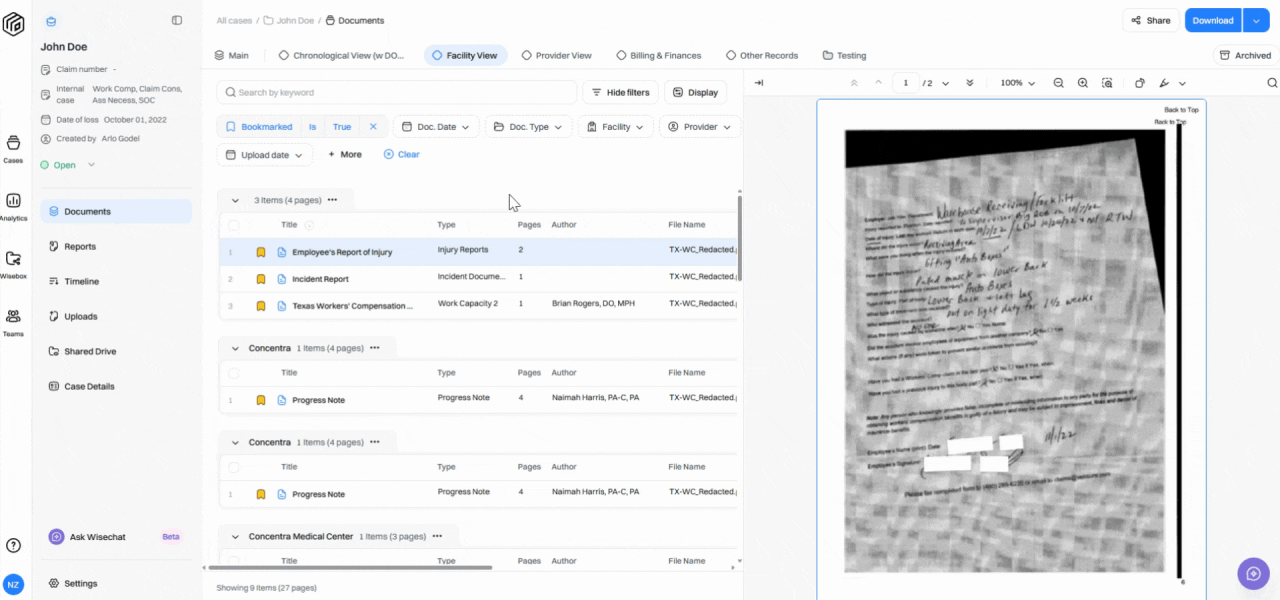
After processing, you can browse records by facility, see details like document type and author, and open the original page beside the list for review.
Because those details are indexed before the summary is created, your analysis isn't limited to what the summary includes. If you need to establish whether a claimant received treatment for back pain before an accident, you can search for the relevant diagnoses, providers, and treatment dates without manually collecting that information from the file again.
Here’s how we make those records easier for your team to review:
- Automated deduplication finds and removes repeated pages so reviewers don’t spend time reading the same records twice. One state workers’ compensation fund saved $900-$1,200 per case on redundant page removal alone after implementing Wisedocs.
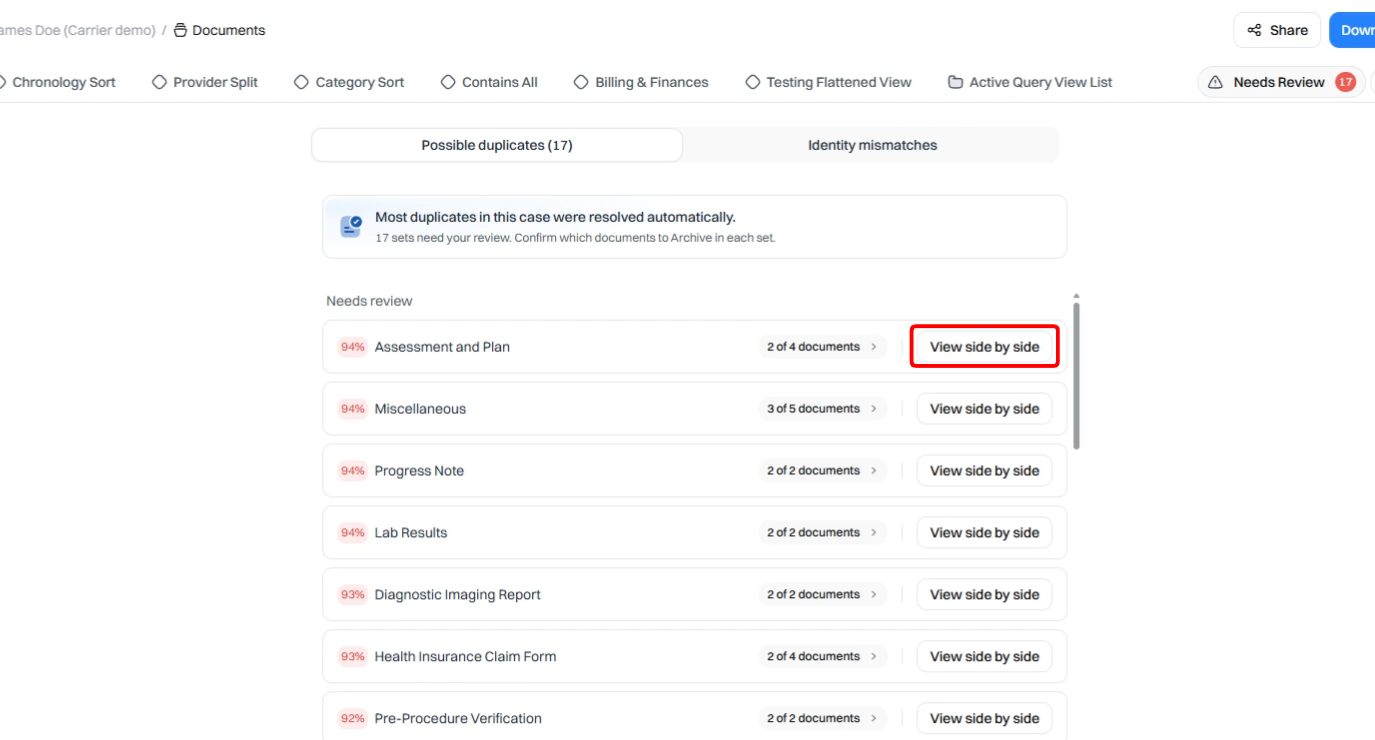
Wisedocs flags possible duplicates that need your review so you can compare them side by side and choose which documents to archive. (Image source)
- Medical Chronologies and Medical Summaries use AI to organize records into a timeline-based view of the entire claim and summarize key medical details, clarifying when treatment started and how it progressed. Your reviewer can follow the treatment history across providers and quickly identify gaps in care, missing procedures, or inconsistencies, without spending hours opening individual records and manually piecing together each visit.
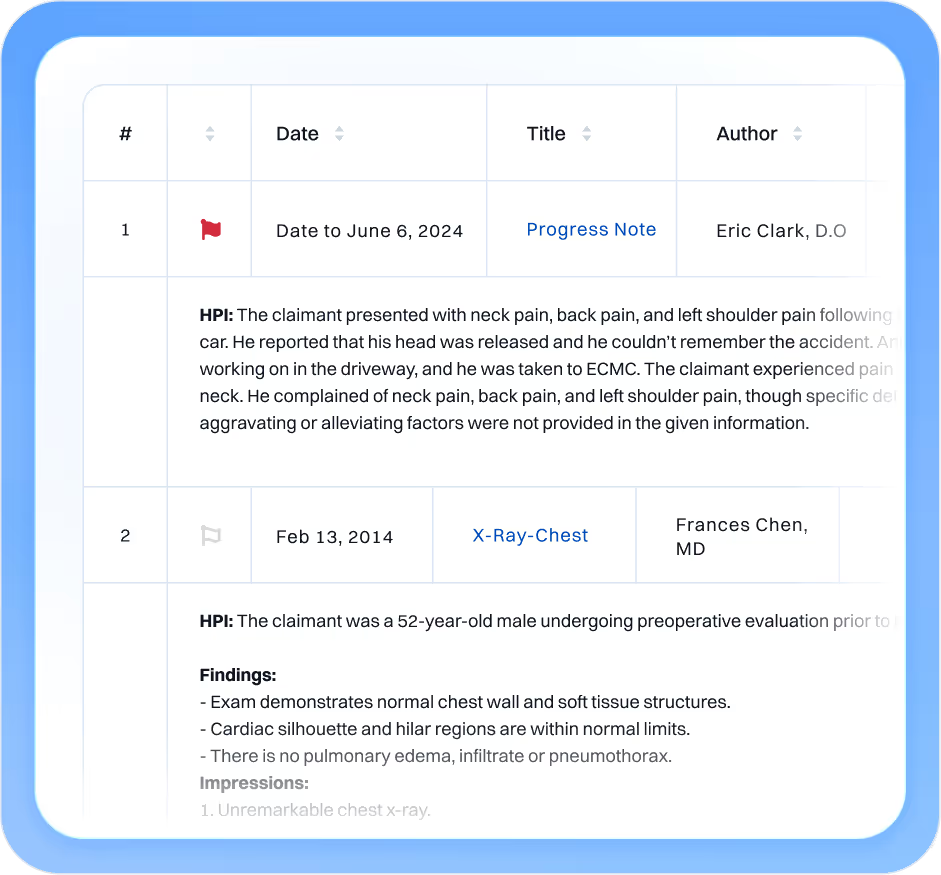
Review summarized medical details alongside each record’s date, title, and author, so you can follow the treatment history without opening every document individually.
- Automated Workflows let you organize records around the review you need to complete. For example, when assessing whether symptoms predate an accident, you can separate records from before and after the incident. When preparing a file for an independent medical examination, you can group records by provider so the examiner can navigate the treatment history without your team rearranging the documents manually.
When records are ready, WiseShare lets you share them with adjusters, outside counsel, and medical experts through encrypted document exchange.
You can control who has access, see who accessed or downloaded records, and revoke access when the matter closes — so your team spends less time coordinating separate copies while keeping control over who can access the file.
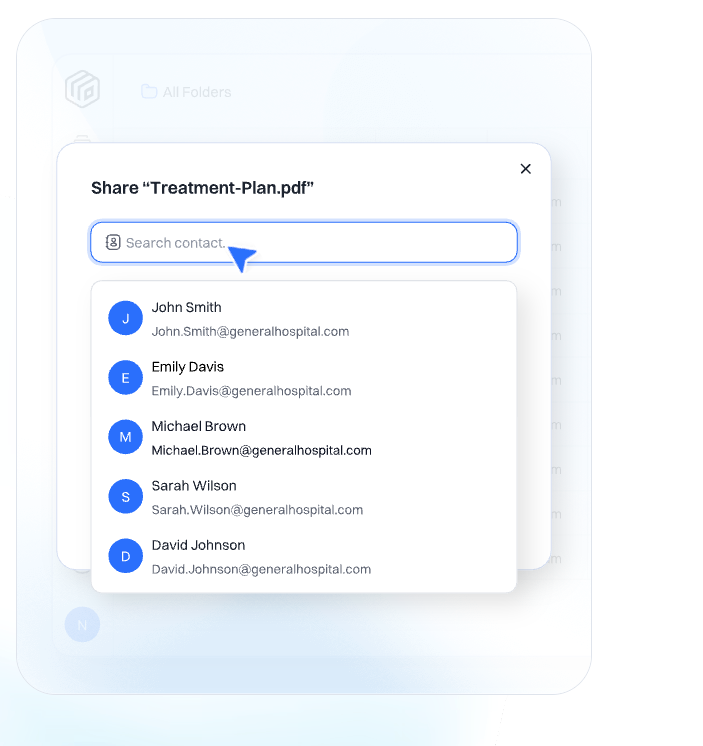
With WiseShare, every share, view, and handoff is tracked, giving your team a single secure channel with complete chain-of-custody audit trails.
Investigate gaps in claim evidence with Wisedocs’ analyzers and WiseChat
When you’re reviewing hundreds of pages against a response deadline, it’s easy to miss a medical detail that could change your risk assessment. An earlier diagnosis or treatment record could give your team grounds to question part of a demand. If that evidence goes unnoticed, you could agree to a payout you had reason to challenge.
Our Medical Insights let you search and filter diagnoses, treatments, procedures, and medications using interactive timelines and lists.
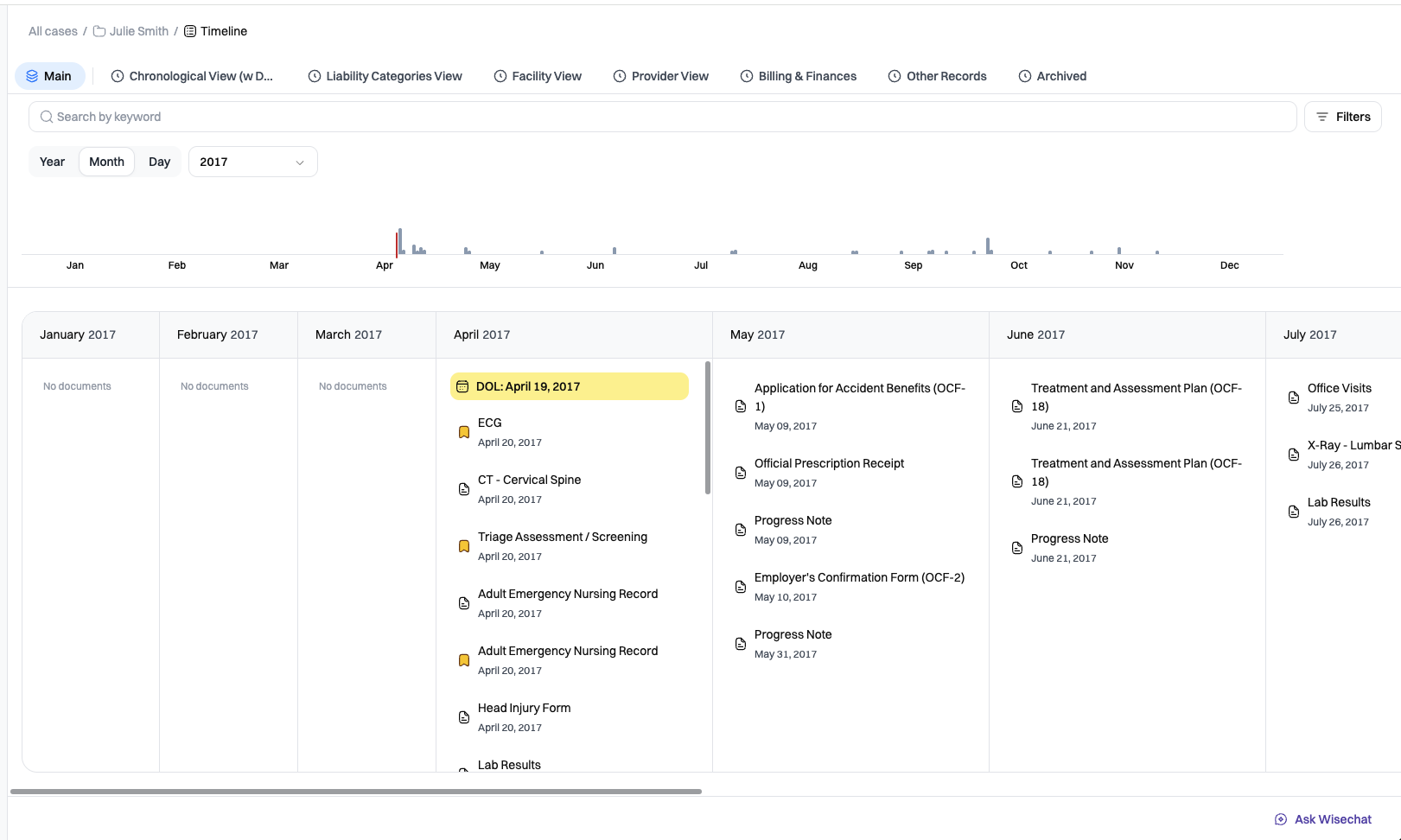
Follow the records around the date of loss in a timeline, so you can see when examinations, tests, and treatment were documented.
Our Claim Consistency Analyzer also flags missing records, gaps in treatment, and conflicting information across providers. For example, if the file mentions an appointment but doesn’t include the visit report, it flags the missing record so your team knows what to request.
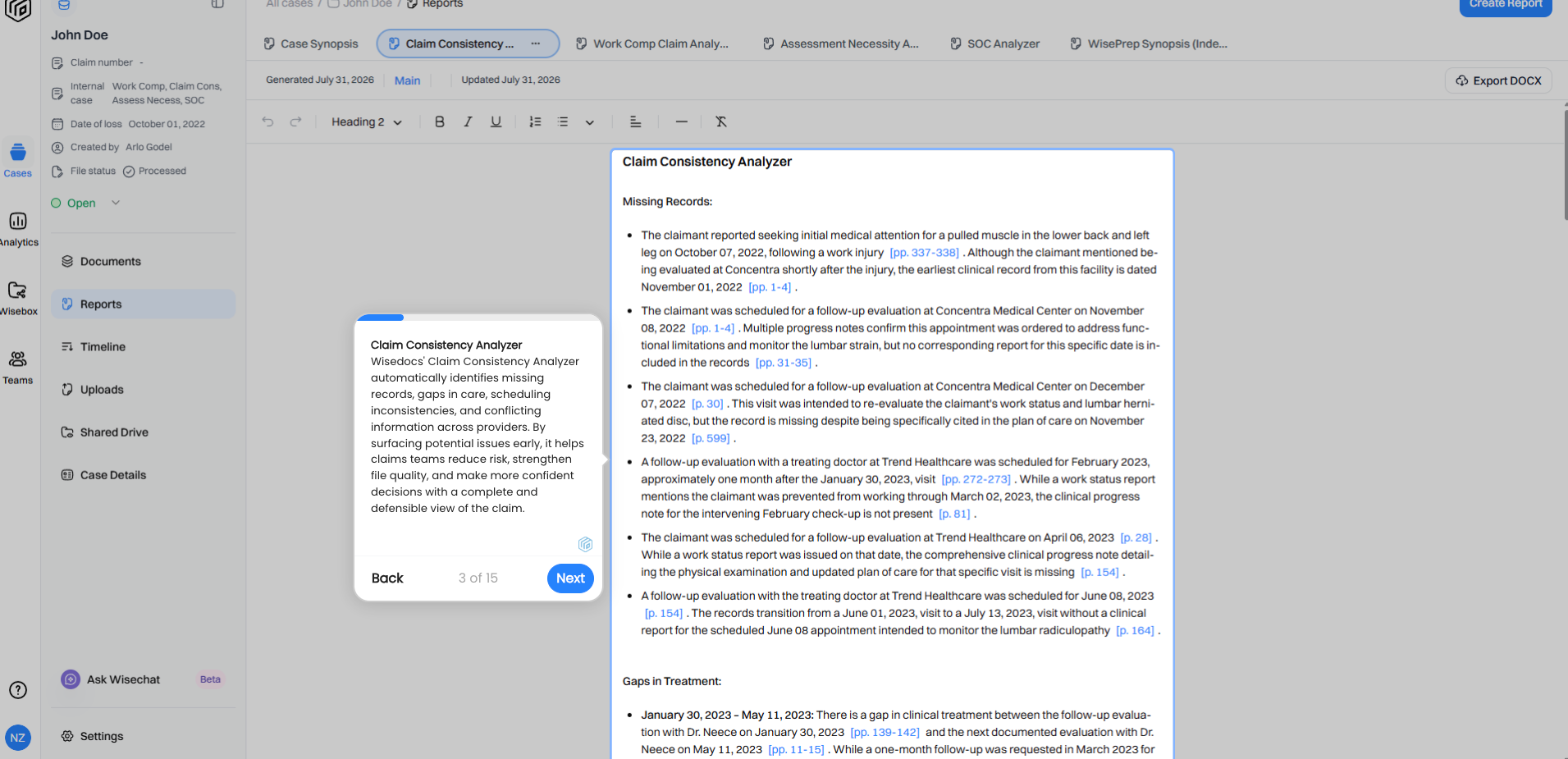
Each finding from the Claim Consistency Analyzer includes an explanation and page references, giving reviewers a specific place to start investigating.
Our Demand Letter Analyzer compares claimed injuries and causation with the supporting records and flags differences, so you know which statements to investigate and which records to review. You can also use deposition analysis to check testimony against the medical evidence.
The financial impact of finding overlooked medical details can be enormous. Here’s a real example a company faced: a regional carrier was preparing to settle a $300,000 demand after reviewing a 700 page claim file without finding grounds to challenge it.
With the response deadline approaching, they used Wisedocs and uncovered unreported pre-existing medical conditions relevant to the claim. They challenged the demand based on that evidence, and it was subsequently dropped, saving the full $300,000.
For your reviewers, acting on a finding like that means understanding the details: when did the condition first appear, what treatment followed, and how does that history relate to the current demand?
WiseChat lets you explore those questions in plain language. For example: “What treatment did the claimant receive for back pain before the accident?” Answers link to the supporting passages so you can examine the evidence behind the response.
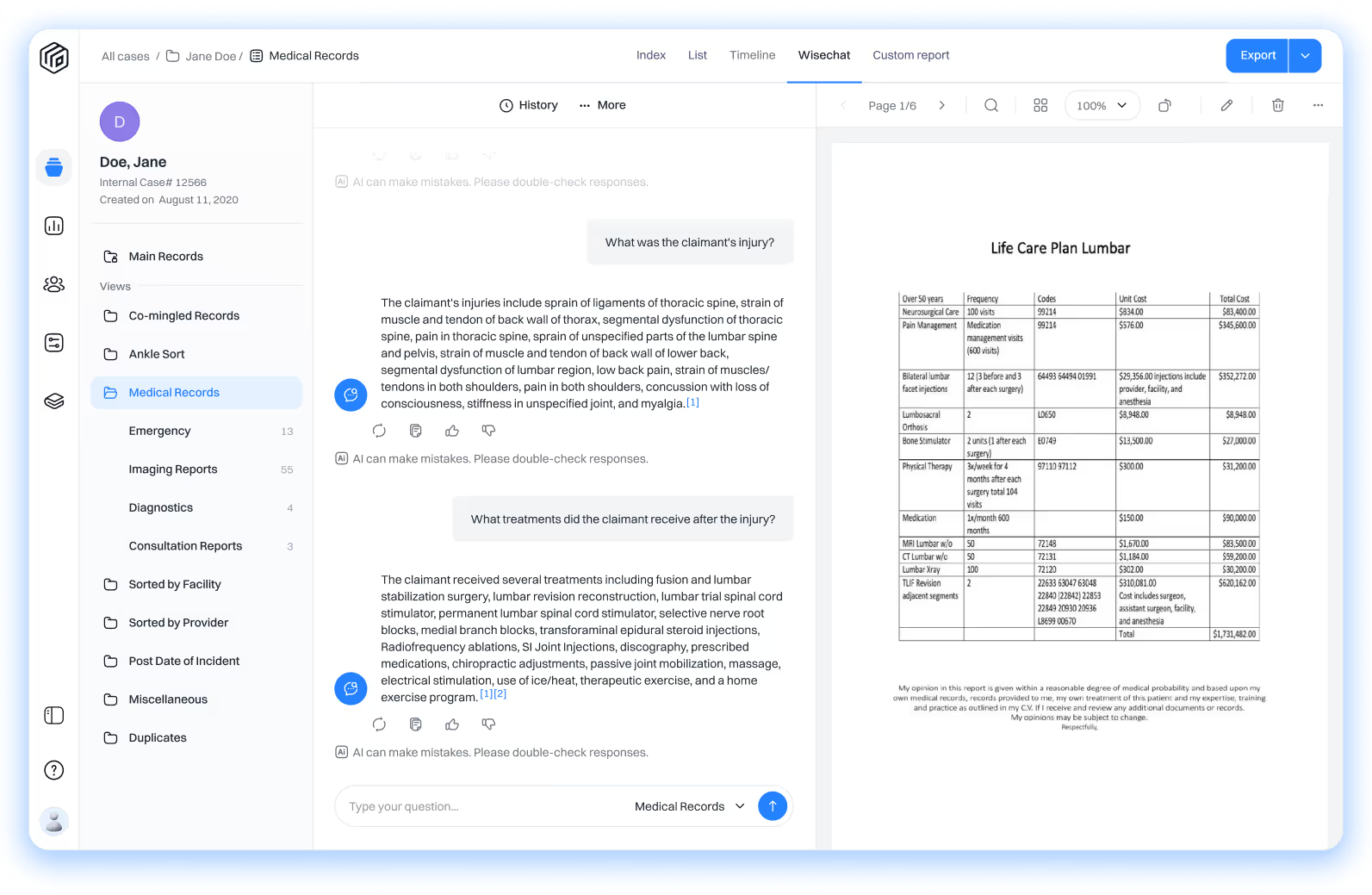
WiseChat keeps your questions and answers beside the open record, so you can review the document without losing your place in the conversation.
Support defensible claim decisions with expert review and traceable evidence
When you reach a claim decision, it needs to be backed up by evidence which can stand up in court.
Many general-purpose AI tools don’t have “explainability” embedded in their tools, which means you either have to find the source references yourself or you risk not being able to defend your conclusion in court.
Wisedocs is trained on millions of medical records and includes a built-in review by medical industry specialists through our Expert-in-the-Loop process. After records are extracted, classified, and processed into medical summaries and medical chronologies, documents that fall below the AI confidence threshold are flagged for our in-house medical experts. They check the information against the claim’s medical documentation, giving your reviewers an additional accuracy check before they use it to assess a demand or prepare a response.
Processing can also pause for expert oversight when needed, with the review scope depending on the document type and your requirements.
Source references let your team trace findings back to the original records. Combined with expert checks and documented activity, they help you explain which evidence supported an assessment and how it was reviewed.
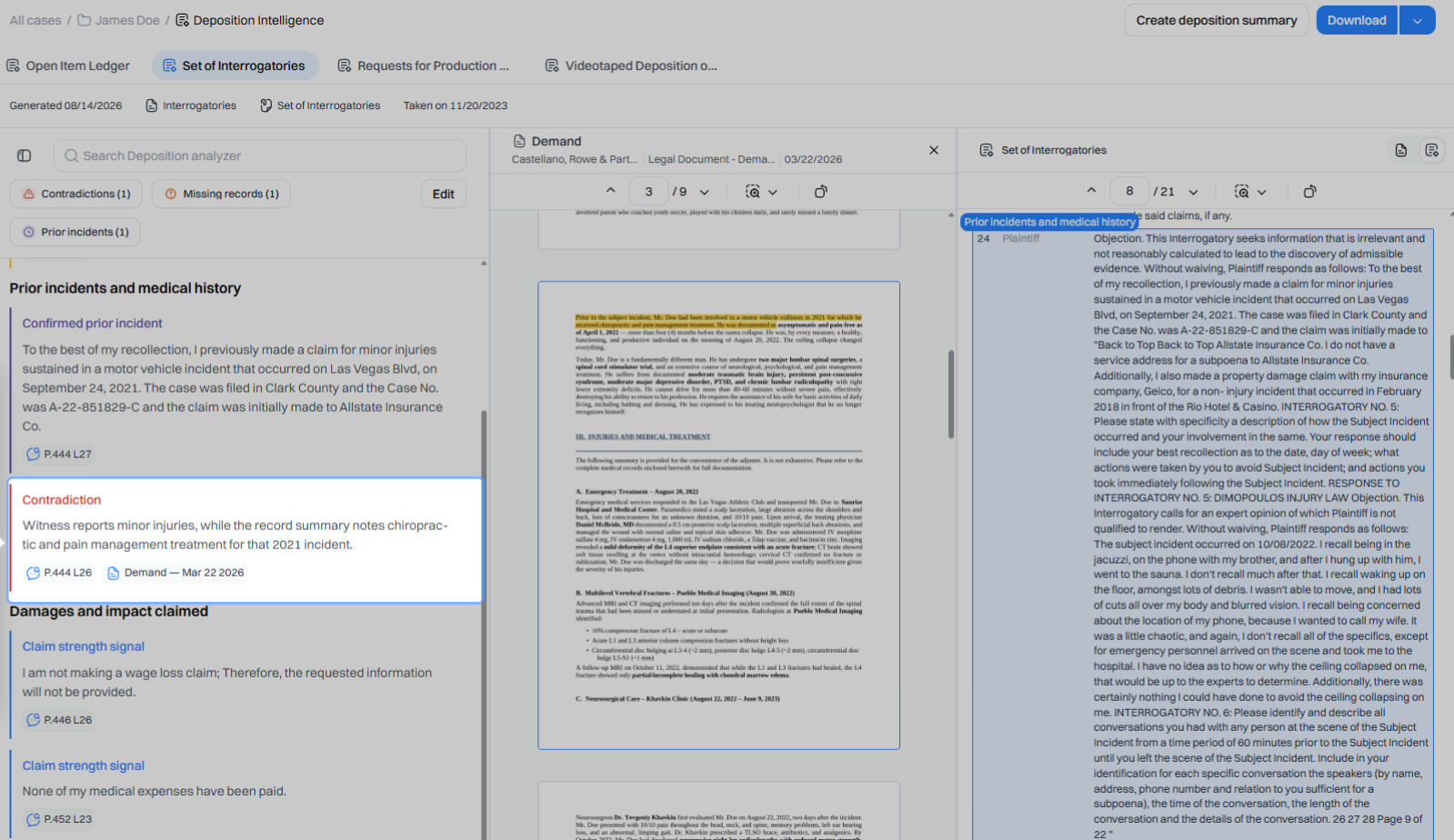
A flagged contradiction includes references to both documents, letting reviewers compare the passages behind the finding side by side.
This oversight also matters as regulators across insurance and financial services scrutinize how firms use AI. The NAIC model bulletin sets expectations for AI governance, risk management, and accurate decisions. Expert checks and traceable sources support your team’s ability to document and explain its use of AI during claims review.
Spot and act on patterns across your book of business with WiseInsights
When your team is busy reviewing individual files, it’s hard to recognize patterns spread across thousands of documents. You might notice a difficult claim without realizing that similar cases are taking longer to close, or that the same providers and plaintiff firms keep appearing together.
WiseInsights brings data analytics to those connections across claims. It uses Wisedocs’ AI, trained on more than 150 million insurance industry documents, to spot patterns a general-purpose LLM might miss. Your team can explore those patterns without pulling together and comparing the details from each file manually.
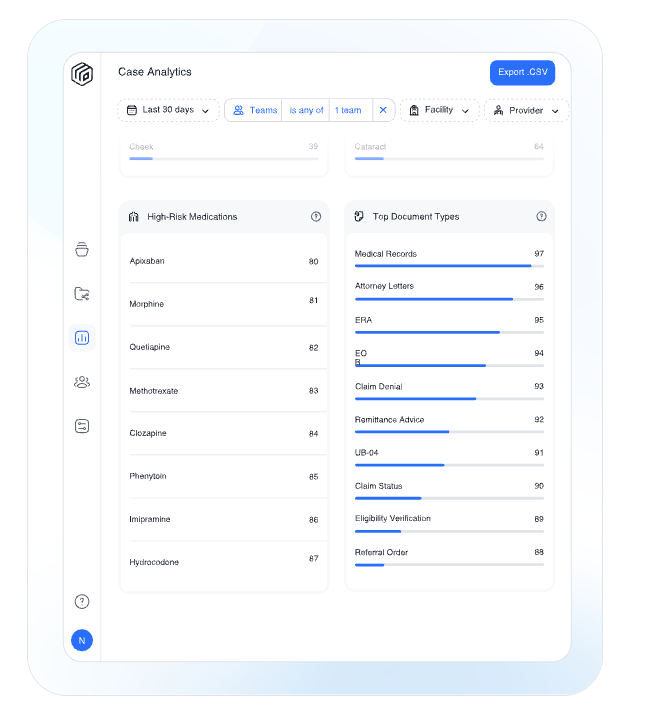
Filter the analytics view by date range, team, facility, or provider to narrow your review, then export the results as a CSV.
Those findings can help you decide where to act. If claims are taking longer to close within one team, you can investigate what’s slowing them down and whether they need more support. If the same providers repeatedly appear in claims of concern, you can focus your investigation on those relationships.
You can also bring the findings into customized claim reports, giving colleagues the relevant details to review and follow up on.
How a workers’ compensation defense firm increased daily processing capacity by 150%
One workers’ compensation defense firm came to us when they realized preparing medical files by hand was leaving their attorneys too little time before deadlines. Their team was sorting documents, removing duplicate pages, and assembling the relevant records manually.
For large files containing 10,000-30,000 pages, the work could take multiple days across up to eight reviewers. Despite all the time and resources the team was pouring in, files were sometimes ready just 1-3 days before the deadline.
We worked with the firm to configure Automated Workflows and AI Medical Chronologies around their review process. Records were automatically sorted into indexed chronologies, with configurable tables of contents and documents separated by type.
That combination of automation and expert human oversight made it easier for attorneys and medical experts to find the information they needed. It also led to better accuracy and consistency across teams.
The firm increased daily processing capacity by 150% and reduced total document processing time by 66%. Large files now require two staff members instead of eight, and files are consistently returned two weeks or more before deadlines, giving attorneys more time to prepare.
After initially using Wisedocs for large files, the firm expanded to processing approximately 80% of incoming files through our platform.
Read the full case study: Workers’ Compensation Legal Defense Firm Automates 80% of Legal File Review — Without Compromising on Accuracy or Oversight.
2. CLARA Analytics: Connect document review with casualty claims intelligence
CLARA Analytics connects findings from medical records and legal demands with broader casualty claim monitoring. [2, 3]
Claims DocIntel Pro, formerly CLARA Optics, identifies, indexes, transcribes, and summarizes claims documents. It brings records and bills into treatment timelines, provides claim and visit summaries, and gives reviewers a searchable view of documents and images. [2]
Its legal demand capabilities assess medical and legal severity. The product also scans for developments that could affect the claim and alerts claim managers when new information emerges or specified thresholds are exceeded. [2]
CLARA also offers predictive analytics tools for prioritizing claims, evaluating treatment providers, managing litigation, and identifying potential fraud. These tools take details extracted from claim documents and use them to update their analysis. [2, 3]
That can make a difference for teams that want to identify when new records change the outlook of a claim and decide whether to take action.
3. DigitalOwl: Analyze medical histories and demand packages
DigitalOwl offers medical record analysis for insurance and legal teams through products that help reviewers understand a file and investigate its details: [4, 5]
- View organizes medical information for review.
- Case Notes adds analysis of the medical evidence, including inconsistencies and missing information.
- Chat lets reviewers ask questions about the records.
For demand packages, these tools help reviewers examine claimant background, recovery progress, billing, and provider details, including differences between the demand letter and the medical records. Reviewers can access the original source material to check findings. [5]
DigitalOwl also offers an API for moving structured data into other systems. Their announced transition to ChartSwap Insights would connect their analysis technology with ChartSwap’s retrieval services, allowing teams to request records, track their progress, and analyze them in one system. The announcement places that expanded functionality in early 2027. [4, 6]
4. Guidewire: Manage the claims process around document review
Guidewire’s ClaimCenter is a core claims management system for property and casualty (P&C) insurers. It supports claims from intake through closure, with workflow automation, centralized information, and access to partner applications through Guidewire Marketplace. [7]
If you’re replacing your claims management system, ClaimCenter would manage the broader claims process, including intake and ongoing claim handling. Medical record analysis would need to fit into that setup.
If your team already uses ClaimCenter, connecting a medical review tool can bring its findings into the workflow your adjusters already use.
The applications and integrations in your setup determine how records and results move between systems, whether your reviewers can access analysis from ClaimCenter, and where they open the supporting medical evidence. [7] Those differences affect how much document handling your team still needs to do.
5. Duck Creek: Bring document intelligence into broader claims workflows
Duck Creek Technologies is best known for core insurance software, including policy administration and billing. Its claims product, Duck Creek Claims, supports assignment and routing, coverage verification, investigations, reserves, payments, and recovery. Teams can configure workflows and connect partner services around those activities. [8]
Their Document Intelligence offering adds automated classification, summaries, search, and checks against cited sources. These capabilities cover claims, underwriting, policy, and billing documents. [9]
That scope places medical records within a broader document workflow spanning multiple insurance functions.
For the medical review tasks covered in this article, the distinction is the depth of analysis: following treatment for an injury or examining the evidence behind a demand requires connecting details across records.
Duck Creek’s published description establishes document processing and source verification capabilities, but doesn’t explain those specific medical review workflows in detail. [9]
Find a better fit for your medical record review process with Wisedocs
Discovery Navigator brings medical record review into Verisk’s broader insurance offering. Whether it’s the right choice comes down to how well it handles the document work your team needs help with.
If you’re exploring Verisk competitors, Wisedocs brings together configurable file preparation, expert quality checks, tools to investigate medical evidence, and secure sharing with counsel and other reviewers.
Your team can also spot patterns across your book of business, like rising litigation in particular jurisdictions or claims taking longer to close, so you can identify where costs are growing and where teams need more support.
Request a Wisedocs demo to see how our approach compares with what you need from Discovery Navigator, and where we could save your team time on tasks they’re still handling manually.
FAQs
Which Verisk product handles medical record review?
Discovery Navigator is Verisk Analytics’s product for AI-assisted medical record review. It extracts medical details, generates chronological summaries, removes duplicate records, and supports demand package reviews. Reviewers can also ask questions and receive answers linked to source pages. [1]
What should I compare when choosing a Verisk alternative for medical record review?
Start with the tasks that take up your team’s time: preparing files, understanding treatment history, investigating discrepancies, or sharing records. Then compare how each provider handles those tasks, including the work needed to check results and move information between systems.
Wisedocs brings together file preparation, document analysis, and collaboration tools, making it an option to consider if your needs span those stages of review.
Who are Verisk’s top competitors outside medical record review?
It depends on which Verisk product you’re comparing. For insurance data and analytics, Verisk’s top competitors include LexisNexis Risk Solutions (part of RELX), CoreLogic, and S&P Global. For core claims and policy software, buyers also compare Guidewire, Duck Creek, and Sapiens. For medical record review, the providers in this article are the closest alternatives to Discovery Navigator.
How does AI help with medical record review?
AI can organize records, remove duplicate pages, and summarize treatment history so reviewers can get familiar with a file faster. Some tools also flag gaps or inconsistencies and answer questions with links to the supporting records. Reviewers still need to check the findings and determine what they mean for the claim.
What’s the difference between a medical chronology and a medical summary?
A medical chronology puts events and records in date order, helping reviewers follow the treatment history over time. A medical summary condenses the information into an overview of diagnoses, treatment, and other relevant details. Teams often use both to understand a file before investigating specific questions.
Does faster medical record processing mean faster claim settlement?
Faster processing can give your team more time to investigate, prepare a response, and make decisions. Settlement timing also depends on the circumstances of the claim, including ongoing treatment, negotiations, and legal proceedings. When comparing providers, keep document processing results separate from claims settlement results.
Sources
[1] Verisk Discovery Navigator product overview
[3] CLARA Analytics platform overview
[4] DigitalOwl platform and products
[5] DigitalOwl demand package analysis
[6] DigitalOwl’s transition to ChartSwap Insights
[9] Duck Creek Document Intelligence

