If you’re working in the insurance claims space, you’re likely facing more demand letters than ever before, and potentially unexplained rising costs and longer claim durations. Without a comprehensive understanding of what is causing these trends, it is impossible to address them.
You probably know you need a tool that gives you an overview of your book of business so you can be more proactive, but with so few true analytics solutions on the market, knowing what to look for in a platform makes this very difficult.
The right claims analytics software should not only help you make better decisions, but also highlight trends that allow you to be more proactive and help your overall book of business perform better.
In this article, we're exploring when it makes sense to use one, how to pick the right platform, and how Wisedocs can help.
We’re covering:
- Examples of insights you can gather with the right analytics software
- When it makes sense to look for insurance claims analytics software
- What to look for in an analytics tool for insurance claims
- Why choose Wisedocs for your insurance claims analytics platform
- How KEMI modernized workers' comp claims review using AI-powered document intelligence
Note: Wisedocs is an AI-powered and human-validated claims analytics platform that helps insurers, legal teams, and medical evaluators turn complex, unstructured records into structured, defensible outputs. Schedule a demo to learn more.
Examples of insights you can gather with the right analytics software
The main benefit of insurance claims analytics software is that it can provide pivotal insights at a much faster rate than any individual reviewer.
The way this type of software works is that it extracts and classifies information from the claim record files you upload onto the platform. This includes provider name, injury, claim type and hundreds of other data points that a person could not analyze by themselves at scale. Simultaneously, it tracks and benchmarks key case updates like claim status changes, treatment milestones, reserve adjustments, and time-to-resolution.
As a result, you get deeper, custom-made insights that can be used across your litigation workflow. Some examples are:
- By analyzing data like claim location, time of year, and the demographics of the claimant, you might discover that certain types of claims are more common during certain peak periods or among certain age groups.
- AI claims processing solutions can identify unusual patterns and spot red flags faster to highlight fraud risk and fast-track legitimate claims, e.g., better identify cases of Family and Medical Leave Act (FMLA) abuse.
- You can use the analytics software to conduct targeted data-based investigations, e.g., into suspicious workers’ compensation claims.
- Benchmarking your own metrics over time, such as duplicate rate by document source, review hours per file, or time from first exposure to settlement, can surface whether performance is actually improving or just holding steady, as well as streamlining opportunities.
- Tracking risk signals for pre-existing conditions or treatment gaps can limit escalation, reduce litigation exposure, and prevent claim leakage before it compounds.
When it makes sense to look for insurance claims analytics software
You may already partner with a claims management system and be wondering how an analytics software would fit within your existing processes. First, it’s important to understand the difference between these two tools:
These capabilities can be helpful to insurance carriers, self-insured organizations, and law firms in a variety of ways. However, they tend to make the most sense if you are facing one of the following use cases:
Your costs are increasing, and you’re not sure why
If your costs are rising, but you can’t pinpoint the cause, insurance claims analytics software can be a direct route to finding both an explanation and a solution.
Because the analysis happens throughout your entire book of business, AI and machine learning tools are able to detect patterns not just across case outcomes, but also through benchmarking things like billing cycles, claims adjuster behaviour, or incoming fraud.
Only by gathering a complete data set can you get a comprehensive view of where your business stands today. And it is these insights that inform and demystify the specific factors that are driving your rising costs, as well as making suggestions for how to react.
For instance, the insurance claims analytics software might reveal:
- Plaintiffs are using more AI, and you don’t have the capacity to review all the incoming demand packets
- The rates of identity fraud are increasing
- You’re paying out on more cases than you were previously
- A specific jurisdiction is driving higher settlements than the rest of your book
- A particular treatment provider is showing up in a disproportionate number of claims
- Claims are staying open for longer, extending the duration and driving up costs
Uncovering claims patterns in-house is not possible due to resource constraints
Manually combing through thousands of pages for patterns and key details is time-consuming and expensive. In the past, or for smaller organizations, this might be viable, but for mid-size and enterprise companies, the increasing rate of plaintiff activity has made in-house reviews unsustainable.
When facing strict compliance deadlines and significant funds at risk, every moment of a litigation team’s work becomes crucial. But currently, all your time is spent processing documents rather than analyzing data and making decisions.
By implementing insurance claims analytics software, substantial work hours could be saved. Claim records are scanned, organized, and analyzed in 24-48 hours, instead of days or weeks, and critical insights are presented to you automatically, without the need for additional staff.
For example, litigation risk and treatment inconsistencies are flagged the moment they appear in a file. Catching these signals early means decisions get made sooner and cost less, plus a suspicious pattern flagged at intake is far cheaper to investigate than one uncovered after a claim has already been paid out.
This might make sense for you if:
- Your claims management team is becoming inundated with demand letters
- Too much time is spent manually preparing documents
- You want to avoid business process outsourcing due to cost and output concerns
You are lacking key insights to make decisions about your company
Without a deep understanding of your case analytics, it is almost impossible to get a clear overview of where your business sits within the market. You can't identify whether certain claim types are taking longer to resolve than they should, you have no benchmark for your review and processing costs, and you don’t know whether litigation rates in specific jurisdictions are rising.
Equally, if you’re using a third-party administrator (TPA) for cases like workers’ compensation claims, you are left a step removed from the data. Without direct visibility on each case, you are seeing the outcomes, but not the decisions behind them. That can cause blind spots in your future strategy.
This is a crucial use case for insurance claims analytics software. You need a tool that can look at the whole picture and present you with the most critical patterns, gaps, and insights. All done automatically and instantly, with HIPAA and SOC 2 Type II compliance.
With insurance claims analytics software, you’ll know:
- Exactly how you performed compared to previous years with high-level breakdowns, reports, and stats.
- Which business lines, claim types, or teams are underperforming relative to others to make evidence-based staffing and resourcing decisions.
- Whether your TPA is handling claims consistently across your entire program, rather than only seeing the closed-file outcomes without the decisions and documentation behind them.
- Where institutional knowledge is at risk of walking out the door, capturing what experienced adjusters and claims leaders know as measurable data, rather than losing it when they leave.
What to look for in an analytics tool for insurance claims
The reality is that there are very few true insurance claims analytics software solutions: platforms that go beyond claims management and provide more features than simple medical summaries or medical chronologies.
Strong analytics platforms will provide you with multi-level insights that inform and improve the claims process. They will assist adjusters in reviewing each case by identifying patterns or gaps, but also provide business-wide insights that support strategy decisions.
These are the most important features to look for:
A tool that does entity extraction and classification before being processed by AI
Entity extraction is a crucial part of gathering insights. Claims software will scan documents for important information, then analyze it for things like patterns or gaps. While many tools will carry out this type of data extraction, not all happen at the same point in time.
Many solutions will extract and classify key information after it is first processed by AI. Although this process is cheaper, it results in a lot of lost information which could be crucial to getting insights on the business. Conflicting information which could be the difference between paying out or denying a claim risks getting lost.
By immediately scanning for information before processing it with AI, the software gathers a lot more data which therefore leads to much higher quality insights.
Has an intuitive interface that sends alerts and makes it easy to share documents
Working across multiple tools with multiple people, teams, and even TPAs makes the insurance claims workflow extremely complicated. Especially when most teams are still managing document exchange through email attachments and unsecured file transfers, which bring continuity and compliance issues.
Instead, look for an insurance claims analytics solution that provides in-platform updates, alerts, and document sharing.
Permissions and encryption are important tools for remaining HIPAA and SOC 2 Type II compliant, and keeping document editing and sharing within one tool allows for a singular source-of-truth. Having access to a chain-of-custody audit trail is also necessary for litigation and regulations.
Allows you to make decisions that are defensible and auditable
There are many tools on the market that can be used to help reviewers decide an insurance claims case. The problem is that many of them are non-compliant, with insights that are not defensible in court.
This is particularly important when it comes to AI. LLMs can, and do, make mistakes, especially when non-specialized in the insurance claims industry, or trained on real-world case documents.
According to the NAIC guideline bulletin, insurers must be able to demonstrate that any decision made or supported by an AI system is not "inaccurate, arbitrary, capricious, or unfairly discriminatory". This is something the majority of LLM tools are not able to do.
For instance, the extent to which humans were involved in the final decision is one of the most important factors. So, without a human-in-the-loop element within the analytics software’s review process, the tool’s outputs are unlikely to be fully defensible or auditable.
Why choose Wisedocs for your insurance claims analytics platform
Our founder witnessed firsthand how disruptive the delays from manual and outdated records processing could be for claims and legal teams, and how it led to a lack of understanding within the claims ecosystem. Ultimately, the need for a cohesive system is what what grew the business. Masses of data are lost, not because organizations don’t want to collect it, but because they do not have the resources to sort, store, and analyze it.
Knowing there had to be a better way to handle this led us to build Wisedocs 2.0: a claims analytics platform designed to deliver crucial insights through claims processing automation and AI.
We work with insurers, legal teams, and IMEs to improve efficiency in medical claims management through a purpose-built suite of tools.
Here are the features you should know about:
Get critical and defensible AI-powered insights trained on 150 million claims documents
Wisedocs 2.0 is designed to help you reach claim decisions using our custom-trained AI that was developed within the specific context of medical insurance claims. This technology will organize, analyze, and summarize thousands of documents, using entity extraction to provide key insights such as:
- Pattern recognition for fraud detection or litigation risk
- Identifying claim inconsistencies or data gaps
- Flagging the most crucial information at a glance
You can also go beyond single-claim review with Cross-Case and Legal Intelligence. These products identify patterns across your entire claims portfolio, not just one file at a time. For instance, you can:
- Filter and search across every case by provider, facility, diagnosis, claimant demographics, ICD code, or date of incident.
- Surface provider behavior patterns and treatment trends that are invisible when claims are reviewed one at a time.
- Spot risks and anomalies earlier by connecting cross-claim data back to the individual case you're reviewing.
- Shift from reactive claim handling to proactive decision-making, with saved views and exportable results for reporting and modeling.
- Crucially, we also prioritize a human-in-the-loop workflow for both QA and compliance with evolving AI regulations, such as the NAIC guidelines being introduced to 25+ states.
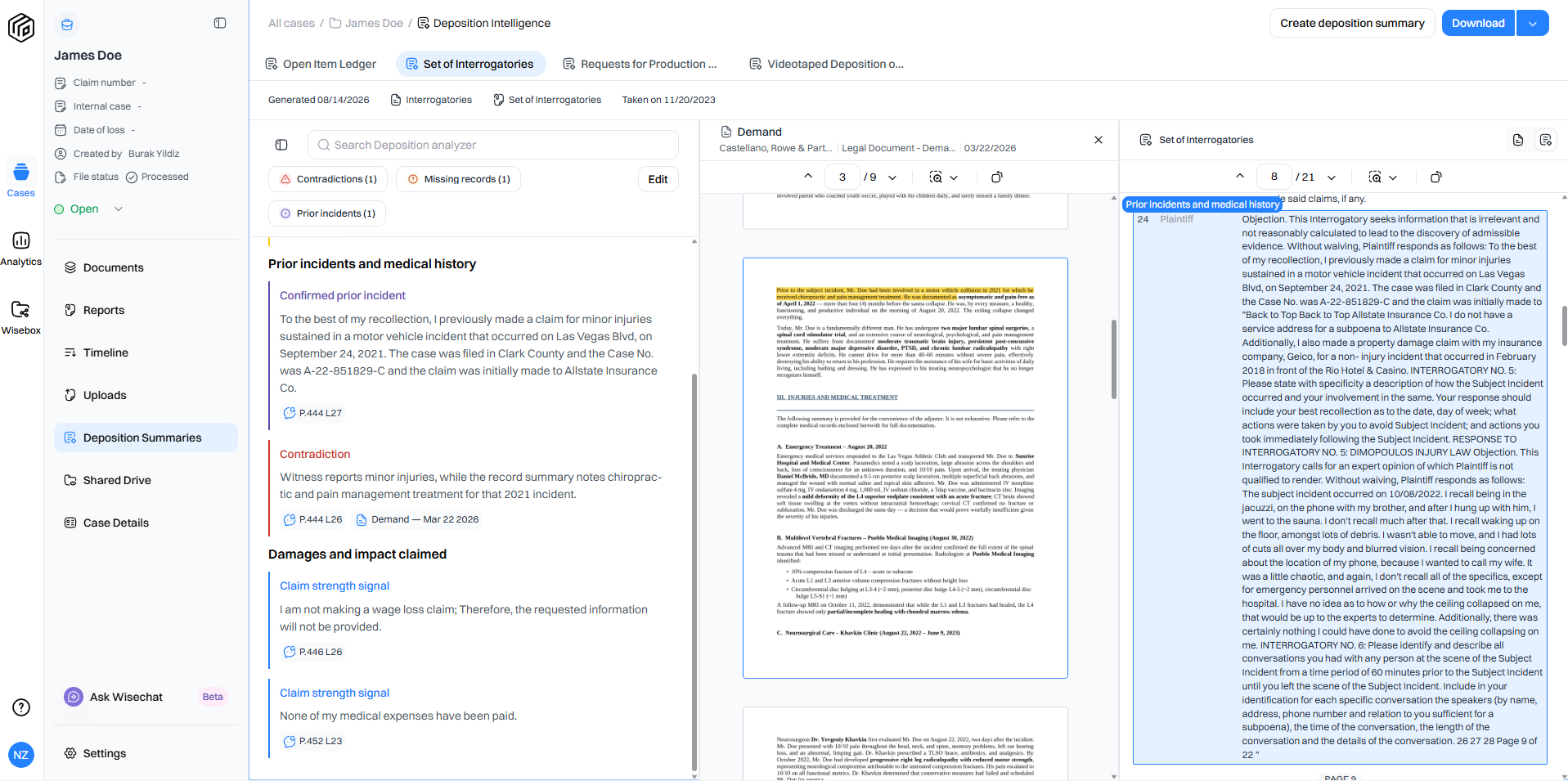
This ensures all AI insights and corresponding decisions are fully defensible with an additional layer of accuracy checks before anything is presented to you.
Make faster decisions using AI analyzers that help save insurance carriers up to $2.8M per year
Your litigation team’s time is valuable, and outside counsel can cost $1,000+ per hour, so long claim durations could be costing you millions of dollars. That means reaching faster decisions directly saves you money.
In the past, you might use your insurance claims management software to save time in reviewing and preparing records, but not to reach a decision. Wisedocs 2.0 offers an alternative solution: it acts as a true end-to-end tool across the claims lifecycle to help you make decisions quicker and in-platform.
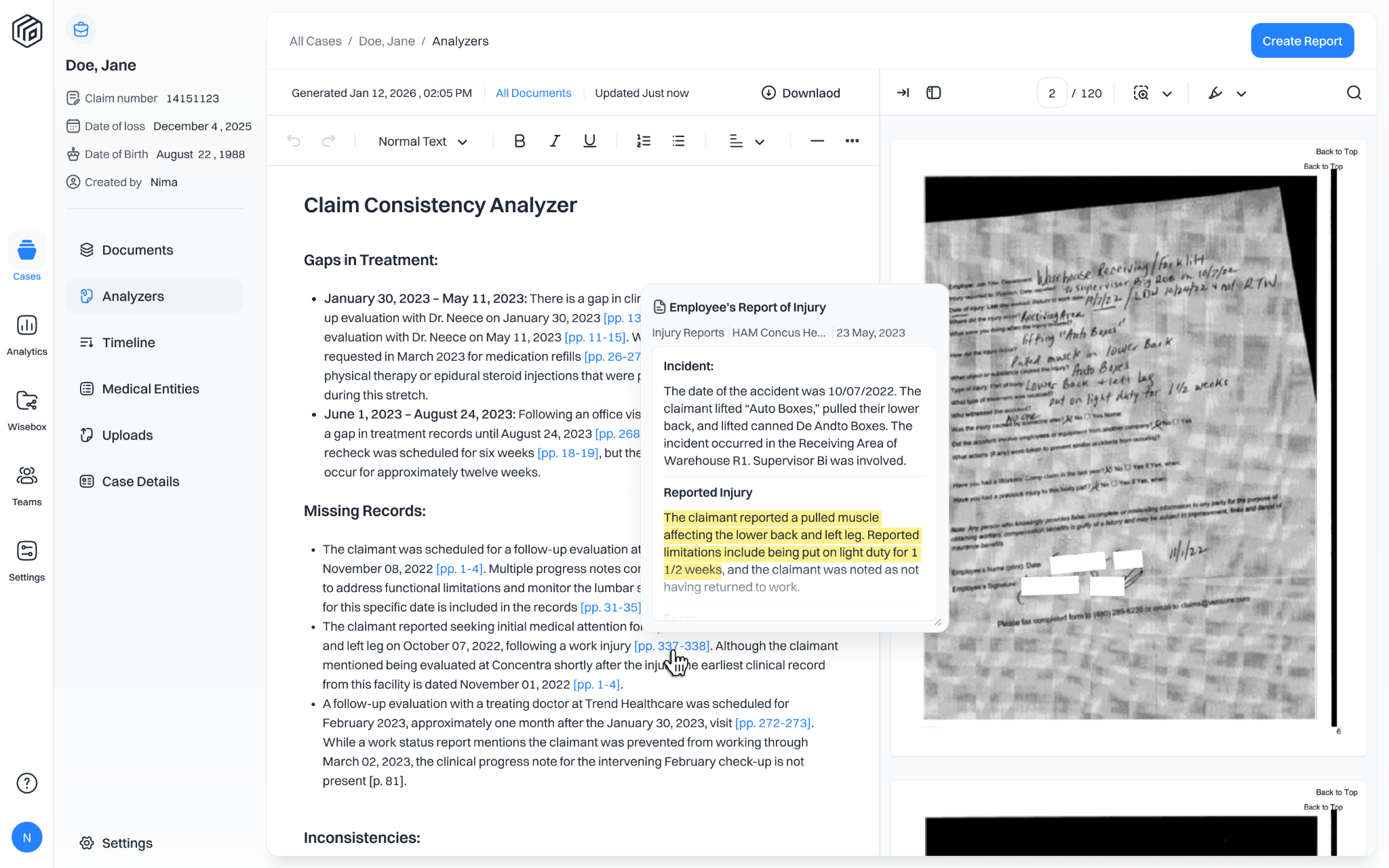
This happens through our modular AI analyzers. The claims AI extracts all key insights and human-verified data to generate custom reports tailored to your organization’s profile. These allow you to create defensible documentation within a few clicks that can be exported, edited, or shared securely.
For instance, the Claims Synopsis analyzer gives you a high-level view of the key facts, medical history, and events driving a case, with each insight being fully cited to the source. This cuts down your team’s review time significantly, as well as immediately flagging risks that might otherwise take hours or days to spot.
Increase examiner capacities by 50-60% with automated document processing and review tools
The AI boom has led to a big increase in plaintiff activity. That means more demand letters, more medical records, and more time spent manually analyzing claims for legitimacy. It’s a substantial drain on time, staff, and money, plus you don’t necessarily have the resources to just throw at the problem.
But manual document review is not the only option. In addition to insights on your business, Wisedocs offers you an array of AI-backed automation tools that let you reach first-touch review 60-80% faster. That means keeping up with the influx of demand letters and identifying fraud at the earliest point.
The platform is built for claims teams who need structured, citation-linked medical record review at scale, and can handle documents that are 500,000+ pages long. It transforms the raw, unorganized records into a clean, searchable case workspace for faster case understanding and decisive action.
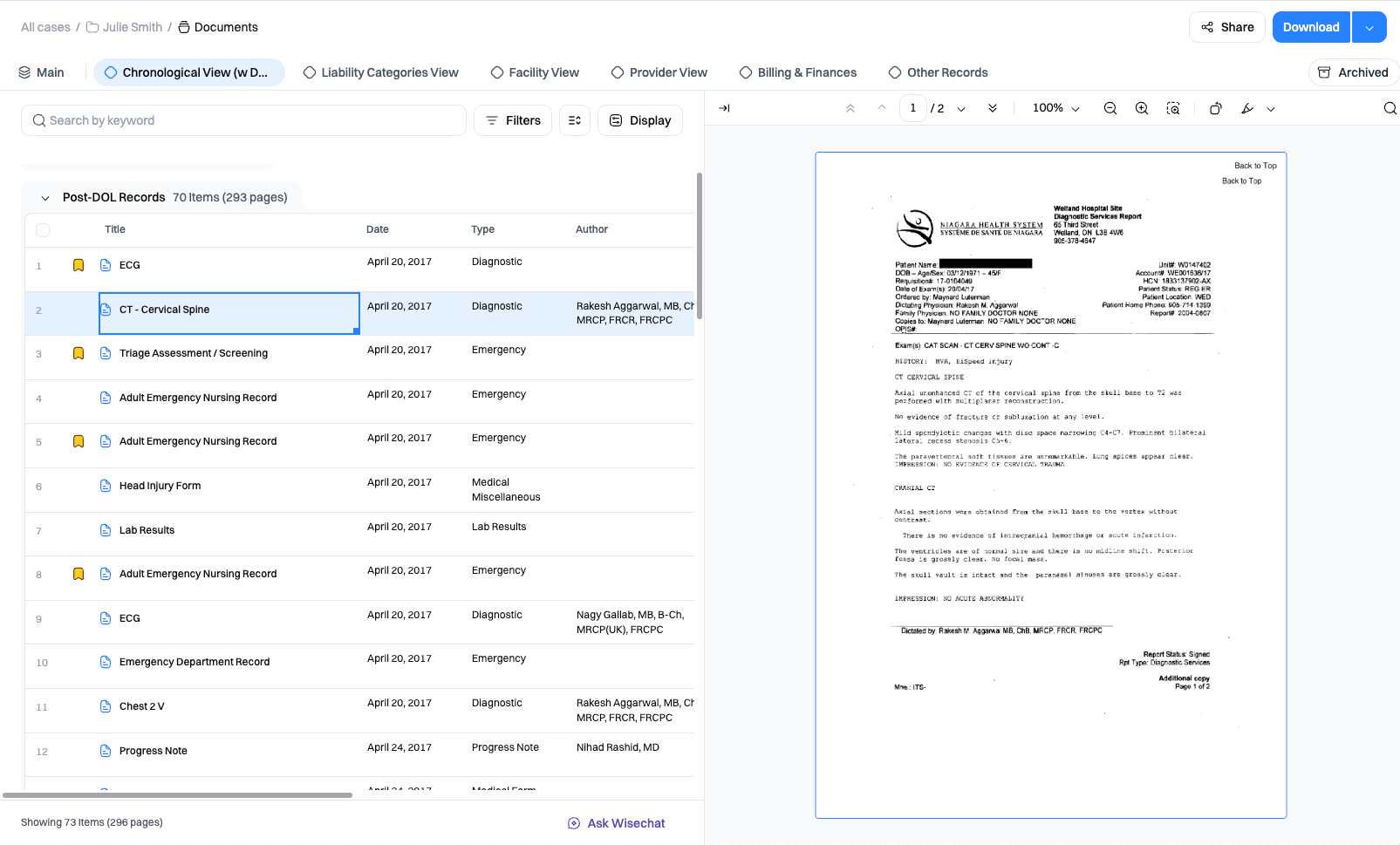
Every record undergoes entity extraction before processing, then WisePrep automates deduplication and the separation of co-mingled records. This alone can reduce claim files by up to 50%.
You’ll then get access to AI-enabled medical chronologies and summaries that are searchable, customizable, and shareable with WiseShare. Every share, view, and edit is tracked, giving supervisors, defense counsel, IMEs, and external partners a single channel for secure collaboration across a case.
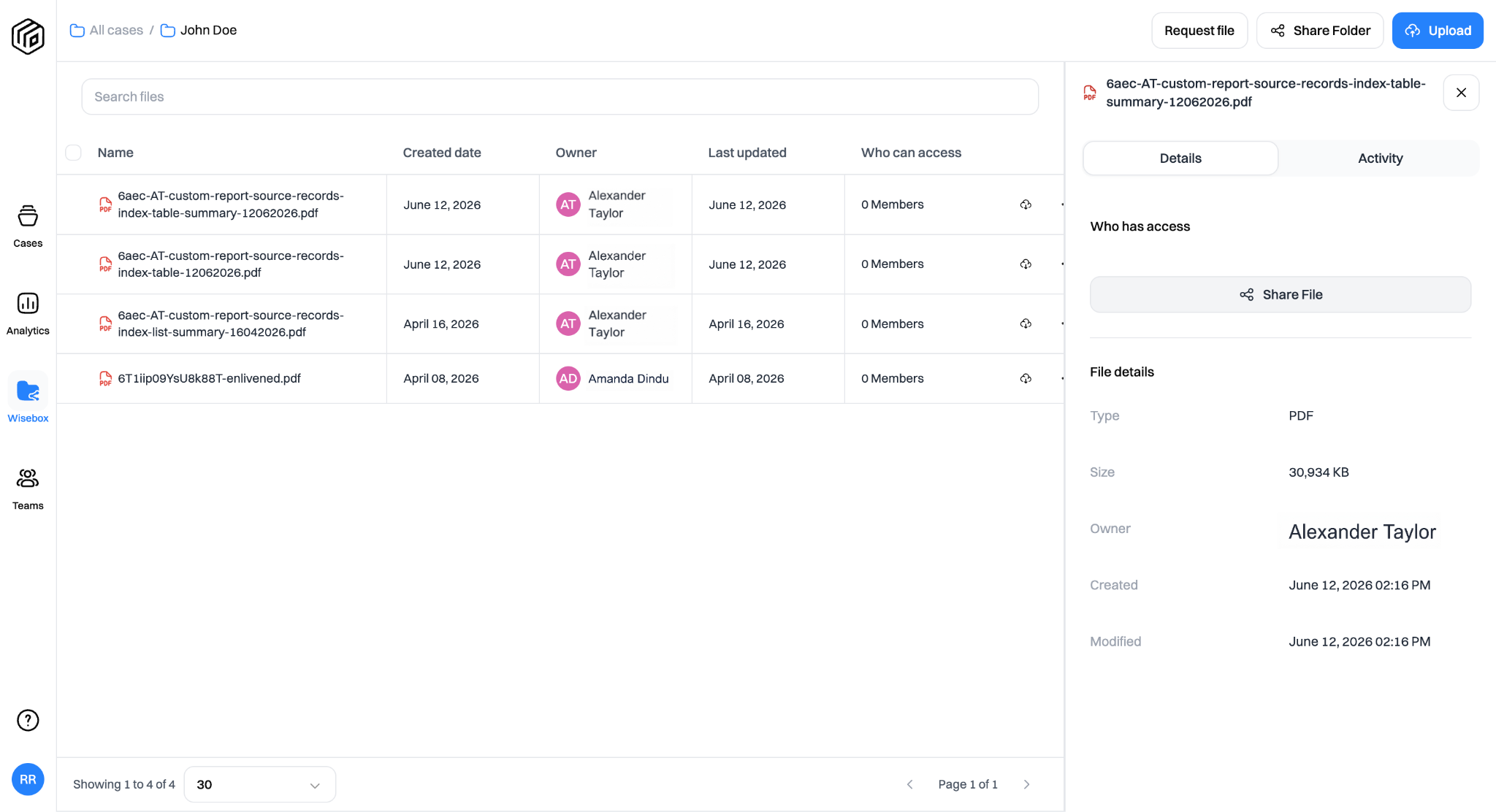
How a state fund modernized workers' comp claims review using AI-powered document intelligence
Kentucky Employers' Mutual Insurance (KEMI) is the largest provider of workers' compensation insurance in Kentucky, serving policyholders across all 120 counties in the state. As claims documentation grew increasingly complex, the organization set out to modernize how its team processed medical records.
KEMI selected Wisedocs to power its Artificial Intelligence Medical Records Review program, making it one of the first state funds in the country to launch this kind of initiative.
The combined goal was to achieve more than just faster processing times. KEMI wanted to find actionable insights that would free up its team to spend more time serving policyholders and less time buried in paperwork.
To do this, the state fund implemented Wisedocs' end-to-end platform to bring structure, governance, and scale to its claims documentation process. This has strengthened KEMI’s reputation as an innovative and trusted workers’ compensation provider, as well as reflecting its long-standing commitment to fairness, accuracy, and excellence.
“Wisedocs’ platform provides the speed, reliability, and ease of use we need to enhance our claims process while staying aligned with our mission to deliver superior service to Kentucky’s employers and employees.” Scott Brown, Legal Manager at KEMI.
You can read more about this case study here: KEMI expands commitment to excellence with wisedocs' AI-powered claims document reviews.
Reach claim decisions with efficiency and accuracy with the right insurance claims analytics software
The usability of your insurance claims analytics software shouldn’t be capped at organization, summaries, and reports. Instead, it should work to directly help professionals come to defensible conclusions within the platform itself.
Wisedocs does this through its specialized AI claims intelligence that provides imperative insights, generates custom analyzers and reports, and builds compliant human-reviewed outputs. Schedule a demo with one of our experts to learn more.
FAQs
What does insurance claims analytics software do?
Insurance claims analytics software analyzes claims data and documents starting from the moment a claim is reported at first notice of loss (FNOL). It then surfaces patterns, carries out risk management, and provides insights that support a decision.
With more advanced platforms, the software will analyze patterns across an entire book of business, like benchmarking billing cycles, tracking litigation velocity by jurisdiction, or flagging provider and plaintiff-firm patterns that only become visible at scale.
Who could benefit from using insurance claims analytics software?
Insurance carriers are the core user, but the benefit extends well beyond them. For example:
- Self-insured employers and third-party administrators bear the same financial risk and compliance obligations as carriers, so they need the same visibility
- Government claims administrators (state workers' comp funds, federal agencies) face public-accountability pressure on top of standard regulatory compliance needs
- IME and medical evaluation providers use it to prepare faster, better-organized case files
- Defense legal teams rely on it to build litigation-ready medical chronologies without manually re-reading a file from scratch.
- Underwriting teams can benefit from claims analytics surfacing exposure patterns (emerging risk types, litigation trends by jurisdiction) that support more accurate risk assessment and would otherwise never make it from the claims side back into pricing, risk-selection, and policy administration decisions.
How accurate is AI for analyzing insurance claim documents?
AI can process large volumes of insurance claim documents with high consistency, extracting structured data from medical records, bills, and legal documents far faster than manual review.
However, accuracy depends heavily on whether the model is trained specifically for claims work or is a generalist model adapted after the fact. Generic AI tools are prone to hallucination, particularly without human oversight. In fact, independent research has found meaningfully high hallucination rates in AI-generated clinical summaries when no human review step is included.
The most reliable approach pairs domain-trained AI with two safeguards: source-linked outputs tied to page-level citations (so every insight can be verified against the original document) and human expert review before anything reaches a decision-maker.
What technology can analyze claim documents and surface risk signals automatically?
Purpose-built AI analyzers are the core technology. These tools are trained specifically on insurance and medico-legal document patterns (rather than general clinical or legal datasets). They also run entity extraction across a claim file to identify conflicting information, missing records, treatment inconsistencies, and deviations from standard care, all tagged and flagged automatically as documents come in.
Platforms like Wisedocs apply this at both the single-case level (flagging risk within one file) and the portfolio level (surfacing patterns across an entire book of business that no individual reviewer could spot case by case). The key technical distinction from a basic document-management tool is that classification and tagging happen at intake, building a structured dataset from the start rather than reverse-engineering insight out of documents after they've already been summarized.

.png)