
Advancements in AI have led to some incredible tools and solutions for optimizing workflows and increasing efficiency across the board. However, it has also enabled higher rates of plaintiff demand letters, resulting in even more pressure for analysts, adjusters, lawyers, and IMEs to implement AI claims solutions within days or weeks, not months.
We understand that when it comes to insurance claims, knowing which AI claims solution to select comes with much higher stakes.
An enterprise-level AI claims solution needs to have the capacity to deal with large record packages, often reaching hundreds of thousands of pages in length, as well as meet other regulatory standards such as HIPAA for data sharing and collaboration.
In this article, we are presenting the top AI claims solutions by use case, as well as how Wisedocs can help streamline your claims processing lifecycle. We’re covering:
- The top AI claims solutions: a quick comparison table
- Why general AI tools are not enough when working with insurance claims
- End-to-end AI claims solutions
- Point solutions for AI medical record review tools
- Point AI solutions for claims document processing
Note: Wisedocs is an AI-powered and human-validated claims analytics platform that helps insurers, legal teams, and medical evaluators turn complex, unstructured records into structured, defensible outputs. Schedule a demo to learn more.
The top AI claims solutions: a quick comparison table
Why general AI tools are not enough when working with insurance claims
There’s no denying that generalized LLMs and AI chatbots like ChatGPT or Claude have some amazing capabilities for simple, everyday tasks.
But if you use them for insurance claims processing, management, or analysis, you risk facing severe financial and legal consequences.
This is because non-specialized AI tools can, and do, make mistakes. They are not trained on insurance-specific documents, not built to meet strict regulatory requirements, and struggle to process large volumes of pages, resulting in missed details.
And we’re already witnessing the results of businesses using these non-specialized models for claims management. Documented court cases involving AI-hallucinated content rose from roughly 200 to more than 2,000 in a single year, with LLMs providing insights without audit trails, links, or sources.
Instead of risking an indefensible AI output, look for a tool that:
- Provides full audit trails and citations
- Meets all necessary legal standards (e.g., HIPAA)
- Was trained specifically using insurance claims documentation
- Has the capacity to perform full entity extraction at scale
To help you to select the right tool that is compliant, specialized, and designed to handle large volumes of pages, we’ve put together this list of the best AI claims solutions, categorized by capabilities.
End-to-end AI claims solutions
Wisedocs
We developed Wisedocs after seeing firsthand how unnecessarily long the medical insurance claims process can take. Backlogged files, long document processing times, and manual record review all come at a severe cost to resources for claims adjusters, lawyers, and IMEs.
Outsourcing to a BPO (Business Process Outsourcing) is often the first solution, but it also has its issues. The biggest being that it’s expensive, with BPO rates often reaching over $1,000 per hour.
That’s why we launched Wisedocs 2.0, an AI-powered end-to-end claims decision intelligence solution built to provide accurate and defensible outputs with double the efficiency of manual workflows.
In just one platform, you can:
- Upload and automatically organize thousands of documents into searchable medical chronologies and summaries
- Implement AI-powered deduplication and the separation of co-mingled documents to reduce file volume by an average of 40%
- Have AI insights that immediately surface critical details such as litigation/fraud risk, inconsistencies, or gaps in information
- Use AI analyzers to produce instant reports for at-a-glance understanding of the case
- Get expert-backed answers with citations and context using WiseChat
- Securely share and collaborate on reports with WiseShare through single source-of-truth documents, encryption, and full chain-of-custody audit trails
- Review your entire book of business to discover key company-level insights
- Reach defensible in-platform decisions
These are the features you should know about.
Process documents faster to save up to $2.8M per year
With increased plaintiff activity has come more demand letters, larger document packets, and a need to process records faster without sacrificing time, staff, or money. Our AI-powered automated workflows work to solve this issue.
With Wisedocs 2.0, you can streamline your document processing and review workflow to reach first touch 60-80% faster. We can handle 500,000 pages at a time, which are uploaded at lightning speed, undergo automated deduplication, and have all co-mingled documents separated.
These organized records are then structured into searchable chronologies, with AI-enabled summaries and insights. Your reviewers are able to reach first touch in 24-48 hours, instead of days or weeks, and are immediately presented with the most important information in order to hit the ground running.
For example, risk factors, missing information, or inconsistencies are all surfaced through WiseInsights Analyzers. That means fraud can be identified faster, avoiding time wasted on illegitimate cases.
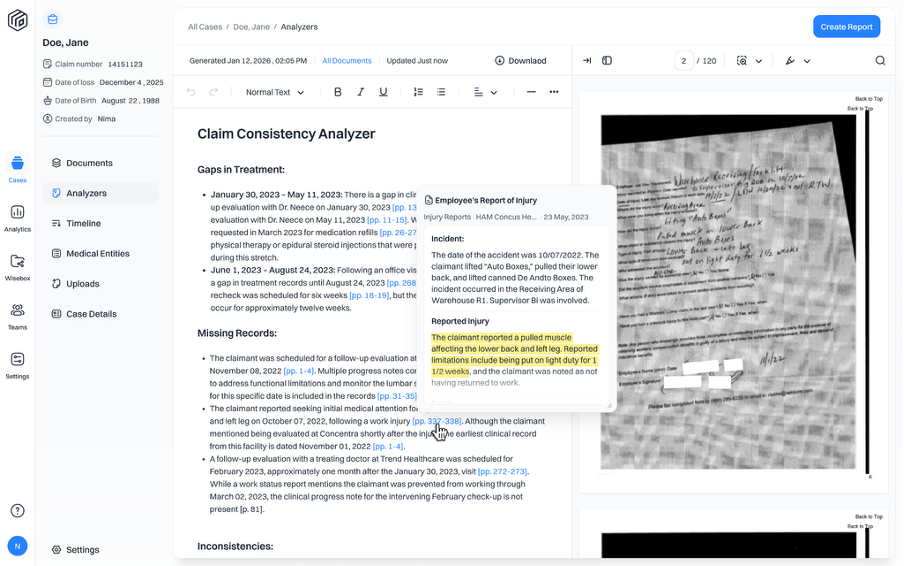
Wisedocs is also priced 3x cheaper than traditional manual business process outsourcing (BPO), with insurance carriers on the platform seeing annual savings of $2.8M. Schedule a demo to learn more about how our solutions might work for you.
Ensure accuracy and defensibility in court with our human-in-the-loop review workflows
After our “AI in Claims” study in partnership with ALM’s PropertyCasualty360 revealed that only 2% of experts have a high level of trust in AI-generated outputs, we knew something had to change.
Incorporating AI into the claims documentation lifecycle is becoming essential to meet the growing plaintiff activity and competition within the industry, but if reviewers don’t trust an AI claims solution, they may end up spending more time reviewing and managing outputs than in a manual workflow.
That’s why every Wisedocs output is fully defensible and auditable.
This happens through human-in-the-loop review workflows that increase expert trust by 4x. Our experts regularly check and refine AI recommendations to ensure accuracy. For example, doctors review AI-generated diagnoses before assigning treatments, making sure important clinical details aren’t missed.
Our AI was also purpose-trained on 150 million claim documents, with outputs accompanied by citations and sources. It meets the NAIC guidelines now implemented in 25+ states, as well as the evolving state-by-state requirements for AI claims solutions used in case decision-making.
And because all documents processed with Wisedocs undergo entity extraction before any AI claims processing, we can ensure every piece of data is individually identified, classified, and stored. This provides the deepest level of document analysis for our AI insights and analyzers, as it ensures nothing is missed.
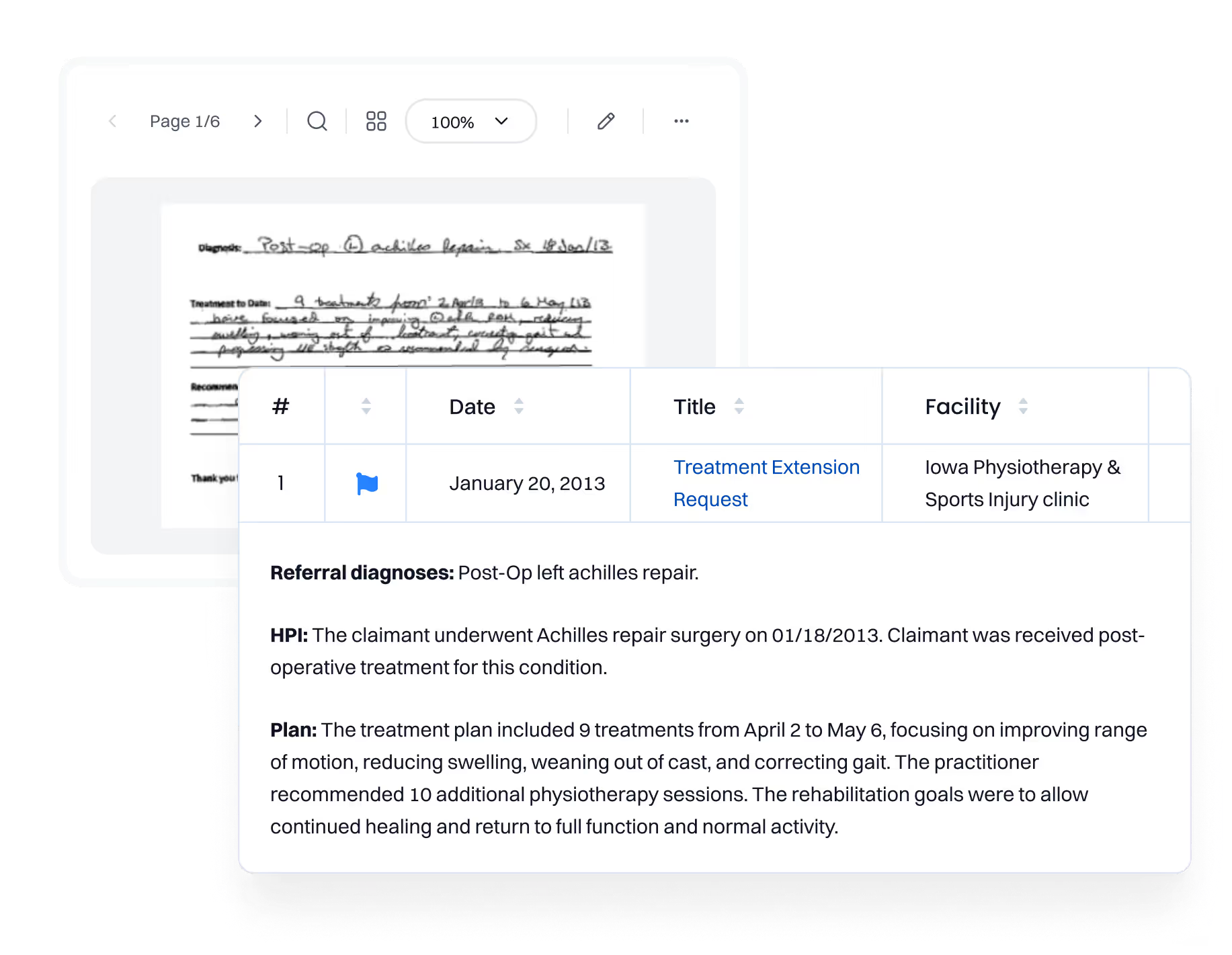
The majority of third-party vendors or other AI claims solutions skip this step and do not extract data until after processing. However, this can cause reviewers to miss critical information. When hundreds of thousands of dollars (often more) are on the line, we make sure no piece of information is overlooked.
Get insights on your book of business to actually decrease costs
There are many AI claims solutions that are designed to improve individual case management. However, without clear insights into business-level activity, insurance carriers are leaving potential at the door.
Our platform uses the data and patterns tracked across all cases within your portfolio to build benchmarks across your entire book of business. Based on these, our claims decision intelligence is able to present larger-scale insights to help you better understand the key details of your business.
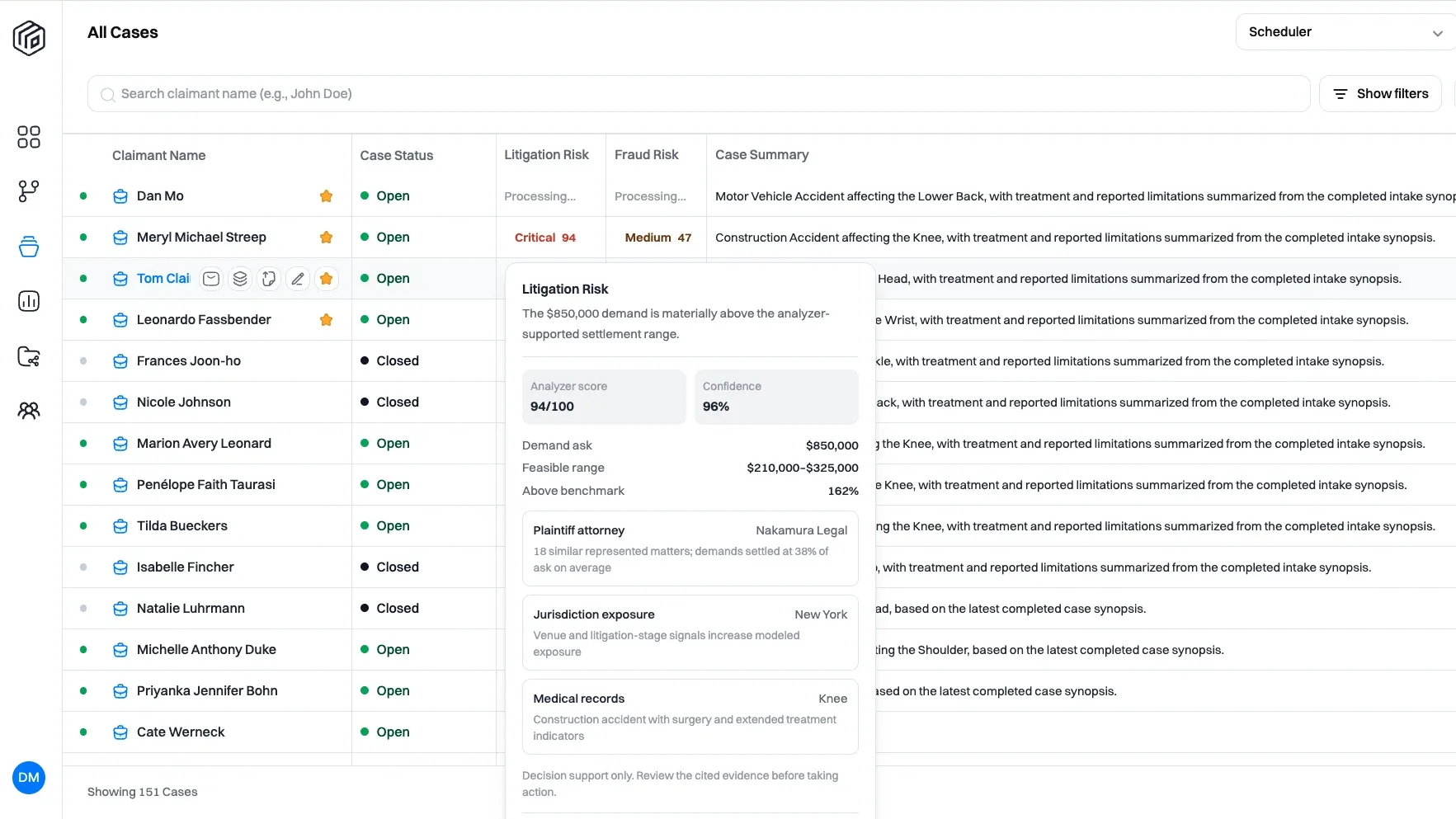
For example:
- Whether fraud rates are increasing or decreasing
- How a particular provider might be appearing in a disproportionate number of claims
- When claims are staying open for longer
- Where you are paying out on more cases than you were previously
- If a specific jurisdiction is driving higher settlements
How a leading workers’ compensation legal defense firm used AI-powered workflows to increase document processing capacity by 150%
This leading legal defense firm specializes in workers’ compensation and represents large insurance groups, smaller carriers, self-insured groups, and public entities. Its attorneys work under tight legal deadlines, often handling case files that run from a few dozen pages to more than 30,000.
Over time, manually processing and reviewing these files became unsustainable. The largest cases were taking days and eight reviewers to sort, deduplicate, and organize. This meant that many cases weren’t being completed until just days before the deadline.
The firm knew they needed an AI claims solution, and decided to work with Wisedocs. We configured the platform around the firm’s existing processes, implementing automated workflows and AI medical chronologies.
The result was that processing capacity rose by 150%, from 8,000 to 20,000 pages per day. Large files that once required eight staff now need only two, and files are returned two weeks or more ahead of deadlines, giving attorneys the time they need to prepare, strategize, and win.
You can read more about this case study here: Workers’ compensation legal defense firm automates 80% of legal file review.
EvolutionIQ (a CCC company)
EvolutionIQ (now a CCC company) streamlines claims workflows by using AI to prioritize cases in need of early intervention instead of a traditional calendar-based system. The AI claims solution then provides a “synthesis” of each case, which connects information across unstructured medical data to surface what could change a claim’s trajectory.
The team started with the goal of helping claims teams handle cases more accurately and fairly, and is specialized in claims involving injury and disability. It processes incoming medical documents, walks reviewers through each case with claim and document syntheses, and guides them through recommendations, with every output cited back to its source.
Key features include:
- Claims guidance: A four-stage approach to documents that distills data, assesses claims that need attention, intervenes before escalation, and elevates the team’s performance
- Medhub: Produces medical record synthesis with AI insights, filters, and summaries
- Demandhub: Detects inconsistencies and contradictions in data and creates guided chronologies
Point solutions for AI medical record review tools
Verisk Discovery Navigator
You can use Verisk’s Discovery Navigator for AI-powered medical record reviews that are guided by human insights. It provides record organization, automated summaries, and AI insights, with targeted search that provides direct answers and citations.
Alone, the tool doesn’t offer book of business insights or predictive outcome scoring, but it does sit within the larger Verisk environment, where it can communicate and collaborate with the other suite of tools.
Key features include:
- Document organization: Deduplication, sorting, and timelines
- Medical extraction and analysis: Extracts and tags data such as pre-existing conditions, ICD codes, surgical procedures, or prescription drugs
- Summaries and reporting: Automated summaries, indexed reports, and AI-driven demand package reviews
DigitalOwl
DigitalOwl provides reviewers with a modular, AI medical record review platform spanning life, LTC, and disability insurers, plus some P&C. It uses generative AI to understand the nuances of medical records, then an entity recognition engine to analyze the larger data sets.
The DigitalOwl knowledge base then adds medical codes and normalizes the data to medical concepts, as well as tagging the severity of the case and information for claims teams. During intake, it also deduplicates and summarizes documents to reduce page count by up to 90%.
The six modular AI tools can be sold separately or bundled. They are:
- View: AI-powered medical summaries that undergo deduplication
- Case Notes: Built to contextualize the subtleties of medical records rather than just identify terms
- Chat: A conversational assistant that provides evidence-backed answers to your team’s case questions
- Triage: Automates case triage by flagging predefined data points across many cases
- Workflows: A tool that applies your decision rules to the medical record automatically and recommends next steps
- Connect: A data API that standardizes and structures data, integrates with existing systems, and maps to rules engines
Point AI solutions for claims document processing
Sprout.ai
Sprout.ai was developed as an insurance-trained AI layer that sits on top of your existing claims operations systems. It automatically converts high volumes of unstructured claim records into organized data using AI-powered optical character recognition (OCR) that can handle handwritten and low-resolution documents.
It then applies its intelligent claims handling process to check for things like policy coverage and fraud indicators to help reviewers make faster decisions. Sprout.ai is a cloud-based SaaS that can be implemented in as little as 3 months.
Key features include:
- Document processing: Converts large volumes of unstructured claim documents across 50 languages with 99% accuracy
- Data enrichment: Cross-checks extracted claim data against external sources, such as medical databases and web data, to fill gaps and verify accuracy
- Fraud detection: Assesses fraud risk on each claim, checks documents for authenticity, and flags unusual patterns.
- Explainable decisioning: Processes routine claims automatically and gives handlers recommendations on complex ones, with the reasoning and confidence scores
Indico Data
Indico Data is an AI document processing solution that turns messy inbound claims documents into clean and organized packages ready for first touch. It ingests from every channel (claims inboxes, portals, and file feeds) and is compatible with a wide range of document types, including emails, zipped bundles, native and scanned PDFs, ACORD forms, loss runs, and handwritten fields.
The platform then extracts and classifies all the information before enriching and validating it, then sending it directly to the right place.
Key features include:
- Multi-channel claims intake: Pulls loss notices from email, portals, and file feeds into a single intake pipeline
- Insurance-specific agentic AI: Purpose-trained agents that were built to process unstructured claims records
- Data validation: Flags missing or conflicting information at intake, so adjusters start with complete files
- Automated routing and Guidewire integration: Sends validated work to the right teams and populates ClaimCenter records directly
Hyperscience
With 99.5% accuracy and 98% automation across printed, handwritten, and digital documents, Hyperscience processes and cleans data for claims teams. The tool has applications across industries, but it does offer insurance-specific capabilities and is built for accuracy across very large documents.
Unlike traditional OCR, its machine learning models read whole words and phrases using the greater context of the document and case. This means it can better understand handwriting that is sloppy, messy, or in cursive, as well as poor-quality images such as faxes and mobile photos.
Key features include:
- Claims intake and extraction: Captures, classifies, and extracts claims data from any format, then recommends next steps
- Handwriting and complex format capturing: Applies context reasoning and uses separate models, e.g., one built specifically for signatures
- Human-in-the-loop workflow: Uses a feedback loop that continuously improves the models on each insurer’s own documents
- Fraud protection at intake: ML models flag suspicious patterns while AI detects false documents
Tractable
Tractable is a photo-based AI tool built specifically for auto insurance claims. It can scan vehicle photos in seconds, making recommendations that allow reviewers to classify, estimate, and settle claims much faster than if assessing each image manually.
The AI is able to analyze images at a pixel level to provide accurate estimates. These outputs are then accompanied by a certainty score based on the image’s visibility, quality, and damage severity.
Key features include:
- FNOL triage: Uses photos taken at first notice of loss to instantly classify claims
- AI-powered estimates: The tool automatically provides estimated repair costs based on damage detection
- Claim review and anomaly detection: Reviews claims for errors and fraud risk
Choose an AI claims solution that produces fully defensible and auditable insights for accurate decisions
An AI solution that simply improves efficiency is not enough for insurance claims processing. What matters is that the artificial intelligence outputs are fully defensible and meet the evolving regulations across state and federal levels.
Wisedocs achieves this through our human-in-the-loop processes and a commitment to meeting those evolving rules, for instance, being compliant with the NAIC guidelines adopted in 25+ states. Schedule a demo to learn how Wisedocs could fit with your current claims processing workflows.
FAQs
How is AI used in the claims management process?
AI helps claims teams handle the growing volume and complexity of claims information. Depending on the tool, it can extract data from incoming documents, flag potential fraud, prioritize claims that need attention, and summarize lengthy medical records into chronologies and key findings.
The most advanced platforms are then able to go beyond automating single tasks. They connect these capabilities across the claim lifecycle, turning raw documents into insights that support faster, more consistent, and more defensible claims decisions.
Is AI going to replace claims adjusters?
No. AI takes on the repetitive, time-consuming work that slows adjusters down, such as sorting documents, removing duplicates, and searching records for key details. That frees adjusters to focus on judgment-heavy work, like evaluating complex claims, negotiating settlements, and communicating with claimants.
Most leading AI claims solutions are built with human oversight in mind, because claims decisions affect people’s lives and must be accurate, fair, and defensible. The goal is to give adjusters better information, faster, not to make decisions for them.
What is the difference between an end-to-end claims intelligence platform and a medical record review tool?
A medical record review tool focuses on one task: organizing and summarizing medical records so reviewers can understand them faster. An end-to-end claims intelligence platform covers the full journey from document intake to decision, combining indexing, deduplication, summarization, and analysis with insights that help claims teams act on what the records show.
In practice, a medical record review tool helps you read the file faster, while an end-to-end platform helps you understand what the file means for the claim, get broader reports and insights, then make accurate in-platform decisions.
How do I choose the right AI claims solution for my organization?
Start with where your bottleneck is. If it’s intake, a document processing tool may be enough. If it’s vehicle damage appraisal, a visual assessment tool fits. If your team spends hours reviewing complex medical records, look for a solution with deep medical expertise and the ability to turn records into actionable insights.
Then evaluate each option on accuracy, explainability, and audit trails, along with human oversight, security and compliance (such as HIPAA and SOC 2), integration with your existing claims systems, and time to value. Ask vendors for results from customers with claim types and volumes similar to yours.
Sources
https://www.evolutioniq.com/about
https://www.evolutioniq.com/platform/claims-guidance
https://www.evolutioniq.com/platform/medhub
https://www.evolutioniq.com/medhub/demandhub
https://www.verisk.com/products/discovery-navigator/
https://www.digitalowl.com/platform
https://indicodata.ai/platform/claims-fnol/
https://www.hyperscience.ai/solutions/insurance/
https://www.hyperscience.ai/solutions/insurance-claims-processing/

