
Finding a true insurance claims analytics platform is difficult for both regional and mid-market insurers. Many core platforms offer basic reporting features, but they fail to present deeper insights that drive business decisions, such as identifying major financial exposures, spotting early treatment trends, or evaluating litigation risk.
In this article, we’re exploring Wisedocs, Guidewire Analytics, Duck Creek, CLARA Analytics, and Shift Technology, the top insurance claims analytics software options for a mid-size carrier.
The best insurance claims analytics software for a mid-size carrier
Wisedocs
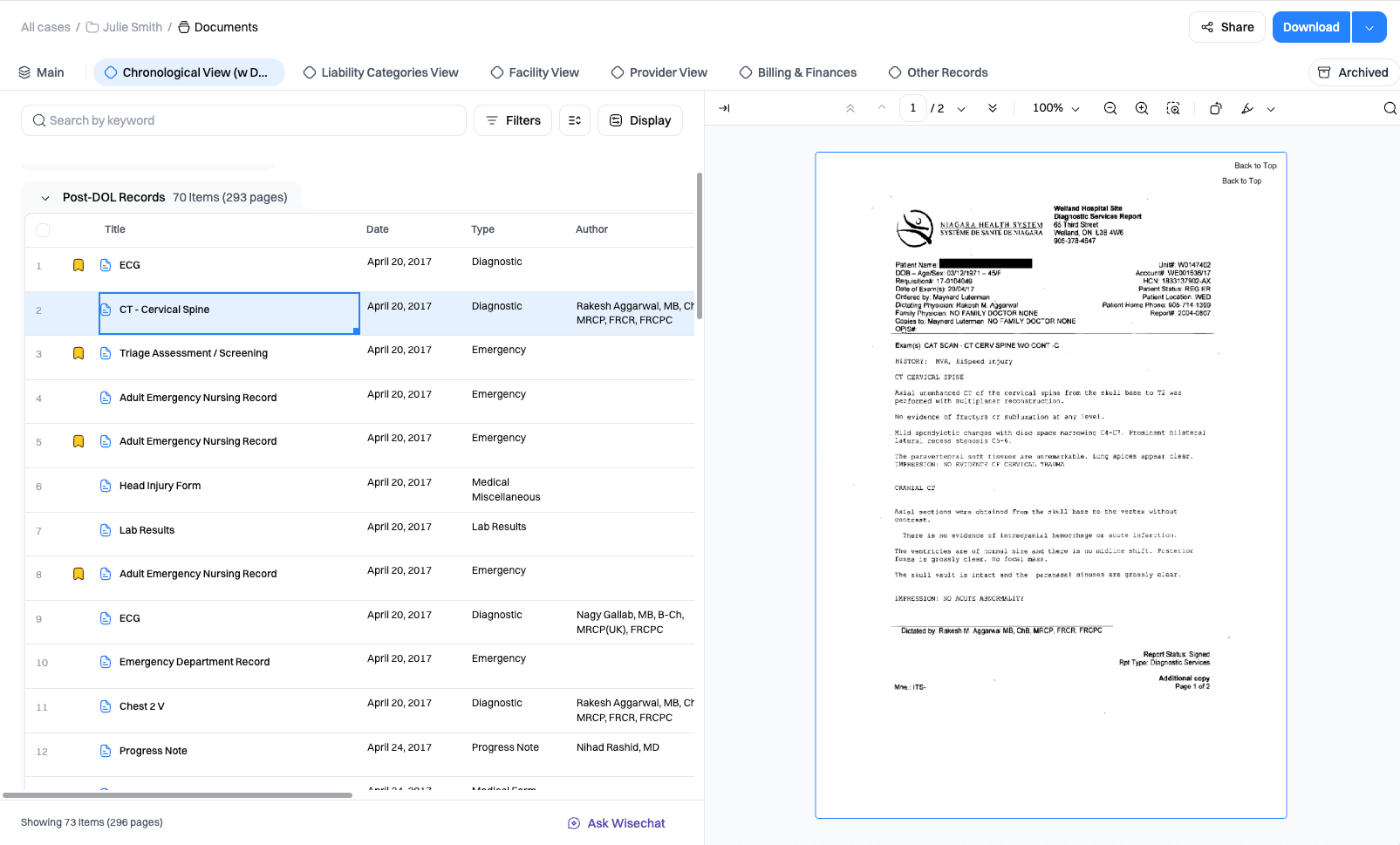
We’ll start with ourselves, as we’re writing this article. Wisedocs is a medical insurance claims analytics software that provides automations, insights, and AI technology to help you make accurate decisions faster.
We know that mid-tier carriers manage the same complex, multi-thousand-page claim files as national insurers, but without their massive IT departments or offshore review teams. Our claims decision intelligence platform solves this by structuring messy medical records, legal documents, and demand letters the moment they arrive.
Instead of your team spending days manually sorting through scanned PDFs, the platform automatically indexes records, removes duplicate pages, and extracts key clinical data.
All while using entity extraction at index to tag and store a huge amount of data. Our custom-built AI trained on 150+M claims documents, then analyzes everything to provide you with critical insights across individual cases and the entire book of business.
This helps adjusters to make in-platform accurate decisions, as well as supports business-level decision-making for scale and revenue.
Core features include:
- Entity extraction: Tag and index every medical entity at intake to eliminate manual sorting and make every record instantly searchable.
- Deduplication: Remove duplicate records automatically to reduce clutter and focus adjusters on relevant clinical details.
- Compliant and defensible insights: Generate defensible, human-reviewed summaries and interactive timelines with page-level citations that comply with state regulations.
- Demand letter analysis: Analyze incoming demand letters instantly against historical records to highlight narrative inconsistencies and exaggerated claims.
- AI analyzers: Get custom-made reports that provide immediate insights into Wisedocs entire findings across a case
Wisedocs may not be the right match for every team, so here are several other strong platforms to consider across the industry.
Guidewire Analytics
Insurers and reinsurers use Guidewire Analytics to make smarter risk and claims decisions. The platform embeds analytical insights directly into policy and claims workflows within the Guidewire environment.
The platform integrates with core property and casualty systems to deliver predictive data to underwriters and adjusters. Then, claims adjusters receive real-time data to triage incoming files quickly.
Core features:
- Monitor claims performance continuously against aggregated industry benchmark data.
- Analyze ClaimCenter data on a unified dashboard to improve cycle times, reserves, subrogation, and salvage.
- Geo-visualize policyholder locations and related claims using Canvas to optimize catastrophe responses.
- Enhance internal carrier data with third-party data feeds for better claims management.
Duck Creek
Duck Creek focuses on unifying fragmented insurance data into a governed platform. The Clarity Data Foundation serves as a centralized hub that accelerates underwriting, claims processing, and enterprise analytics.
The platform creates a trusted environment for analytics by reducing IT complexity and improving operational visibility. Carriers can monitor cycle times and performance trends in real time.
Core features:
- Create a single governed platform for enterprise claims data and artificial intelligence.
- Access curated, real-time data to make faster pricing, renewal, and underwriting decisions.
- Track operational trends and claims performance to drive consistent adjudication.
- Simplify integration across core administration modules.
CLARA Analytics
CLARAty.ai by CLARA Analytics is a casualty claims intelligence platform designed for carriers, managing general agents, reinsurers, and self-insured organizations. It focuses on reducing loss costs and administrative expenses through document intelligence and claims guidance.
The platform scans and analyzes incoming claim files to ensure important details are not overlooked. It helps adjusters identify potential litigation risks and medical severity early in the claim lifecycle.
Core features:
- Scan legal demand packages and medical records to flag critical deadlines and key language.
- Safeguard data with annual SOC 2 Type II certification and HIPAA compliance.
- Mitigate model hallucinations by isolating client data and avoiding personally identifiable information in model training.
- Calculate potential return on investment through structured proof-of-concept evaluations.
Read more: How claims processing automation bridges the talent gap for insurers.
Shift Technology
Shift Technology provides AI solutions designed to increase liability accuracy and detect fraudulent activity. Top property and casualty insurers use Shift to automate routine investigative tasks and standardize claims assessments.
The software assesses incident details, witness statements, police reports, and negligence laws continuously as new information arrives. It guides adjusters toward the next best action to maintain consistent decision-making logic.
Core features:
- Standardize liability assessments to reduce repeated reviews and manual file adjustments.
- Use human-in-the-loop design to keep every automated action transparent and auditable.
- Uncover complex fraud schemes spanning multiple carriers using the Insurance Data Network.
- Unify details from first notice of loss, claims notes, and communications into a single file view.
How Wisedocs supports mid-size carriers with claims analytics for cases and scaling
Selecting the right claims analytics platform comes down to how effectively software turns complex records into actionable intelligence. For mid-size carriers, effective analytics must evaluate reserve accuracy, pinpoint major financial exposures, and identify emerging treatment trends without requiring an enterprise-sized IT staff.
Wisedocs does this seamlessly through in-depth entity extraction, specialized AI, and custom reports that let your litigation teams understand cases more deeply and make the best possible decisions.
"I would say there are very few true claims analytics solutions there. They try to bolt it on to some of the core applications, but all they're looking for right now is point in time, and the reason why they're looking to purchase that is: do I have the right level of reserving? What are my biggest exposures? Are we seeing new trends starting to develop? And I think that's still relatively new in terms of the insurance industry."
Mark Tainton, SVP Data & Global Ops, Wisedocs
Frequently asked questions about insurance claims analytics
What is the difference between core claims management systems and claims analytics software?
Core claims management systems handle the administrative baseline of a claim, such as logging notifications, issuing payments, and assigning tasks. Claims analytics software sits on top of or alongside these core platforms to extract insights, detect fraud, evaluate liability, and identify financial exposures across unstructured documents.
Why do mid-size carriers need dedicated claims analytics tools?
Mid-size carriers often manage high document volumes without the massive IT teams or custom software budgets of national insurers. Dedicated claims analytics tools help mid-size carriers automate manual record reviews, maintain consistent reserving practices, and compete effectively against well-funded plaintiff tactics.
How does artificial intelligence improve claims analytics defensibility?
Artificial intelligence improves defensibility when it operates with human oversight and transparent source tracking. Leading platforms link every extracted fact, diagnosis, and date directly back to the original source page, giving adjusters an auditable paper trail that stands up during regulatory market conduct examinations or court proceedings.
Can claims analytics software integrate with existing policy administration platforms?
Modern claims analytics platforms integrate with major core policy and claims management systems through application programming interfaces or secure file transfer protocols. This allows structured insights, medical chronologies, and risk flags to flow directly into existing adjuster workflows.
Sources:
- https://www.guidewire.com/products/analytics
- https://www.duckcreek.com/product/clarity-insurance-data-analytics-software/
- https://claraanalytics.com/
- https://www.shift-technology.com/en-gb/