
Medical summaries are the first thing you generate when assessing a claim, but can be lengthy and complex to set up. What are some ways you can automate summaries while ensuring they’re still accurate?
You may first try using general AI tools like ChatGPT, but they often cannot process thousands of documents and will also leave out details that change the meaning of a medical note. For example, a doctor might write “suspected wrist fracture” and order an MRI to investigate. If the summary simply says “wrist fracture,” you could assume the doctor confirmed a broken bone.
In this guide, we’ll explain what your medical record summary should include, show those elements in an example, and cover the risks of using general AI to prepare it. We’ll also examine how a third-party claims decision intelligence platform like Wisedocs can speed up the process of creating accurate, defensible medical summaries:
- What should a medical record summary include?
- Medical record summary example
- How AI can help with summarization—and the pitfalls of using a generalist AI tool like ChatGPT
- How Wisedocs helps you create and review medical record summaries
- How Empowerment Health tripled IME capacity to 5–6 assessments per week with Wisedocs
- Reduce the time and cost of medical record review
Already spending too much time preparing medical files? Book a Wisedocs demo to see how we organize records and create medical record summaries with links to the supporting documents.
What should a medical record summary include?
A medical record summary should explain the relevant history, how the condition developed, what care was provided, and the latest documented outcome. Dates and source references allow you to examine the evidence behind that account.
The emphasis depends on the review:
- In workers’ compensation, an adjuster needs to follow treatment, functional limitations, and changes in work restrictions.
- In personal injury claims, counsel needs to connect the reported incident to the injuries documented afterward to assess causation and damages.
- In medical malpractice, counsel and medical experts need the sequence of clinical findings, decisions, and interventions to assess causation the care provided.
- For an independent medical evaluation, the physician needs the relevant history and previous findings to prepare their examination and opinion.
The purpose of your review determines which records you need and which details your summary should preserve.
That said, a robust medical record summary should generally include the following elements:
1. The records the summary is based on
New records can arrive after you’ve prepared a summary, disrupting timelines and forcing reviewers to restart the process. That’s why it’s important for anyone reading the medical summary to know which information and records it covers.
At the start of the summary, list patient demographics such as name, date of birth, and claim number, followed by the documents you reviewed and the providers and treatment dates they represent. This lets you check whether a report is missing from the summary or whether you still need to obtain it.
For example, your summary might cover hospital records through January and therapy notes through April. Listing those dates separately makes clear that the hospital records don’t cover the same period. If you need to establish whether the claimant received further hospital care after January, you’ll know that this summary doesn’t answer that question.
2. Relevant history and the circumstances of the claim
Explain the reported incident or condition you’re assessing, then describe any parts of the patient’s medical history that could affect your understanding of it.
If you’re assessing a shoulder injury, for example, an earlier note about shoulder pain may point to a pre-existing condition, but it doesn’t establish whether the earlier symptoms and current injury are related. Include when the earlier symptoms occurred and what the provider documented. If a clinician states that those symptoms are related to the current injury, include their explanation and name them as the source of that opinion.
Primary care and specialist physician notes can show whether the claimant experienced similar symptoms or received treatment before the reported incident. Incident reports and testimony can add information about how the injury occurred and how the claimant describes its effects. Identify the source and date of each account so you can compare it with the medical records and investigate any differences.
Our article on medical summaries for lawyers explains how organized medical evidence supports legal review.
3. Clinical findings, treatment decisions, and response
For each patient encounter — such as an office visit, specialist consultation, or hospital stay — include the date, provider, findings, assessment, and treatment plan.
Organizing the encounters in chronological order lets you follow the sequence of care, even when clinicians signed the notes later. It also makes gaps in care easier to spot, such as months without treatment between two appointments. A medical chronology can also accompany the summary when you need a more detailed timeline across providers.
Different records contribute different parts of the treatment history. Hospital records and progress notes describe assessments and care plans. Imaging, laboratory, and pathology reports provide test findings. Procedure notes explain what the clinician performed, while medication records document prescriptions and changes.
For clinical notes, SOAP format gives you a consistent way to organize the information:
- Subjective: Symptoms, experiences, and history reported by the patient.
- Objective: Findings documented through examination, observation, or testing.
- Assessment: The clinician’s interpretation or diagnosis, including any uncertainty.
- Plan: Recommended treatment, investigations, referrals, and subsequent appointments.
With those four parts laid out, you can see why the doctor recommended a particular treatment or test. For example, if a patient reports difficulty gripping objects and the doctor finds limited wrist movement during the exam, they might suspect a fracture and order imaging to investigate.
Your summary needs to make clear that the doctor hasn’t confirmed a fracture yet. If you have the imaging report and a follow-up note, include what the test showed and what the doctor recommended next. That lets you follow the investigation through to the findings and treatment decisions that followed.
4. Functional changes and the latest documented status
As you follow the treatment history, you also need to understand how the claimant’s condition affects what they can do day to day. Therapy notes might show that they can walk farther or lift more than they could earlier in treatment. Medical evaluations and work status reports add the clinician’s recommendations about which activities they can resume and which restrictions still apply.
It’s important to capture the dates of each functional change because you need to know which restrictions applied at each stage. If a doctor initially limited lifting and later cleared the claimant for modified duties, include both recommendations, who made them, and how long each applied. You can then check the recommendations relevant to the period you’re assessing.
Finish with the latest documented condition, ongoing treatment, and planned appointments so you know where care stood when the records ended.
5. References and questions requiring further investigation
Include source references, like a document name and page number, Bates number, or direct link, so you can verify a finding without searching the entire file. That source traceability lets you compare the summary with the clinician’s exact wording and read the surrounding context.
You’ll also use those references to check dates, diagnoses, medications, procedures, and which side of the body was affected, and make sure the clinician’s meaning is kept intact throughout the summary: a suspected diagnosis needs to remain tentative, and a treatment recommendation shouldn’t read as if the patient already went through with it.
If you’re still left with an unanswered question after reviewing the original records, make a note of the question itself and any additional details you’ll need to resolve it. If answering it requires another report, capture any info you have about the provider and appointment date in the note so the person following up knows which record to request.
When updated records arrive, add the new information to your summary and revisit any unanswered questions you noted. If a new report answers a question, add the answer directly beneath that question in the summary, along with a reference to the report. Add the report to the list of documents reviewed, too, so readers know the summary now includes it.
The example below shows how these elements fit together, including how to flag a question that the available records don’t answer.
Medical record summary example
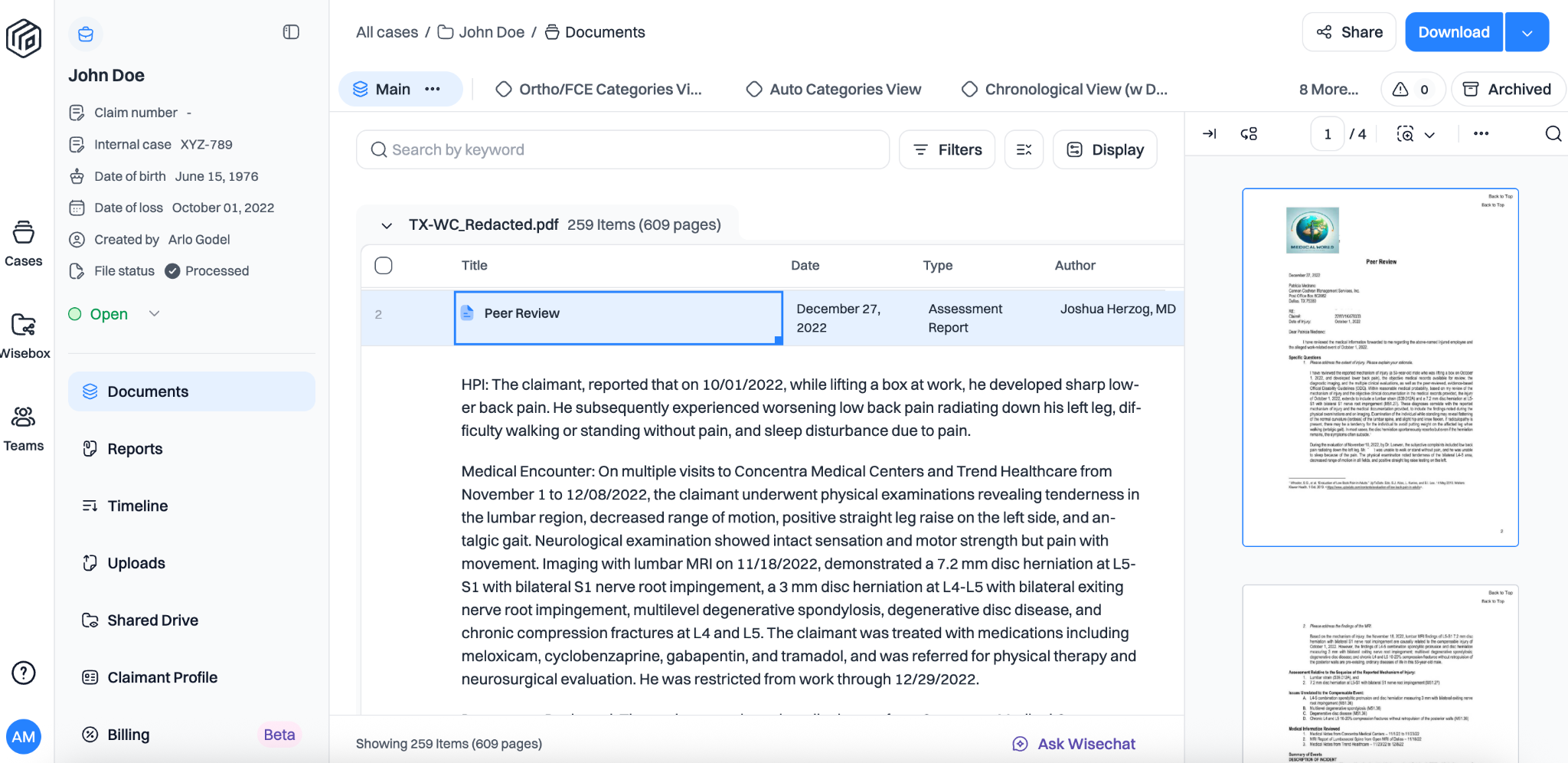
The fictional example below follows a short course of treatment after a musculoskeletal injury reported after a workplace incident. The patient, events, and source references are invented for illustration:
| Summary field | Details |
|---|---|
| Document Title | Peer Review |
| Date | December 27, 2022 |
| Document Type | Assessment Report |
| Author | Joshua Herzog, MD |
| HPI | The claimant reported that on 10/01/2022, while lifting a box at work, he developed sharp lower back pain. He subsequently experienced worsening low back pain radiating down his left leg, difficulty walking or standing without pain, and sleep disturbance due to pain. |
| Medical Encounter | On multiple visits to Concentra Medical Centers and Trend Healthcare from November 1 to 12/08/2022, the claimant underwent physical examinations revealing tenderness in the lumbar region, decreased range of motion, positive straight leg raise on the left side, and antalgic gait. Neurological examination showed intact sensation and motor strength but pain with movement. Imaging with lumbar MRI on 11/18/2022, demonstrated a 7.2 mm disc herniation at L5-S1 with bilateral S1 nerve root impingement, a 3 mm disc herniation at L4-L5 with bilateral exiting nerve root impingement, multilevel degenerative spondylosis, degenerative disc disease, and chronic compression fractures at L4 and L5. The claimant was treated with medications including meloxicam, cyclobenzaprine, gabapentin, and tramadol, and was referred for physical therapy and neurosurgical evaluation. He was restricted from work through 12/29/2022. |
| Documents Reviewed | The evaluator reviewed medical notes from Concentra Medical Centers (11/1/2022 to 11/23/2022), Trend Healthcare notes (11/23/2022 to 12/08/2022), and the lumbar spine MRI report from Open MRI of Dallas dated 11/18/2022. |
| Conclusions | The evaluator concluded that the injury of 10/01/2022 extended to include a lumbar strain and a 7.2 mm disc herniation at L5-S1 with bilateral S1 nerve root impingement. These diagnoses were determined to be causally related to the compensable injury based on the reported mechanism of injury and objective clinical documentation. The evaluator further determined that the L4-5 combination spondylotic protrusion and disc herniation measuring 3 mm with bilateral exiting nerve root impingement, multilevel degenerative spondylosis, degenerative disc disease, and chronic L4 and L5 10-20% compression fractures were pre-existing, ordinary diseases of life and were unrelated to the compensable event. |
Wisedocs is an end-to-end claims platform that streamlines the complex claims processing timeline. That includes providing AI-powered medical record summaries. Here's an example of how these appear in the Wisedocs 2.0 platform:
How AI can help with summarization (and the pitfalls of using a generalist AI tool like ChatGPT)
AI can speed up medical summarization by extracting and organizing information from your records. But generalist tools like ChatGPT also introduce risks you need to account for when reviewing the output, such as:
Generalist LLM tools can miss key information when large documents exceed their context window
Complex claims can involve hundreds of thousands of pages, particularly in asbestos and mass tort cases. An AI tool’s context window limits how much information it can consider at once. It could summarize an early diagnosis without accounting for a specialist’s later correction elsewhere in the records, leaving you with an outdated understanding of the claimant’s condition.
They tend to prioritize a coherent narrative, which can hide contradictions you need to investigate
Generalist AI tools aim to produce a clear, consistent answer. When the records contain conflicting accounts, that tendency can lead the tool to smooth over the disagreement as it summarizes the treatment history.
As an adjuster, you need those disagreements brought to your attention. If two providers give different accounts of the claimant’s progress, you need to see what each documented and when, so you can investigate the difference.
AI summaries can also contain invented details or unsupported conclusions. References to the original evidence let you check the summary against each provider’s notes and identify information the AI omitted or misrepresented.
They may misinterpret clinical details
When condensing a medical note, a generalist AI tool can lose wording that differentiates a recommendation or plan from completed care.
For example, if your AI summary turns “surgery recommended” into “underwent surgery,” you could end up relying on an inaccurate treatment history — or taking on duplicative medical record review work to correct the summary before you can use it to assess the claim.
Their privacy safeguards can fall below medical industry requirements
Generalist AI tools differ in the security controls they give you over the sensitive medical records you upload. Depending on the service and account you use, you might have limited options for restricting access, deleting stored files, or preventing their use in model training. Before using one of these tools for medical summaries, have your organization confirm that the tool’s safeguards meet your organization’s privacy requirements.
If your organization is subject to HIPAA, confirm that the provider will sign a business associate agreement covering the specific AI service you plan to use. The agreement sets out the provider’s responsibilities for protecting the health information you upload, alongside the safeguards required under HIPAA.
Specialized medical record summary platforms build medical document processing into the summary workflow. For example, our Intelligence Engine is trained on more than 150 million industry-specific documents. Wisedocs extracts and classifies details like dates, providers, and diagnoses before generating a summary, keeping that information available for searches and comparisons across records.
Here’s how Wisedocs combines that preparation with source references and expert review to speed up your medical summary process.
How Wisedocs helps you create and review medical record summaries
Preparing and checking medical summaries adds to review costs when you’re handling claims or preparing a defense. If you conduct IMEs, that preparation also limits how many assessments you can fit into your week.
Wisedocs automates document organization and generates medical summaries, helping you complete record reviews up to 70% faster. When you need to verify a finding, citation links within the medical summary take you directly to the supporting records for further analysis and defensibility.
Here’s what that looks like in practice.
Quickly produce detailed, accurate medical summaries that are defensible in court
By the time you’ve collected the medical records for a case, your deadline can already be approaching. Sorting those records and preparing a summary takes more time out of the same window, leaving you even less time to investigate discrepancies or prepare your recommendations.
Wisedocs can import records directly from retrieval companies through secure file transfer, reducing the need to download and upload the documents yourself. You can also upload files directly — our platform handles files with more than 500,000 pages, including PDFs, TIFFs, handwritten notes, and direct EHR exports.
Once the records arrive, our deduplication removes redundant pages. Wisedocs also flags co-mingled records that mention a different claimant within the medical documents, so you can check and separate misfiled pages before relying on them in your assessment.
Our Medical Summaries condense the clinical information in those records — including the claimant’s symptoms, diagnoses, treatment, and the clinician’s recommendations — using a summary format that reflects the type of record being reviewed. A progress note summary, for example, separates what the patient reported from the examination findings, the clinician’s assessment, and the treatment plan. Each summary links to the original record so you can check the wording and context.
You can review this information by date to follow the treatment history or sort by provider to examine one clinician’s care. If providers give conflicting accounts of the claimant’s progress, you can locate their summaries and open the supporting notes to compare what each documented and when.
If you need an overview based on specific records, you can use Custom Reports to bring those selected files into a condensed case summary. You can configure the sections for your review, edit the report, and export it with references to the source documents.
If you conduct independent medical evaluations, you can use a custom report to review the treatment history before an appointment, then open individual records to examine findings in more detail.
The progress note summary below shows how you can examine a suspected wrist fracture and the clinician’s recommendation for MRI imaging alongside the original note. You can see that the diagnosis remained uncertain and verify that the summary preserves the clinician’s wording.
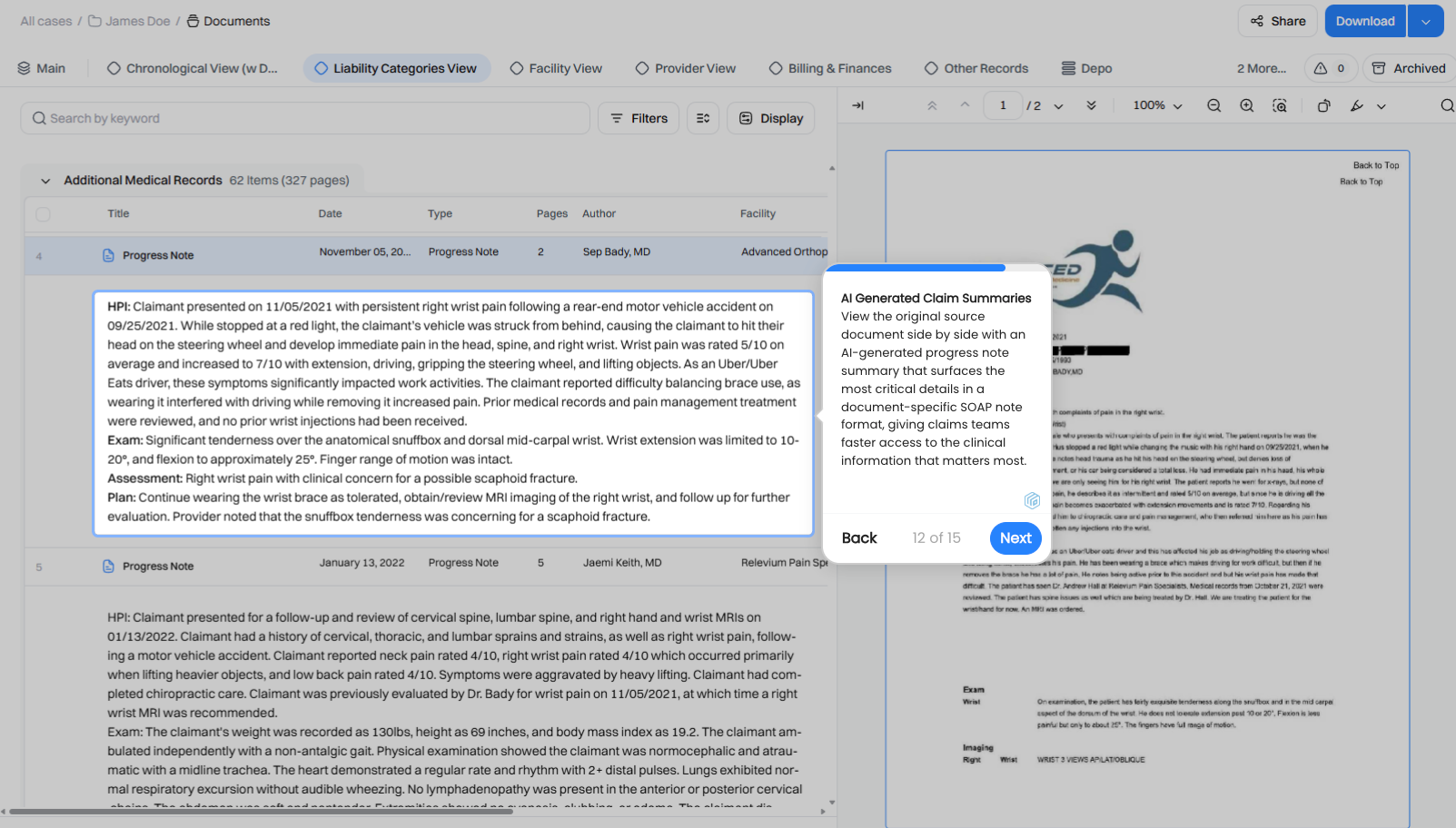
A progress note summary in Wisedocs preserves the clinician’s assessment and planned investigation beside the original record, allowing you to check the findings in context.
In addition to those references, Wisedocs automatically flags AI outputs that fall below our confidence thresholds and routes them to medical industry specialists through our Expert-in-the-Loop process. These specialists check the flagged outputs against the original records, and you’re notified when the verified documents are ready for your final review.
You can then examine the findings that inform your assessment and document how you verified them. Keeping your review notes alongside the supporting records helps you explain the evidence behind your assessment if a finding is challenged during litigation.
For insurers, that documentation can also be relevant during a regulatory examination: the NAIC model bulletin outlines expectations for AI oversight and the documentation insurance regulators can request.
Speed up first-touch review by 60-80%
If you’re dealing with years of treatment across multiple providers, you can spend hours locating the records needed to answer one question. Outside counsel can then repeat that preparation when you pass them the case, adding another layer of cost.
Wisedocs helps claims teams complete first-touch review 60-80% faster.
Our Medical Chronologies organize the treatment history by date and provider, so you can follow the course of care across appointments. When you need a particular type of evidence, you can use our configurable workflows to group documents into collections, like imaging reports or evaluations, so you can go straight to those records without sorting through the rest of the file.
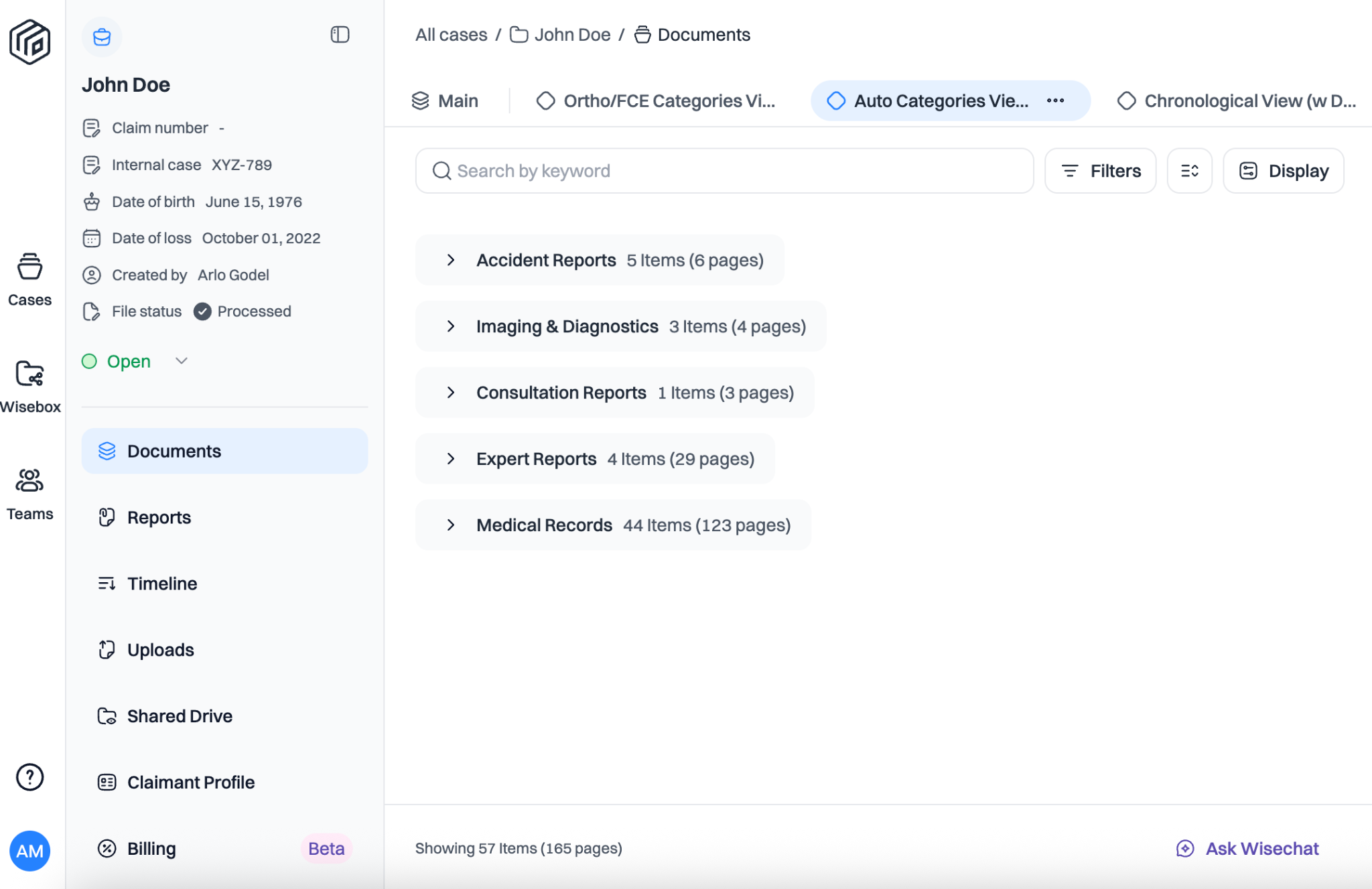
Document collections in Wisedocs let you locate relevant record types without manually sorting the file.
Once the records are organized, the Claim Consistency Analyzer flags records that appear to be missing and differences between providers’ accounts that you might want to investigate further.
In the example below, the analyzer identifies notes mentioning evaluations that are missing corresponding documentation or visit reports in the rest of the uploaded records. The source links take you directly to those notes, so you can find the appointment details you need to request the missing reports.
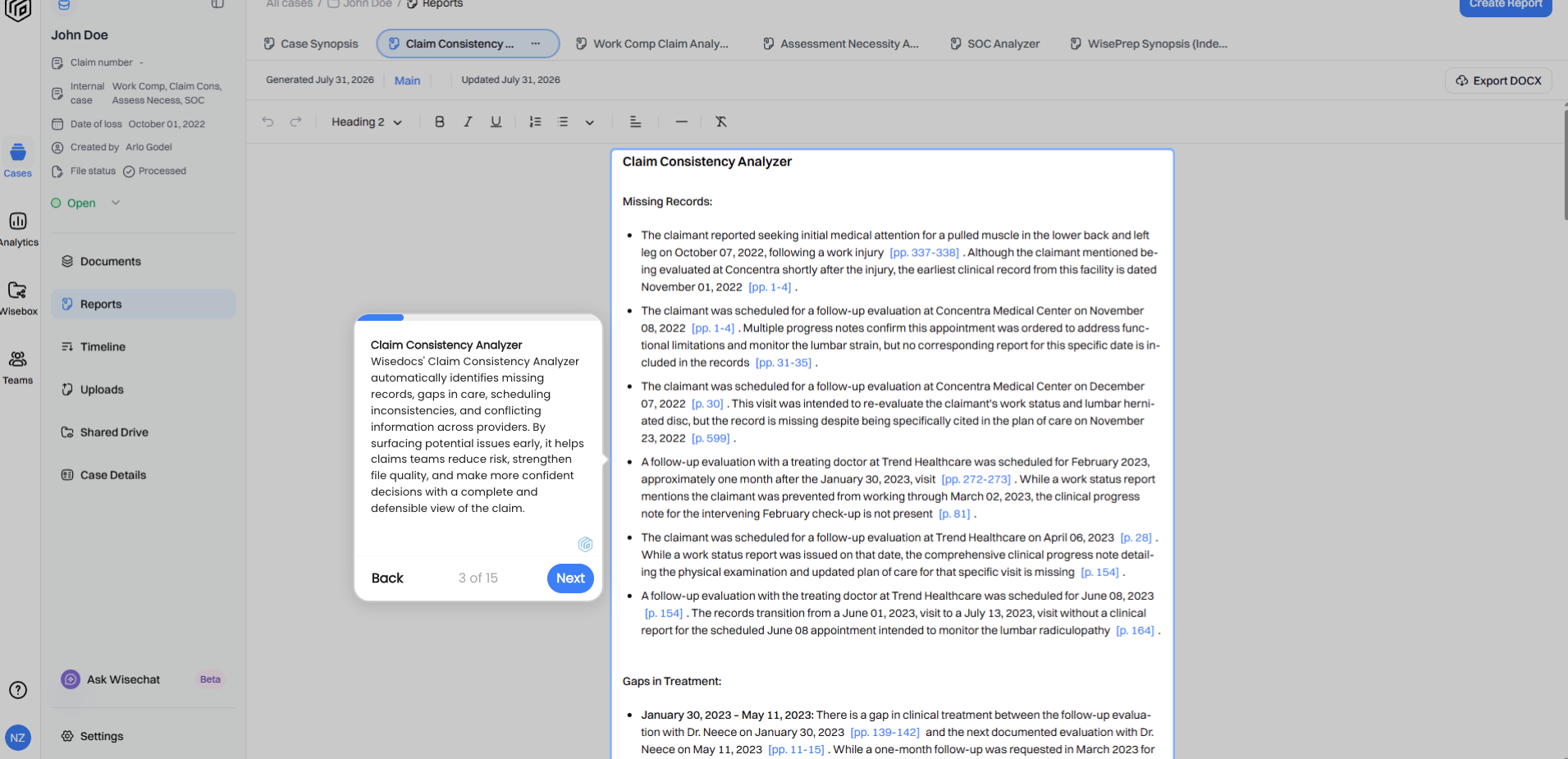
Wisedocs flags evaluations with missing reports and cites the notes that reference them, giving you specific records to investigate.
For workers’ compensation teams, a missing evaluation report could contain an updated recommendation about work restrictions, directly influencing return-to-work decisions, benefit eligibility, and the overall direction of a claim. Requesting that report can help you determine if the earlier restrictions still reflect the clinician’s recommendations.
To review the restrictions documented in the records you already have, you can ask WiseChat, “What lifting restrictions were documented, and when did they change?” Those answers also include linked citations and highlighted source context so you can examine the supporting entries.
When a claim moves into litigation, you can pass counsel the organized history, the questions you’ve identified, and the records behind them. In medical malpractice cases, that timeline also helps counsel and medical experts examine the findings available to clinicians when they made a treatment decision or performed a procedure.
Get deeper insights into what can improve your overall book of business
When medical record reviews keep you working up against deadlines, you have less time to examine what’s happening across your claims portfolio. Plaintiff firms using AI to prepare larger demand packages add to that pressure by sending even more documentation for your team to work through.
But you still need to know where claims are taking longer to close, where litigation is increasing, and which recurring issues need your attention.
Wisedocs classifies documents consistently across claims, so you can use the data gathered during individual reviews to analyze bigger trends across your book of business.
You can use WiseInsights to get answers to questions like:
- How is your book of business performing overall and by adjuster?
- Are claims staying open longer, and where are closure rates falling?
- Which jurisdictions are seeing more litigated claims?
- Do the same plaintiff firms and treatment providers repeatedly appear together?
- Where is suspected fraud increasing, and could earlier detection have brought it to your attention sooner?
If litigation is increasing in one jurisdiction, for example, you can investigate what those cases have in common and consider how to prepare for similar claims.
How Empowerment Health tripled IME capacity to 5–6 assessments per week with Wisedocs
Dr. Tara Power at Empowerment Health conducts independent medical evaluations focused on neuropsychology and health psychology. Her case files averaged around 900 pages, with substantial time spent organizing and reviewing the records.
She adopted Wisedocs to create medical chronologies, remove duplicates, and summarize the documentation. Working with our team, she also developed outputs tailored to her IME preparation, bringing relevant history and functional concerns into view ahead of the appointment.
Since then, Dr. Power has reduced preparation time immediately ahead of interviews to approximately 15-20 minutes. In parallel, her weekly assessment volume increased from 1-2 to 5-6, with no additional headcount.
With less of her week devoted to preparing records, Dr. Power had more time to put her clinical expertise to work and take on additional assessments.
Read the full case study: Empowerment Health IME Triples Weekly Assessment Capacity with Wisedocs.
Reduce the time and cost of medical record review
When a summary leaves out a significant finding or gives you no way to check its source, you pay for that omission in further review. Across your entire caseload, those searches consume the hours you need for assessments and case preparation.
A medical record summary should explain how the condition and treatment developed, with references you can check and specific gaps you can investigate.
Wisedocs reduces the time you spend organizing records and preparing summaries, with expert review and source references built into the process. That gives you more time to assess the claim and easy access to the evidence you need to back up your conclusions.
Book a Wisedocs demo to see how our platform could reduce preparation time for your next medical record review.
FAQs
Is there a free way to summarize medical records?
Yes. You can create a summary manually in a document or spreadsheet using the structure above. A basic table can include the date, provider, encounter details, and source reference.
The time involved depends on the file. A free template still requires someone to organize the records, extract the relevant information, and check the completed summary.
Can AI summarize medical records?
Yes. AI can extract information from medical records and organize it into medical summaries and medical chronologies. For claims review, the output needs to preserve clinical detail and provide references to the supporting documentation.
Wisedocs combines this automation with medical expert review and source links so your team can examine the evidence behind the summary.
How long should a medical record summary be?
Its length should reflect the record set and the purpose of the review. A short treatment episode can need only a brief overview and a few dated entries. A history spanning years and multiple providers will require more detail.
An opening overview lets readers understand the course of care before examining the longer chronology.
What is the difference between a medical record summary and a medical chronology?
A medical record summary condenses relevant information from the file. It can be organized as narrative, by topic, or by date.
A medical chronology emphasizes the sequence of encounters and events. The two can work together: an opening summary explains the course of care, and the chronology provides the dated detail and references.

