
Enterprise carriers and regional carriers face entirely different operational pressures when reviewing claims.
A massive national carrier handling millions of medical pages needs deep IT integration and portfolio-wide risk tracking. A regional team usually just needs to clear local claim backlogs and cut manual review time with a focus on quick implementation.
While both need clear facts from complex claim files, their technology requirements look nothing alike.
Many software solutions are tailored to one type of organization or another, although some platforms, like Wisedocs, offer flexible document processing and claims decision intelligence that work across both operating models.
The role of insurance claims analytics software
Picture an adjuster opening a 10,000-page medical file on a complex bodily injury claim. Finding critical treatment gaps or prior injuries manually takes days, and heavy caseloads mean key details often get missed.
Insurance claims analytics software addresses these exact operational bottlenecks. They extract data from thousands of records, tagging, categorizing, and storing it for automated and AI analysis. This allows insurers to access deeper insights within hours instead of days.
And it goes beyond individual case files. Structured claims data surfaces portfolio-wide medical insights across your entire book of business. Aggregating these records reveals systemic treatment patterns, provider billing anomalies, and emerging risk trends before they impact reserves.
As a result, insurance claims analytics software has use across several core areas:
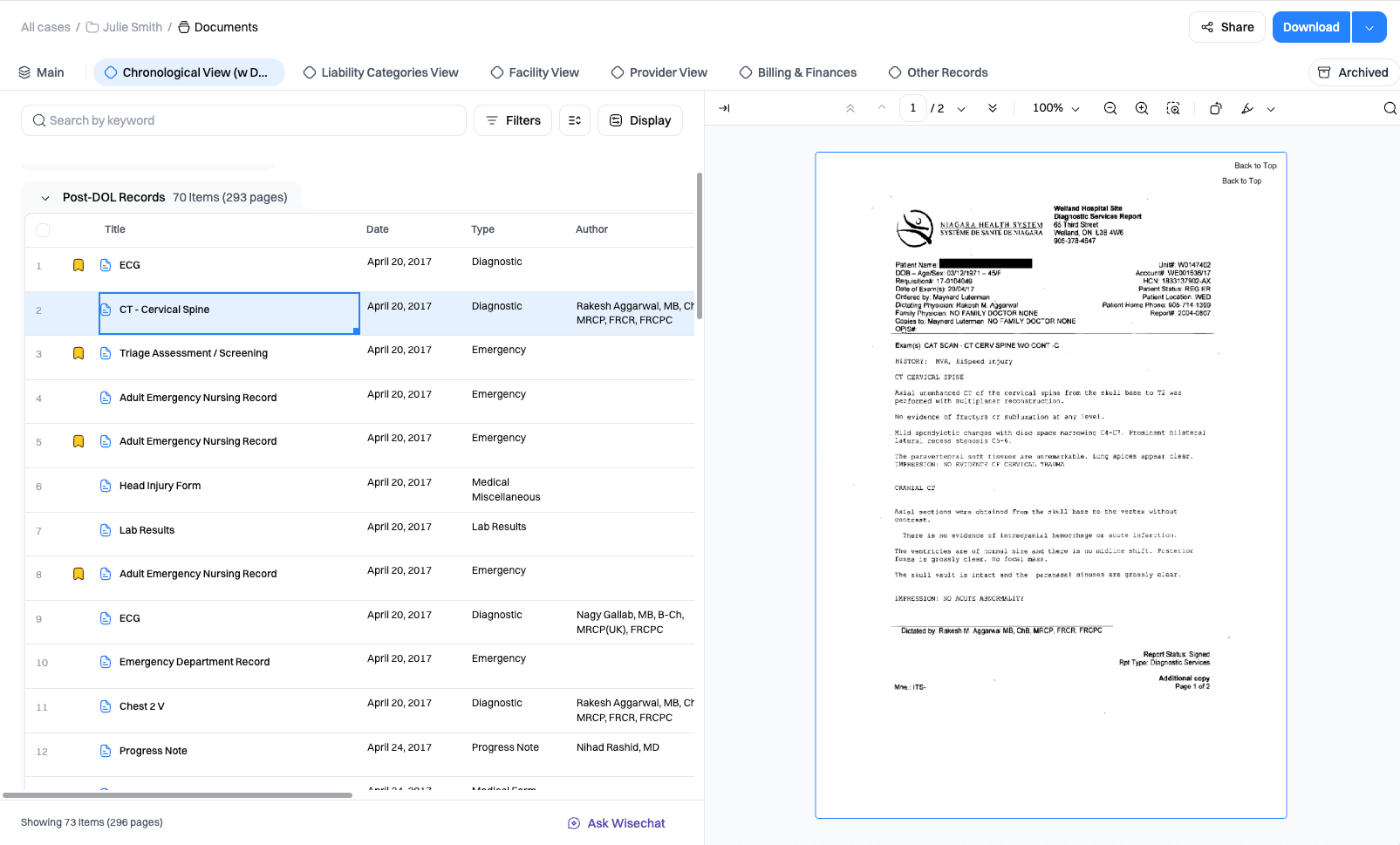
- Help adjusters reach accurate decisions faster. Automated medical chronologies and indexing pull diagnoses, treatment dates, and provider details directly from medical summaries, turning unstructured files into searchable files so adjusters can act immediately.
- Provide insights on the entire book of business. Evaluating unstructured claim files at scale surfaces portfolio-wide trends across facilities, legal firms, and injury types rather than reviewing claims in isolation.
- Helps a business better understand where it is losing money. Systemic tracking identifies duplicate billings, unnecessary procedures, and sudden spikes in severity before reserves need to be restated.
- Benchmark important data. Standardized metrics track cycle times, reviewer hours per file, and open-to-close ratios across internal teams and regional offices to improve operational performance.
Read more: Understanding claims processing automation for IT decision makers.
The difference between insurance claims analytics software for enterprise vs regional carriers
Enterprise carriers and regional carriers evaluate claims software through different operational lenses. Enterprise organizations prioritize deep IT integration, data governance, and cross-portfolio analytics, while regional carriers focus on rapid deployment, out-of-the-box workflows, and immediate cost reduction.
Key differences between enterprise and regional carrier analytics software
Focus
Enterprise carriers: The focus is heavily on broad portfolio intelligence, judicial hellhole trends, and cross-case provider patterns. Their risk teams need analytical oversight to protect balance sheets against severe losses and litigation spikes across multiple state jurisdictions.
Regional carriers: Targeting direct operational efficiency for their immediate claims teams is key. Their priority is cutting manual handling time, speeding up workers' compensation claims, and preventing local claim backlog.
Data scale
Enterprise carriers: Organizations process millions of unstructured pages across hundreds of thousands of files annually. Managing this volume requires automated entity extraction to standardize provider data across disparate regional offices.
Regional carriers: Operations handle smaller, targeted claim volumes focused on local markets. These carriers frequently collect records internally, making clean document organization and simple medical record chronologies essential.
Architecture
Enterprise carriers: Systems often rely on complex core platforms undergoing migration from legacy on-premise setups to cloud environments. Flexible application programming interface integrations and private cloud hosting help preserve legacy data during these shifts.
Regional carriers: Software that connects to current systems without custom coding or developer support is preferred. For instance, cloud tools that can work with existing services.
Cost
Enterprise carriers: Leadership typically allots substantial budgets into custom integrations, multi-year licenses, and complex IT infrastructure. Software costs are measured against long-term indemnity savings across massive risk portfolios.
Regional carriers: Operations work within tighter IT budgets and evaluate tools based on immediate financial returns. They favor per-file or volume-based subscription pricing that eliminates steep upfront fees.
Implementation
Enterprise carriers: Rollouts involve multi-stage pilot programs, extensive compliance reviews, and strict security sign-offs. These deployments typically require six to twelve months to complete.
Regional carriers: Fast onboarding relieves adjuster workload pressures immediately. Turnkey deployments allow regional teams to begin processing complex medical files within weeks.
Read more: How AI medical record review tools help detect and clean duplicate medical records.
How Wisedocs provides a true analytics solution
Wisedocs delivers an AI-powered claims intelligence platform built to support both enterprise carriers and regional insurance organizations. By combining point-of-indexing entity extraction with human-in-the-loop oversight, the platform turns unstructured medical records into defensible, searchable assets.
Then, tools like WiseInsights analyze data across your entire book of business, surfacing cross-portfolio trends impossible to detect when reviewing files in isolation.
You can use Wisedocs to:
- Extract and tag data at point of intake. Pull and store every data point on the page, including care dates, providers, insurance carriers, body parts, and medications, to remove redundant data through medical record deduplication.
- Automate document sorting and workflows. Organize incoming files automatically by provider, date, or document type to build clean medical chronologies and streamline review processes.
- Maintain compliance and defensibility. Align with National Association of Insurance Commissioners (NAIC) guidelines across 25+ states with human-reviewed outputs, page-level citations, full audit trails, and SOC 2 Type II, HIPAA, PHIPA, and PIPEDA attestations.
- Analyze trends across the entire book. Surface portfolio-wide insights across all processed files to spot provider billing anomalies, treatment patterns, and hidden litigation risks.
- Deploy flexibly across any IT environment. Adapt to your infrastructure using multi-tenant SaaS, private cloud, on-premise, or hybrid hosting with an API-first architecture, role-based access controls, SAML SSO, and SCIM provisioning.
Wisedocs may not be the right fit for every claims department, so evaluating alternative claims management platforms helps ensure you match software capabilities to your specific operational scale.
FAQs
What is the main difference between enterprise and regional claims analytics software?
Enterprise software focuses on broad portfolio risk trends, custom API integrations, and multi-state compliance governance. Regional software prioritizes rapid setup, out-of-the-box workflows, and immediate adjuster productivity gains.
Why is data quality important for insurance claims analytics?
Incomplete or unindexed data prevents insurance claims analytics software from generating accurate risk insights. Comprehensive entity extraction at intake ensures every medical fact, provider name, and treatment date is tagged and searchable across the claim file.
How does claims analytics software handle medical record review?
Claims analytics platforms use optical character recognition and domain-trained models to extract clinical data from unstructured files. They remove duplicate pages, organize records chronologically, and summarize key medical events.

