Evaluating claims analytics platforms requires looking beyond standard features to verify how each vendor safeguards electronic protected health information. Selecting the right platform depends on whether your team handles complex bodily injury cases, healthcare fraud investigations, or medical coding automation.
In this article, we’re covering a list of the top insurance claims analytics software that are both HIPAA and SOC 2 compliant. They are:
- Wisedocs
- FraudOps
- RapidClaims
- CLARA Analytics
- Riskonnect Claims.
List of HIPAA and SOC 2 compliant insurance claims analytics software
Wisedocs
Seeing as we’re writing this, we’ll start with our own platform. Wisedocs is an enterprise-grade claims decision intelligence platform designed for insurance carriers, third-party administrators, law firms, and medical evaluators.
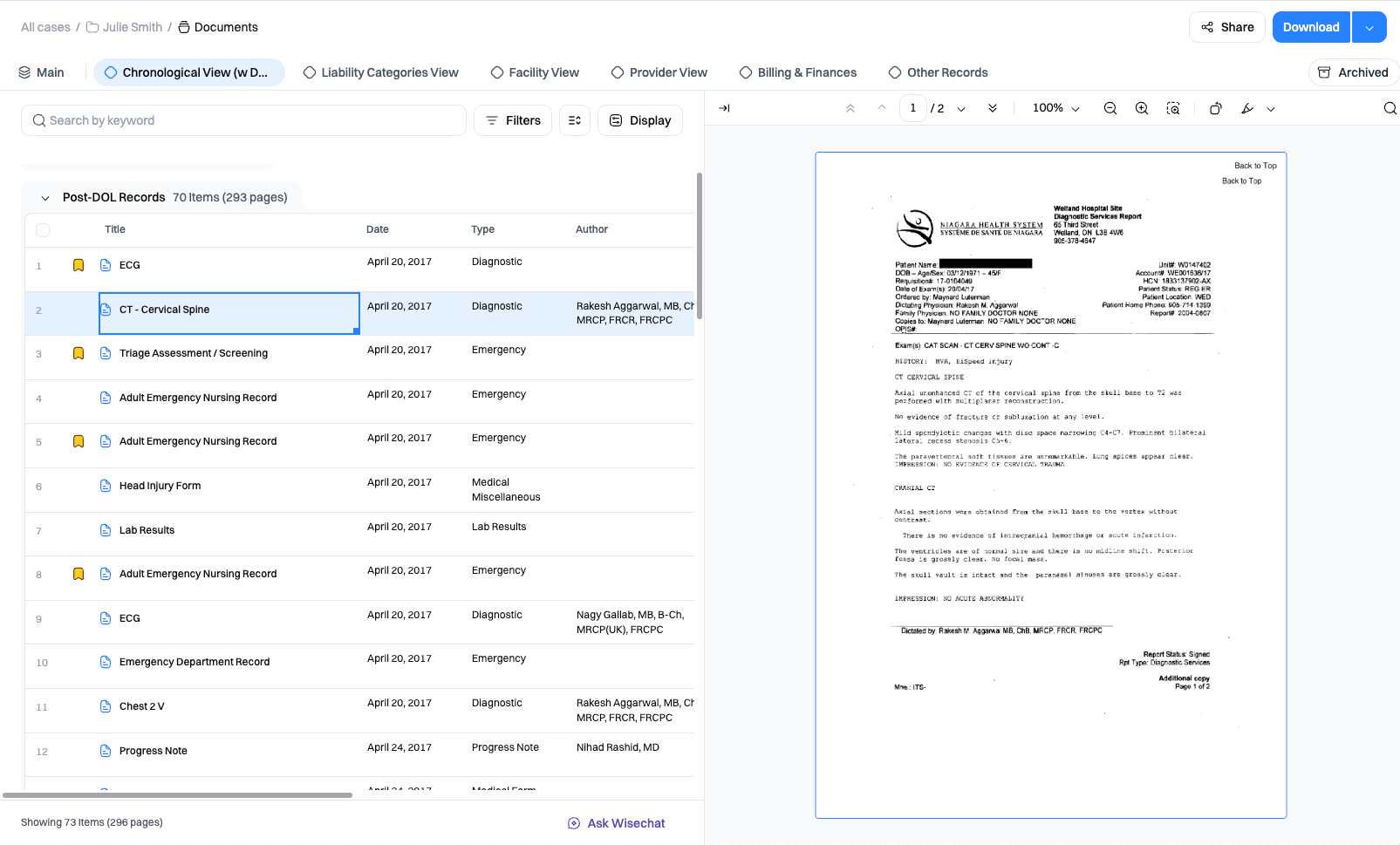
The platform uses domain-specific artificial intelligence to index, deduplicate, and summarize complex medical records while maintaining rigorous security standards. Our AI was trained on 150 million medical claims records, and we use entity extraction and data tagging during medical claim indexing for analysis that ensures no piece of data is missed or overlooked.
You can read more about how teams use these tools in our guide on AI medical record review defensibility.
Core features include:
- Achieved SOC 2 Type II attestation with zero audit findings, demonstrating continuous processing integrity, data security, and privacy.
- Maintains full HIPAA and PIPEDA compliance through an audited security program built specifically for handling sensitive health data in insurance workflows.
- Features WiseShare to provide encrypted document exchange, permission-based access, and user-level activity logs for a complete audit trail during legal reviews.
- Uses specialized AI case analyzers to cross-reference medical records and legal documents such as demand letters against medical data sets, flagging inconsistencies, gaps, and potential fraud risk.
- Incorporates human-in-the-loop reviews for defensible and compliant AI insights that meet the NAIC guidelines adopted across 29 states
"One of the things that people are not really looking at is who actually owns the decision or outcome that's made from AI. Is it the carrier themselves or is a third-party provider? What states are saying is it's not the third party provider, it's the carrier because they are holding the underlying final decision and the final risk. And a lot of that gets lost in translation." Mark Tainton, SVP Data & Global Ops, Wisedocs
We know that Wisedocs might not suit every team, especially organizations that only need general property estimating or basic billing tools without deep medical record analysis. If you need a different focus, several other compliant platforms are worth considering.
FraudOps
FraudOps is a specialized investigation platform designed to identify and resolve suspicious healthcare claims. Instead of forcing investigators to navigate multiple systems, spreadsheets, and logins, the software consolidates detection tools and case management into a single workflow.
The platform safeguards patient data during fraud reviews by using role-based access controls and end-to-end encryption for stored and transmitted files. Automated policy checks and detailed user activity logs give insurance carriers the evidence required to prove compliance during regulatory audits.
RapidClaims
RapidClaims provides automated medical coding software that processes clinical charts and encounter documents before claim submission. Its core engine, RapidCode, reads encounter files, identifies documentation gaps, and applies specific payer rules to scrub claims before they reach the clearinghouse.
The platform meets SOC 2 Type II and HIPAA standards while preparing for HITRUST certification. Each generated code links directly back to the specific line in the medical chart, giving claims administrators a fully auditable trail for every code assigned.
CLARA Analytics
CLARA Analytics offers casualty claims intelligence tools that help risk professionals and adjusters manage loss costs and litigation exposure. Its document intelligence module scans complex medical files to extract critical details, identify prior conditions, and forecast settlement trajectories.
The system protects sensitive information by maintaining SOC 2 Type II certification and strict HIPAA compliance protocols. The underlying machine learning models encrypt data at rest and in transit, omitting personally identifiable information during model training to reduce algorithmic bias.
Riskonnect Claims
Riskonnect Claims is an enterprise claims management tool that manages the entire lifecycle of a claim from initial intake to final settlement. It integrates data across multiple internal and external sources to automate routine tasks, streamline administrative workflows, and shorten claim durations.
The software supports workers' compensation predictive modeling alongside broader risk management features. Its security framework includes SOC 2 Type II certification, ISO 27001 alignment, and HIPAA compliance verification to ensure secure data handling across complex organizations.
Checklist for confirming HIPAA and SOC 2 compliance
Evaluating vendor claims analytics software requires checking specific security evidence rather than trusting marketing badges on a website. You can learn more about how Wisedocs meets these requirements in our buyer's guide to claims documentation platforms.
- Require a published SOC 2 Type II report.
- Execute a formal Business Associate Agreement (BAA).
- Verify encryption standards across all connections. Look for AES 256-bit encryption for stored records and TLS 1.2 or higher for transferred data.
- Enforce role-based access controls and user activity logs.
- Confirm human expert review for automated outputs.
- Align with evolving state artificial intelligence governance.
FAQs
What is the difference between HIPAA compliance and SOC 2 Type II certification?
HIPAA is a federal regulatory standard in the United States that governs how protected health information must be handled, stored, and transmitted. SOC 2 Type II is an independent audit framework created by the American Institute of Certified Public Accountants that evaluates a vendor's security, confidentiality, and availability controls over a sustained period.
Can insurance analytics software be compliant without a Business Associate Agreement?
No. A software vendor cannot legally process protected health information for a regulated entity without executing a formal Business Associate Agreement, regardless of the security features built into the application.
Why is human verification necessary for compliant artificial intelligence claims software?
While HIPAA and SOC 2 regulate data security and access controls, they do not guarantee the factual accuracy of artificial intelligence outputs. Human review ensures that extracted medical facts and generated claim summaries are accurate, traceable, and legally defensible before a carrier makes a coverage or settlement decision.
Who bears the legal risk for decisions made using claims analytics software?
Insurance carriers retain the final legal liability for claim outcomes, coverage determinations, and regulatory compliance. State insurance commissioners hold the regulated carrier responsible for decisions, even when those decisions rely on third-party software or automated tools.
Sources:

.png)