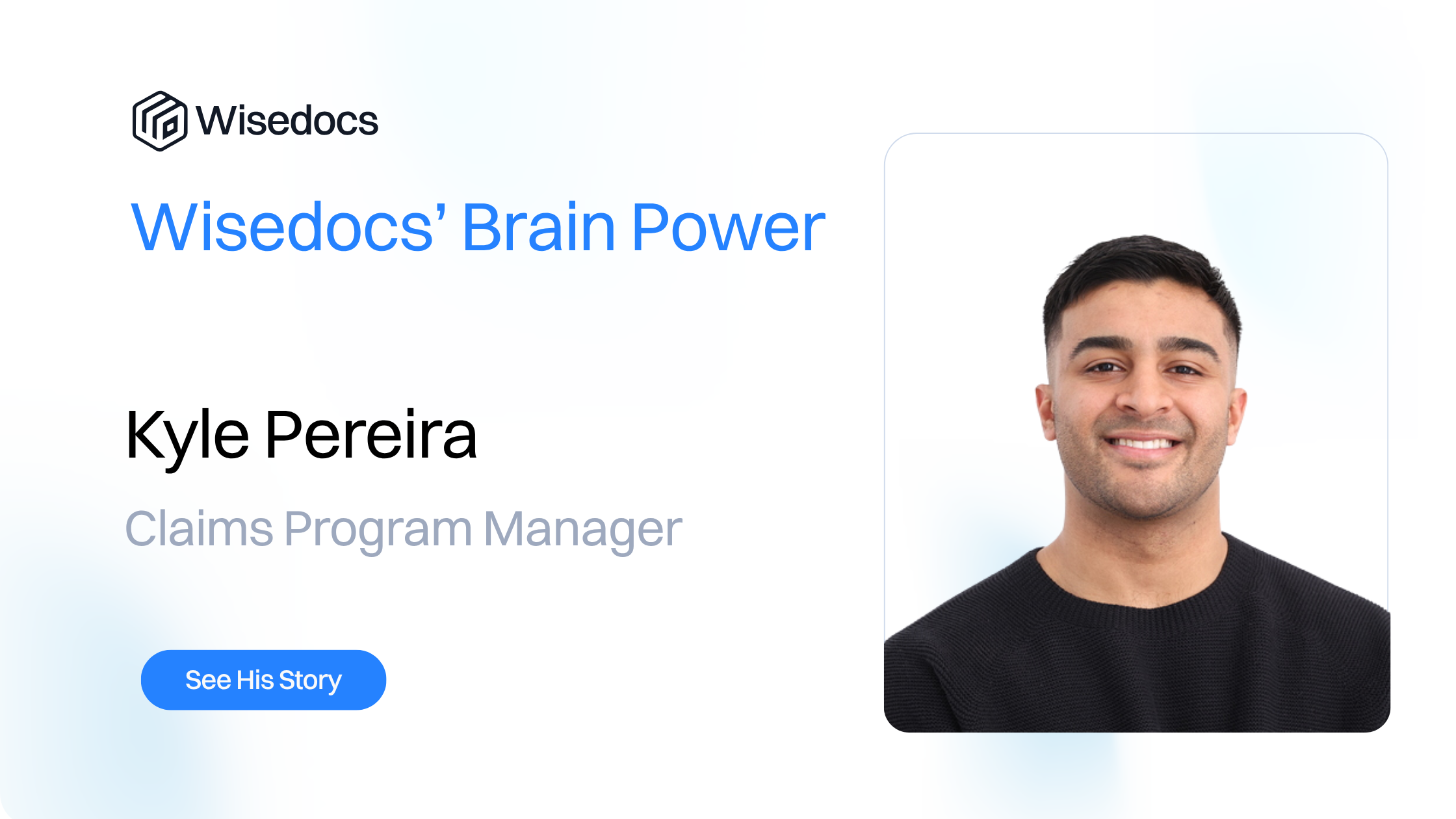
At Wisedocs, our Brain Power series gives us a chance to spotlight the people helping shape our team, our culture, and the future of claims decision intelligence. Recently, we introduced you to Aryan Dhar, Machine Learning Engineer. Today, we’re featuring Kyle Pereira, Claims Program Manager at Wisedocs. In his role, Kyle works closely with claims organizations to understand what they need from AI-powered technology, where their teams are feeling pressure, and how Wisedocs can help bring more clarity and confidence to complex claims workflows. With a thoughtful, people-first approach, Kyle brings a valuable perspective on what buyers are asking for in market, what makes Wisedocs different, and why the work continues to feel meaningful.
Tell us about your path to Wisedocs, what drew you to the insurance and claims space. What made you want to be part of solving this particular problem?
“What drew me to this space was never really about the industry itself in the traditional sense. It was about the people on the other side of every claim. These aren’t just files or case numbers. They’re real people navigating some of the hardest moments of their lives, a workplace injury, a long recovery, a dispute over what they’re owed. The decisions that get made in this process have a direct and lasting impact on someone’s outcome." - Kyle Pereira, Claims Program Manager
"That’s what pulled me toward Wisedocs specifically. Creating fair, accurate, and positive outcomes for claimants isn’t a marketing line for this company. It’s the reason it was built in the first place. When I understood that the core mission was about restoring integrity and speed to a process that affects millions of people, it wasn’t a hard decision. I wanted to be part of that.”
What makes you excited about the work you're doing at Wisedocs, and what does it actually take to help a claims organization go through a transformation like this?
“What excites me most is the scope of the impact. Wisedocs isn’t a point solution. It has the potential to transform the entire operational model of a claims organization across the full lifecycle of a claim, whether the goal is faster cycle times, better compliance, cost reduction, or all three at once. That breadth is rare." - Kyle Pereira, Claims Program Manager
"The market is competitive, and there are a lot of vendors moving quickly in this space. What sets Wisedocs apart is the discipline behind what we build. Every output we produce has to be accurate, compliant, auditable, and defensible, because our customers are making clinical and legal decisions based on it. That’s a standard many claims document automation and AI vendors are not held to, and honestly, one many cannot meet. Being part of a team that takes that responsibility seriously, and earns customer trust because of it, is something I don’t take for granted.”
That same discipline is reflected in Wisedocs 2.0, our Claims Decision Intelligence platform built to help claims teams move from document intake to decision support with greater speed, precision, and confidence. Through solutions like WisePrep, WiseInsights, WiseShare, and WiseChat, Wisedocs helps organizations prepare decision-ready files, identify claim-level patterns, collaborate securely, and ask questions across complex medical records.
Give us a day in the life of a Claims Program Manager: what’s your 9-5 look like?
“Honestly, the 9 to 5 framing doesn’t quite fit the job. Our customers span the US, Canada, and Australia, so my day often shifts depending on who I’m working with. I’d rather meet customers where they are than ask them to fit into my schedule.
No two days look the same. Some are spent in discovery conversations with new prospects, understanding their operations, pain points, and where accuracy or productivity may be slipping. Other days involve supporting customers through implementation or helping leadership teams understand the ROI of expanding with Wisedocs. There’s always outreach, follow-up, and learning, because you can’t be a credible partner to claims leaders without staying close to what’s happening in their world.”
Wisedocs brings this customer-first mindset into its broader market education efforts, including CLM Tech Talks and resources on California workers’ compensation, QME, IMR, UR, AI medical record review, and reliable claims decisions. Recent conversations at the CLM Workers’ Compensation Conference reinforced what Kyle hears in market every day. Claims leaders are not only asking what AI can do. They are asking how it can be trusted, audited, and defended in real claims workflows.
At the center of it all is one question. How do we give this customer a better experience? Everything else flows from that.
You partner with claims organizations to streamline their claims decision intelligence processes. What are the biggest pain points you're hearing in the market right now?"
“The conversation happening in the market right now is really about the compounding pressure claims organizations are under. On one side, you have the sheer volume and complexity of medical records, IME packages, treating physician notes, and demand letters that adjusters are expected to read, organize, and synthesize before making a single decision. Research shows claims professionals can spend 40 to 60% of their time on document work alone before any actual claim decision happens. That’s not sustainable.
On the other side, there’s growing urgency around defensibility. As AI starts showing up in litigation, from AI medical summaries entering workers’ comp proceedings to plaintiff attorneys adopting new tools faster than the defense bar, claims leaders are asking serious questions about what they can actually stand behind. States like California are already moving on regulatory frameworks, and other jurisdictions are watching closely."
"The organizations we talk to are not just asking if AI works. They’re asking if they can defend it in court, in an audit, and in front of a regulator. That’s the question we’re built to answer.” - Kyle Pereira, Claims Program Manager
This is also the focus of Wisedocs’ recent work around AI you can defend, including Itay Mishan’s presentation and article on what high-stakes claims demand from AI. In claims, a polished medical record summary is not enough. Teams need medical record summaries, medical record chronologies, and AI medical record review outputs that can be traced back to the source record. As Itay shared, “black box” AI becomes a liability when teams cannot show where an output came from.
The market is moving beyond basic AI medical record summarization. Claims leaders are looking for a claims intelligence platform that can support claims processing automation while keeping outputs traceable, reviewable, and audit-ready across the claims lifecycle.
When you're talking to a claims leader who's evaluated various AI vendors, what's the moment they realize Wisedocs is doing something genuinely different?
“It usually happens when we walk them through the architecture and show how we go from raw, unstructured medical records to a defensible, cited, auditable output. Most of what they’ve seen before is an LLM wrapper with a clean interface. That might look impressive in a demo, but when a claims leader starts asking hard questions about clinical oversight, source-linked evidence, and what happens when the model is wrong, those products don’t hold up.
With Wisedocs, they can see the auditability. Every finding is cited back to the source document. Every output is built for enterprise accountability, not just convenience. We have genuine clinical expertise embedded in how our models are trained and validated, not as a feature, but as a design principle. By the end of the conversation, the shift is usually the same. They came in evaluating an AI tool and they leave realizing they’ve been talking to a clinical and legal decision-support platform. That’s a very different thing, and it’s the right tool for the decisions that actually matter.”
Wisedocs’ work with Claude Managed Agents reflects this same focus on verifiable outputs, quality, and accountability. Through early access to Claude Managed Agents, the team built Agentic Document Verification to support quality assurance for documents generated by its insights engine. Paired with human review, this system helped auditors complete file audits 50% faster and catch 30% more mistakes compared to the human baseline.
For someone who wants to work at the intersection of technology and customer impact, what makes someone great at this kind of role?
“The trap in this kind of role is thinking that knowing the product deeply is enough. It’s not. The best people I’ve seen in this space are the ones who lead with curiosity about the customer’s world, their workflows, their regulatory environment, their internal pressures, and what success actually looks like for the person they’re talking to versus the organization they work for.
There’s no single template. A self-insured employer, a TPA, and a national carrier may all operate in the claims space, but they face very different problems. The ability to adapt, ask the right questions, and build a solution story that fits that specific customer is what separates good from great. You also have to be comfortable not having all the answers, because this industry is evolving quickly. The willingness to keep learning, and to bring that knowledge back to the customer in a way that helps them trust you as an advisor, not just a vendor, is the foundation everything else is built on.”
Kyle captures exactly what customers can expect from Wisedocs. Our team of experts listens first, dives deep into each organization’s workflows and goals, then helps claims leaders see how claims decision intelligence can support clearer, faster, and more evidence-backed decisions.
Wisedocs Claims Decision Intelligence helps teams move from raw medical records to source-linked medical record summaries, medical record chronologies, and decision-ready outputs across the claims lifecycle.
See how Wisedocs can help your team bring trust and expert oversight into AI-powered medical record review today and book a call with one of our experts.

.png)