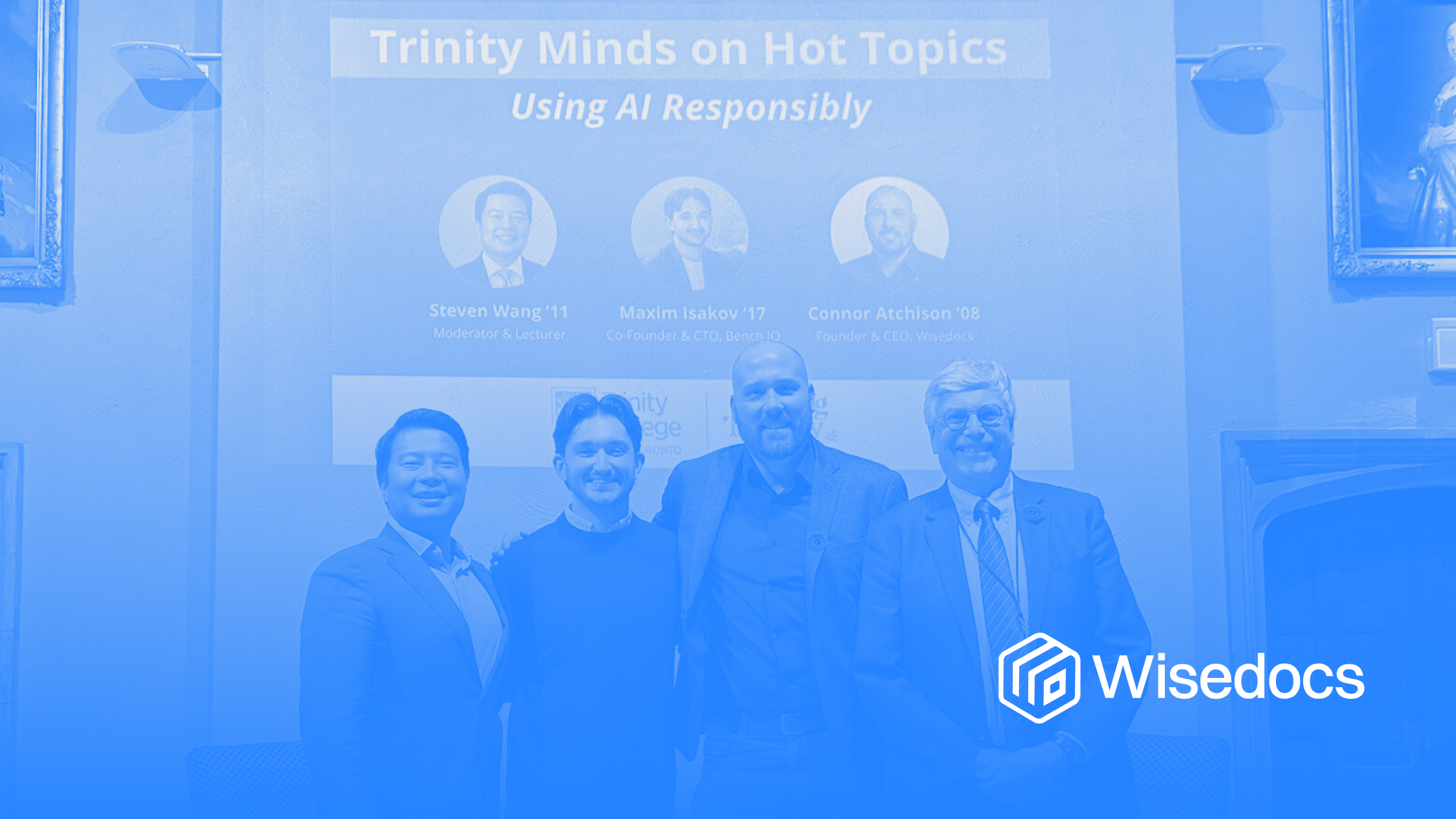
At the tail end of 2025, Wisedocs’ CEO Connor Atchison visited his alma mater Trinity College for its Trinity Minds on Hot Topics series on Monday, November 10. With the help of corporate attorney and Harvard Law School lecturer Stephen Wang, who acted as moderator, Connor sat down with Maxim Isakov, CTO of Bench IQ for a compelling discussion on responsible AI. The discussion spanned industries like insurance, law, and enterprise technology, with one consistent theme – poor information workflows are one of the biggest drivers of delay. Here is what we learned:
Moving Beyond “AI Must Be Perfect”
The medical documents used in claims environments are inherently messy, imperfect, and sometimes inconsistent. Claims can take years thanks to regulatory requirements, inconsistent recordkeeping, and messy medical histories – but AI should not be used to diagnose, decide, or judge. The true value in AI, Connor suggested, was in organizing complexity for human users. With the power of AI, human experts can organize, sort, and process documents faster than they would be able to do otherwise. In insurance and legal contexts, highly trained professionals can reason through documents much faster with AI assistance than without it.
“For me, the big thing is experts-in-the-loop,” Connor said. “When you have the right experts involved and there’s oversight, AI can actually accelerate progress in every industry. That’s what’s exciting about this panel: we’re talking about AI in the presence of domain experts — judges, lawyers, claims professionals, doctors — not as some magical replacement for them.”
Inefficiencies Cause Delays, with Real Human Impact
Both panelists highlighted the fact that traditional workflows weren’t designed for data volumes today. In insurance and legal contexts, employees still spend much of their time reviewing documentation by hand, searching for key events, and identifying information that is inconsistent. These inefficient workflows don’t just slow things down – they increase the risk of errors, missing pages, or duplicated documents. When professionals are forced to rush through messy, disorganized information, they dramatically decrease their efficiency and increase the chance of error. This has real legal and financial consequences.
In claims, poorly structured medical records & medical chronologies create unnecessary friction between the insurers, legal teams, claims teams, and claimant. With technology, though, the user can speed up workflows without sacrificing the human component. AI tools can hone in on the right information and help the human user zero in on details, without making the final call. Maxim argued that this is essential: “ultimately, [the user is] going to verify anything we produce — they have a fiduciary duty to do that.”
Connor agreed. “If we build AI with that in mind — as an accelerator for humans rather than a replacement — it’s like going from typewriter to computer or horse-and-buggy to car. The analogy I use is: build smart systems with smart frameworks, but keep the human at the centre.”
Building Trust in AI
On the topic of trust, Connor spoke to the panel about the 2025 Wisedocs Survey Report, an independent study of users across the claims industry. He pointed out that without a human in the loop, only about 16% of respondents said they trusted AI enough to use it. With a human in the loop, that number jumped to 60% – for a 4x increase in trust. In an industry like claims, where human experts need refined, verifiable data, human insight is a trust multiplier.
“I was on a panel with Judge Rassp and he said his biggest frustration with AI is “black box” models. You can’t walk into a courtroom and say, “The AI said so,” and expect that to be acceptable. You have to show how it reached that conclusion. Responsible AI is about making that trail visible.”
With an obvious tension right now around innovation and regulation, AI is finding its balance. Too much focus on building the company adds risk to compliance, but focusing too much on compliance means you have no opportunity to innovate. The panel made it clear that balance is a priority – as well as trust, and reliability. AI in claims is not about replacing experts – just giving them cleaner inputs, better visibility, and giving them back more of their time.
To learn more about how Wisedocs is implementing responsible AI-driven workflows for enterprises, while keeping experts-in-the-loop for defensible results, speak to one of our experts today.

.png)