The headlines warning of an AI apocalypse have been hard to miss. Since Chat GPT launched in November 2022, concerns about artificial intelligence eliminating jobs have dominated workplace conversations. Yet, nearly three years later, the data tells a different story: AI isn’t causing mass unemployment; it’s actually making workers more productive.
Recent research from Yale University’s Budget Lab and the Brookings Institute examined 33 months of labor market data following ChatGPT’s release and found no evidence of widespread job displacement due to AI. The study measured changes in how workers are distributed across available jobs in the economy and concluded that the broader labor market has not experienced a discernible disruption since ChatGPT’s release, contradicting fears that AI automation is currently eroding demand for cognitive labor. While this doesn’t necessarily mean the labor market is thriving, the research is clear: AI isn’t the culprit behind current employment challenges.
Technology Takes Time
History offers essential context. Widespread technological disruption in workplaces tends to occur over decades, rather than months or years. When computers and the internet emerged, similar anxieties arose. Yet by 2002, only 7% of workers needed to switch occupations to keep pace with the labor market. The current shifts in job composition since 2022 follow a remarkably similar trajectory, suggesting AI’s impact is unfolding at a typical pace for new technology.
The Productivity Story
Ultimately, AI has not caused job losses; it has delivered productivity gains. Research from the Federal Reserve Bank of St.Louis surveyed workers in August and November 2024 and found compelling evidence of time savings:
Among workers who used generative AI within the week of the survey:
- 20.5% saved four hours or more per week
- 20.1% saved three hours
- 26.4% saved two hours
- Average time savings: 5.4% of work hours
For someone working a standard 40-hour week, that 5.4% translates to roughly 2.2 hours saved weekly – time that can be directed toward higher-value tasks. More frequent users reported even greater benefits, with 33.5% of daily AI users saving four hours or more per week.
This aligns with what claims professionals are experiencing firsthand. In a recent survey conducted by Wisedocs and PropertyCasualty360 on Trust in AI & claims, 76% of respondents believe AI can boost efficiency by accelerating document handling and optimizing resources.
The most anticipated areas for AI improvement include:
- Document automation and data extraction (69%)
- Operational workflow automation (57%)
- Claims decision support (31%)
A Tool, Not a Replacement
Evidence suggests that AI functions best as a productivity amplifier rather than a workforce replacement. Workers are using AI to handle routine tasks, freeing them to focus more on strategic problem-solving, relationship management, and decision-making that require human judgment.
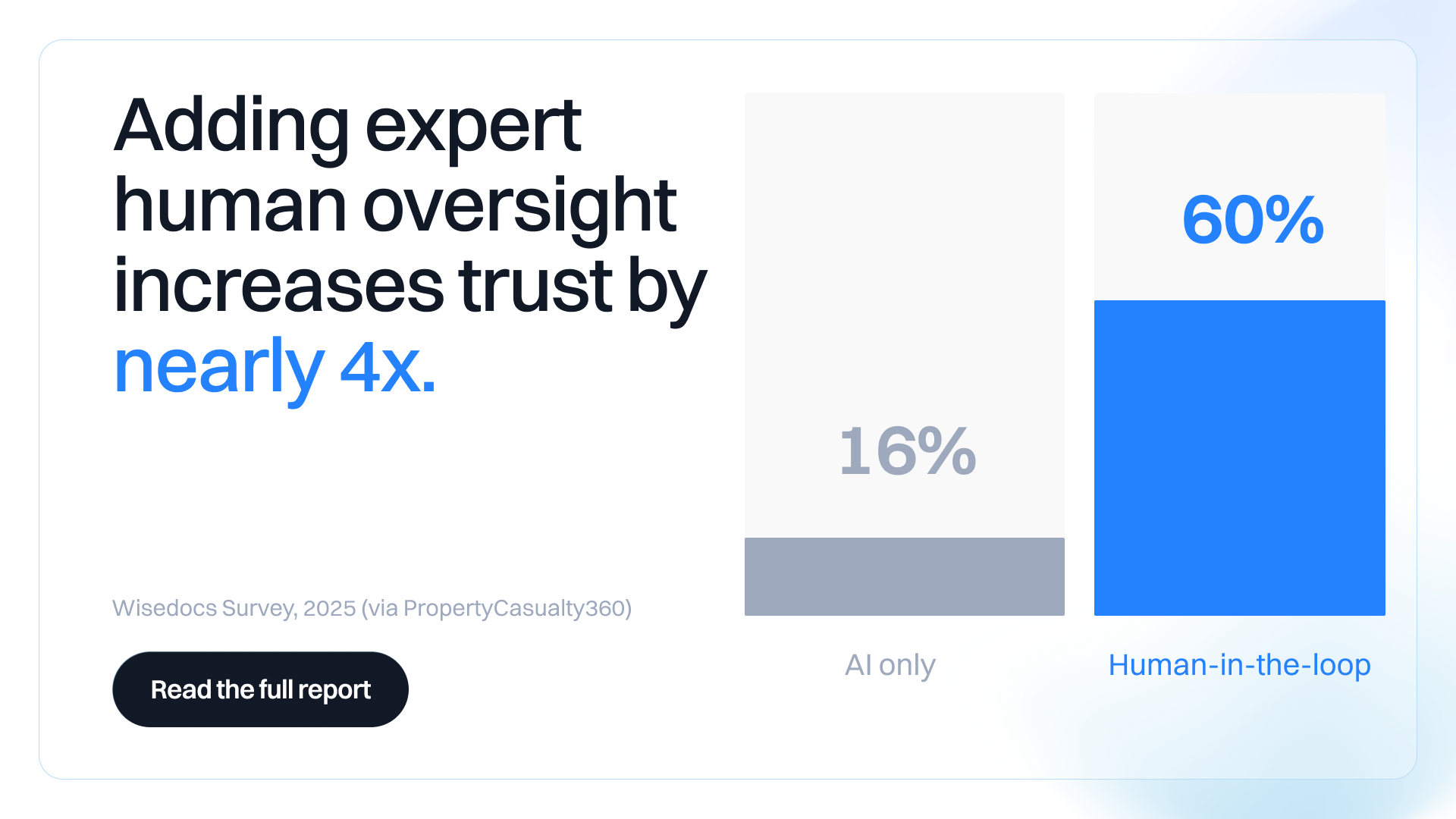
Wisedocs’ AI in claims oversight survey revealed another fascinating insight: trust in AI alone remains relatively low, with only 16% of claims professionals expressing medium or high trust in AI-generated outputs. However, with expert human validation added to the process, that trust level jumps to 60%, nearly a four-fold increase. This Human-in-the-Loop (HITL) approach appears to be the sweet spot, combining AI’s speed with human expertise.
Looking Ahead
The Yale-Brookings researchers acknowledge their analysis is not predictive of the future and plan to continue monitoring trends monthly to assess how AI’s job impacts might change. The technology is still evolving, and adoption remains in early stages across many industries.
What seems clear is that AI’s role is shifting from a feared job killer to a valued productivity partner. Organizations that embrace this reality stand to gain significant competitive advantages through improved efficiency. Workers who adapt by learning to work alongside AI tools, rather than competing against them, will likely find themselves more valuable, not less.
One thing remains clear: while the AI revolution changes the way we work, evidence suggests it will be a gradual evolution for the better than the dramatic displacement many fear.

.png)