Every claims adjuster knows the drill. 300 pages of medical records land on your desk, and buried somewhere in the discharge summaries, progress notes, and diagnostic reports is the one detail that makes or breaks the case. You could spend the next two days hunting for it, or you could find it in minutes. The difference isn’t luck or experience; it’s an AI medical summary that transforms how insurance carriers, legal teams, and TPAs cut through the noise to get to what actually matters.
What is an AI Medical Summary?
An AI medical record summary is an AI-enabled solution that extracts and condenses large volumes of unstructured medical data into clear, actionable insights. Unlike traditional manual review processes that require adjusters or paralegals to spend hours reading through hundreds of pages, AI for medical records uses advanced natural language processing to identify key clinical events, dates, diagnoses, treatments, and outcomes in a fraction of the time.
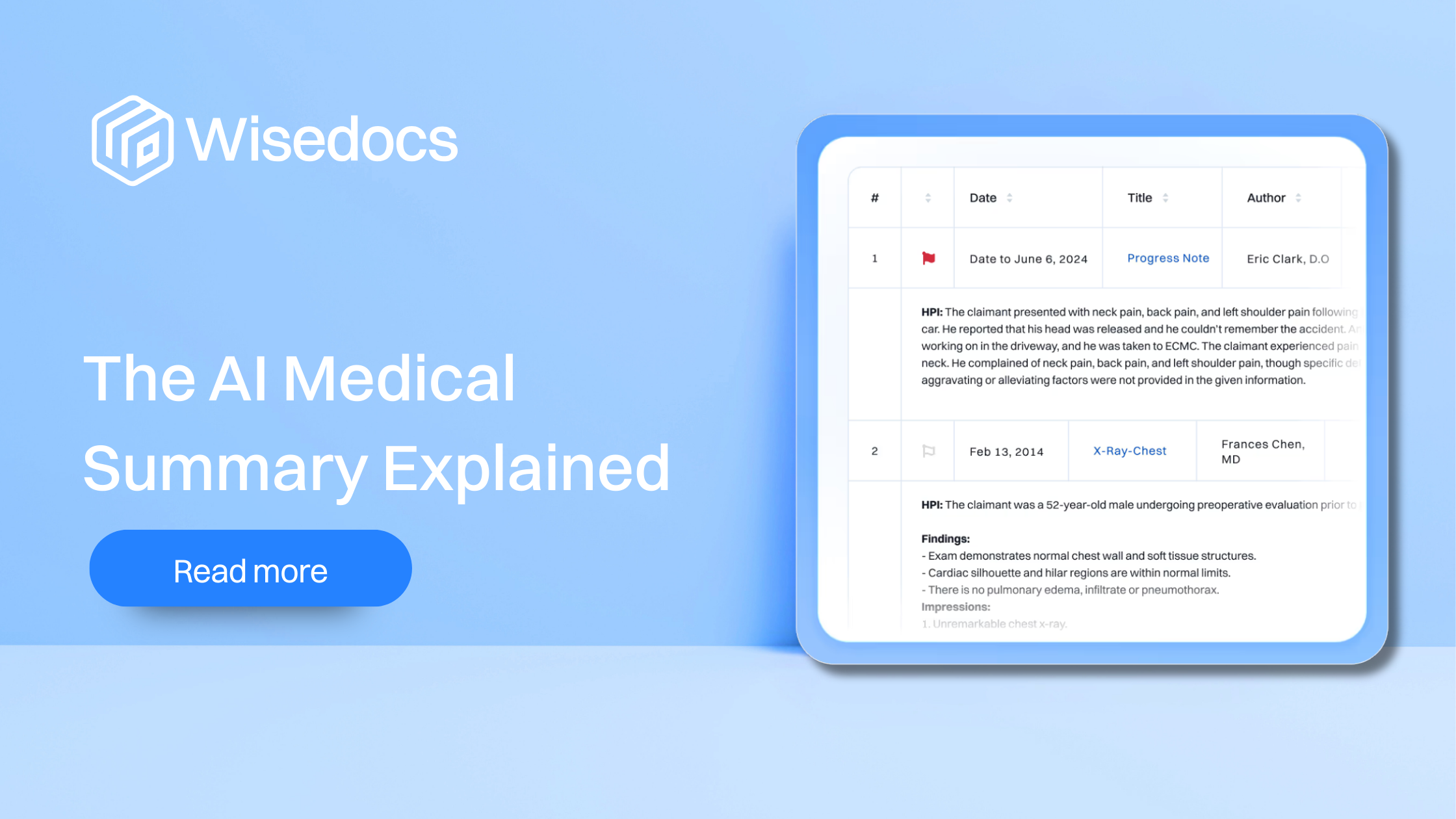
These systems can process everything from physician notes and imaging reports to pharmacy records and treatment plans. Medical report summary AI doesn’t just pull random sentences; it understands medical terminology, recognizes patterns across different document types, and presents information in formats that claims professionals can immediately use, such as AI medical chronologies, key facts in an AI medical summaries, or detailed medical record summaries per record.
How AI Medical Record Review Works
AI medical record review tools work by employing domain-trained algorithms specifically designed to understand healthcare documentation. When you upload medical records to a platform like Wisedocs, the domain-trained AI to summarize medical records scans each document, identifies relevant clinical information, and organizes it into structured outputs. The technology can generate an AI medical chronology timeline showing the patient’s journey, or produce focused summaries highlighting injury-related findings, treatment gaps, or pre-existing conditions.
What sets modern medical record summary tools apart is the Human-in-the-Loop (HITL) model. While an AI medical summary can surface and condense documents at unprecedented speed, expert reviewers validate the output to ensure accuracy and completeness. This combination addresses a critical trust gap: according to Wsedocs’ survey report with PropertyCasualty360, only 16% of respondents have medium or high trust in AI-generated output alone, with just 2% reporting high trust. However, when expert reviewers validate AI outputs, that number jumps to 60% – a nearly 4x increase in trust, with those having high trust rising from 2% to 22%.
Why an AI Medical Summary Matters for Claims Stakeholders
The benefits of an AI medical summary for lawyers, adjusters, and claims teams are substantial. First, there’s the speed factor. Traditional manual record retrieval and review can take days or even weeks, depending on complexity. With an AI medical summary, this process is reduced to hours or minutes, accelerating claim resolution and reducing cycle times. According to Wisedocs research, 75% of respondents believe AI can improve efficiency by optimizing resources.
Second, and AI medical summary delivers greater consistency and fewer errors. Human reviewers working under deadline pressure may miss details or interpret information differently. Medical record AI applies the same analysis to every case, flagging important clinical events and ensuring nothing falls through the cracks.
Third, these claims documentation platforms enable faster, better-informed decision-making. When claims professionals can quickly access an AI medical chronology or summarize medical records with AI-powered precision, they can assess liability, determine settlement values, and identify red flags much earlier in the claims lifecycle. This advantage is integral, given that 58% of survey respondents either do not use AI in their claims process or are unsure whether they do, indicating massive untapped potential.
Ready to Transform Your AI Medical Summary Process?
An AI medical summary represents the future of claims documentation by combining cutting-edge technology with human expertise to deliver faster, more reliable results. Whether you’re looking to reduce costs, accelerate case resolution, or simply gain better visibility into your claims, AI-powered medical record review is no longer optional.
Learn more about how Wisedocs’ domain-trained AI platform can streamline your claims workflow. For first-time buyers evaluating your options, check out the Wisedocs Buyer’s Guide to make an informed decision for your organization.

.png)