
Choosing a medical record review platform for your law firm means evaluating how much work it takes off your team’s plate against the accuracy of the tool’s outputs. Processing speed is part of that decision, but so is the time spent turning the results into something you can use. A medical record summary delivered in minutes offers limited savings if your paralegals still spend hours finding supporting notes or rebuilding the treatment history.
You also have to choose a platform that fits your cases, record volume, and deadlines. Claims decision intelligence platforms like Wisedocs can reduce preparation and verification work by combining organized medical histories, summaries with source references, expert checks, and analysis of conflicting accounts.
Here’s how to identify your bottlenecks, evaluate capabilities, and compare providers through a demo or trial.
How to identify bottlenecks in your medical record review process
Start by reviewing your recent cases in order to identify where your attorneys and paralegals spent the most time. Some common bottlenecks in claims processing are:
- Uploading records, sorting documents, removing duplicates, and grouping records by provider or document type.
- Reconstructing treatment histories into treatment timelines.
- Verifying summarized findings against original notes.
- Investigating conflicting accounts or missing reports.
- Preparing summaries focused on the injuries and disputed facts relevant to counsel or medical experts.
Understanding these bottlenecks helps you prioritize the platform capabilities that will make a difference.
What should you evaluate in a medical record review platform?
Once you know where your team needs to save time, the next step is to assess how well each platform performs that work. For legal teams, the quality of the results matters throughout case preparation, especially when you need to rely on them in an argument.
As Alexander Temelkovski, Head of Enterprise Programs at Wisedocs, explains:
“I’ve never met a lawyer who said 95% is okay when it comes to being accurate. Because it’s either right or it’s [wrong]. The practice of law is about precision. There’s nuance in there, but you need to know what the 5% that’s off consists of…”
Whether entity extraction happens before or after document processing
Entity extraction is the process of identifying and pulling data out of unstructured files. It isolates specific data points like facility names, treatment types, diagnoses, and diagnostic codes directly from the source pages.
And the order of this step matters. Generic AI platforms often run raw documents through a language model first to generate a quick summary. This approach risks compressing vital information out of existence or confusing conflicting facts.
Extracting structured entities before summarizing is key to ensuring that every fact is tagged and verified up front.
Doing this accurately requires domain-trained machine learning models that recognize an array of document templates. A medical packet might list ten different dates on a single page, including treatment dates, fax timestamps, and birth dates. Specialized models pinpoint the correct data points across changing layouts so critical details don't get mixed up.
How easily you can investigate specific medical details or AI insights
When you're preparing a case, you need to verify facts fast. Every summary or insight must link directly back to its source page in the original record. With page-level source citations, when an output flags a pre-existing condition, you can click the reference and verify the text immediately.
A good platform also lets you query the file directly. Instead of skimming hundreds of pages to find out if a claimant lost consciousness, you can use an AI chatbot for medical records to ask direct questions. You'll get a clear, cited answer using the records you uploaded, with links to the source page for verification.
Custom reporting then turns those answers into usable work product. Different claims require different details, so your team should be able to run tailored analyzers. For instance, if you need an audit of medical bills or a targeted synopsis for defense counsel, custom reports would summarize the relevant information in documents that you can export or share.
Who reviews the medical information, and how corrections are handled
If an AI medical summary lists a suspected diagnosis as a confirmed one, it's going to derail your defense strategy. That’s why you need to know how the software’s human review process catches mistakes before the file hits your desk.
It helps to evaluate who performs the review, their medical qualifications, and which pages they examine. You'll also want clarity on what triggers a manual check and whether human-in-the-loop review comes at an extra cost.
The platform should also notify your team whenever a summary changes. If a reviewer updates a "confirmed fracture" to a "possible fracture," seeing that edit right away keeps you from briefing an expert or building an argument around outdated details.
How Wisedocs handles medical record review for legal teams
Wisedocs is an AI-powered claims decision intelligence platform built for complex medical claims. It uses domain-trained machine learning models alongside expert human review to turn thousands of unstructured medical, legal, and billing pages into structured chronologies and analyzers.
The platform is designed specifically for defense law firms, insurance carriers, and independent medical evaluators. It gives adjusters and defense counsel the page-level source citations and audit trails they need to make fast, defensible decisions.
You can use Wisedocs to:
- Organize treatment histories. The platform handles record review processing of up to 500,000 pages at a time to produce searchable medical chronologies.
- Verify medical summaries. Our expert-in-the-loop process flags documents below the AI confidence threshold for medical industry specialists.
- Investigate cited findings. WiseInsights flags potential inconsistencies, treatment outliers, and billing anomalies. WiseChat answers questions about the file with supporting references.
- Prepare tailored reports. Select and organize findings around the injuries, treatment periods, or disputed medical issues relevant to each reviewer. Edit the content and export Custom Reports as Word documents or PDFs.
- Control access to shared records. WiseShare provides permissions and activity tracking. Wisedocs holds SOC 2 Type II attestation and supports HIPAA-compliant processing.
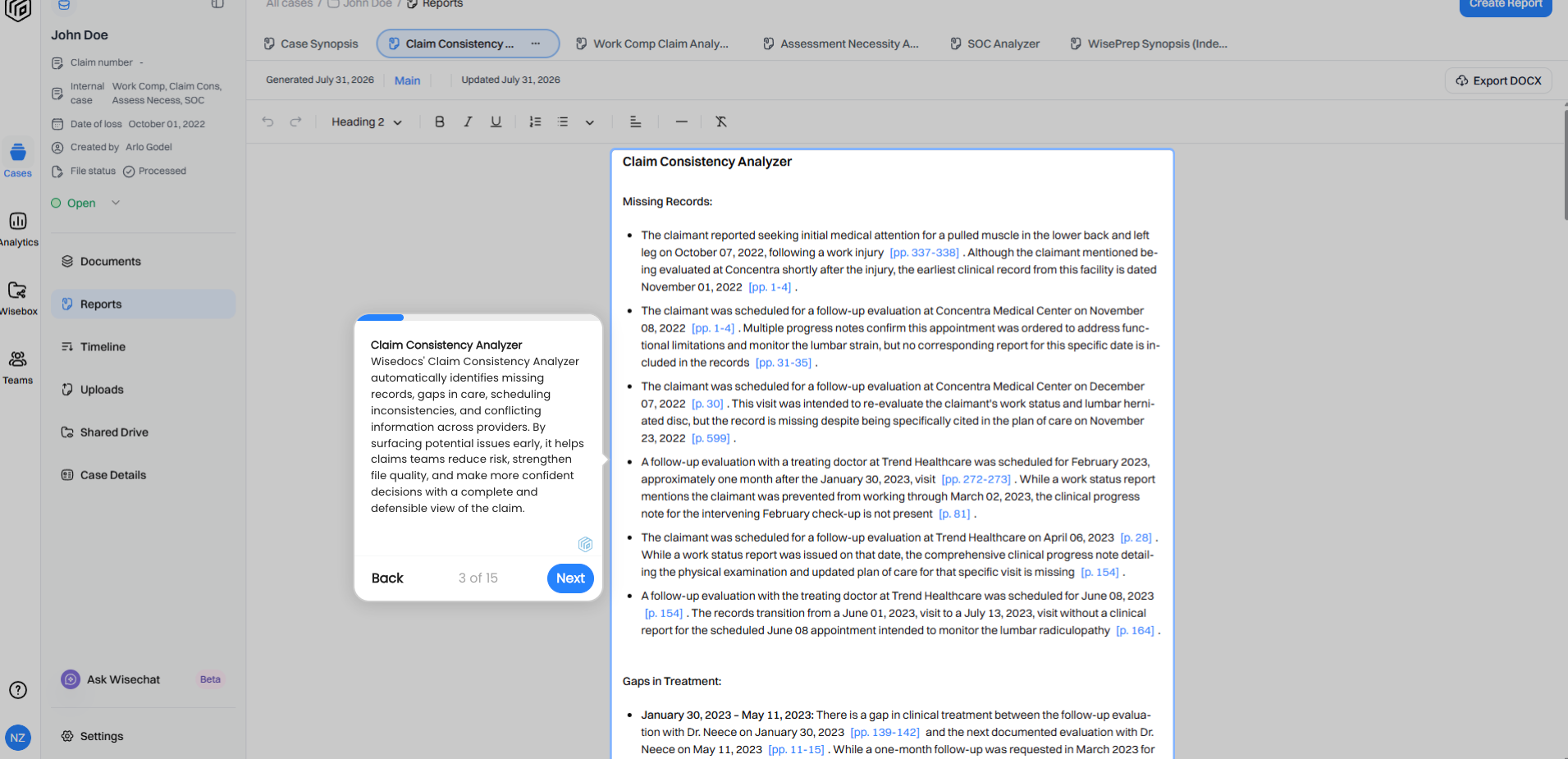
Example of Wisedocs’ Claim Consistency Analyzer identifying potentially missing medical records, with source references attorneys can check before requesting additional documentation.
Choose a platform that fits your firm’s typical cases and workload
The medical record review platform you choose should reduce preparation and correction time, make supporting records easy to find, and fit your law firm’s workload and budget.
A specialized AI platform like Wisedocs can help your team automatically organize medical files, verify findings faster, and prepare reports for colleagues and medical experts.
FAQs
How do I compare platforms for plaintiff work versus insurance defense?
Evaluate the documents your team needs to produce and the questions they need to answer. A plaintiff firm could prioritize turning treatment history and medical expenses into a demand package. A defense team could need to compare that demand with prior medical history or deposition testimony. Ask providers to demonstrate your firm’s task using the relevant document types.
What should I ask during a medical record review software demo?
Ask what happens when records are added after the initial file has been processed. Find out how the chronology is updated and how your team can identify new information. Also ask the provider to show how a user corrects an error and how that correction appears in subsequent reports.
How can I calculate whether a platform will save my firm money?
Estimate the staff hours currently spent preparing and reviewing a typical file, then apply your internal staff cost per hour. Compare that amount, plus outsourcing fees, with software charges and the staff time still required after processing. Repeat the calculation for larger files so usage limits and overage fees are reflected.
Do medical record review platforms include human review?
The service varies by provider. Some review selected outputs based on AI confidence scores; others offer professional review as a separate service. Establish exactly what is included, the reviewers’ qualifications, and the effect on turnaround. Your firm needs to know which work has already been performed before assigning its own reviewers.
What security documentation should I request from a provider?
Request the current SOC 2 Type II report, data handling policies, and a Business Associate Agreement where required. The contract should explain how long records are retained, how deletion is handled, and how client data is used. Have the person responsible for your firm’s security review those terms before uploading client files.

