Workers' compensation claims teams deal with a mountain of paperwork every single day. That heavy reading burden stalls return-to-work plans and drives up handling costs. In fact, claims professionals typically spend between 40% and 60% of their working hours just sorting, reading, and searching through medical files before making a single decision on a claim.
Platforms like Wisedocs solve this issue by surfacing critical clinical insights from complex medical records, helping teams pinpoint treatment gaps, and flagging inconsistencies while keeping every decision fully defensible.
"The workers' compensation industry has spent decades optimizing the speed of claims processing automation. AI is now exposing the difference between processing work faster and making better claim decisions. Those are not the same thing."
Mark Tainton, SVP Data & Global Ops at Wisedocs
A quick comparison table: the top insurance claims analytics software platform
What makes a strong insurance claims analytics software platform for workers’ comp claims
Evaluating the right platform requires looking closely at how effectively a system handles dense medical files, safeguards sensitive data, and verifies clinical findings.
Here are the features to look for:
- Entity extraction at indexing: A strong platform pulls out key details before any AI processing and tags diagnoses, treatments, procedure codes, and medications right away. This ensures the maximum possible amount of data is categorized and stored for future insights and analysis by claims teams.
- Secure collaboration: Workers' comp files move constantly between claims adjusters, nurse case managers, defense lawyers, and medical evaluators. Platforms must offer secure, permission-based workspaces with full audit logs. Everyone works from a single source of truth while meeting strict HIPAA, PHIPA, and PIPEDA privacy standards.
- Accurate and defensible insights: Generic AI models often make factual mistakes or smooth over missing details. In a contested workers' comp case, an unverified summary can ruin a legal defense, so specialized AI with clinical quality checks to deliver verified facts is essential.
Read more: How independent medical evaluators handle complex file reviews
Comparing the top insurance claims analytics software platform for workers’ comp claims
Wisedocs
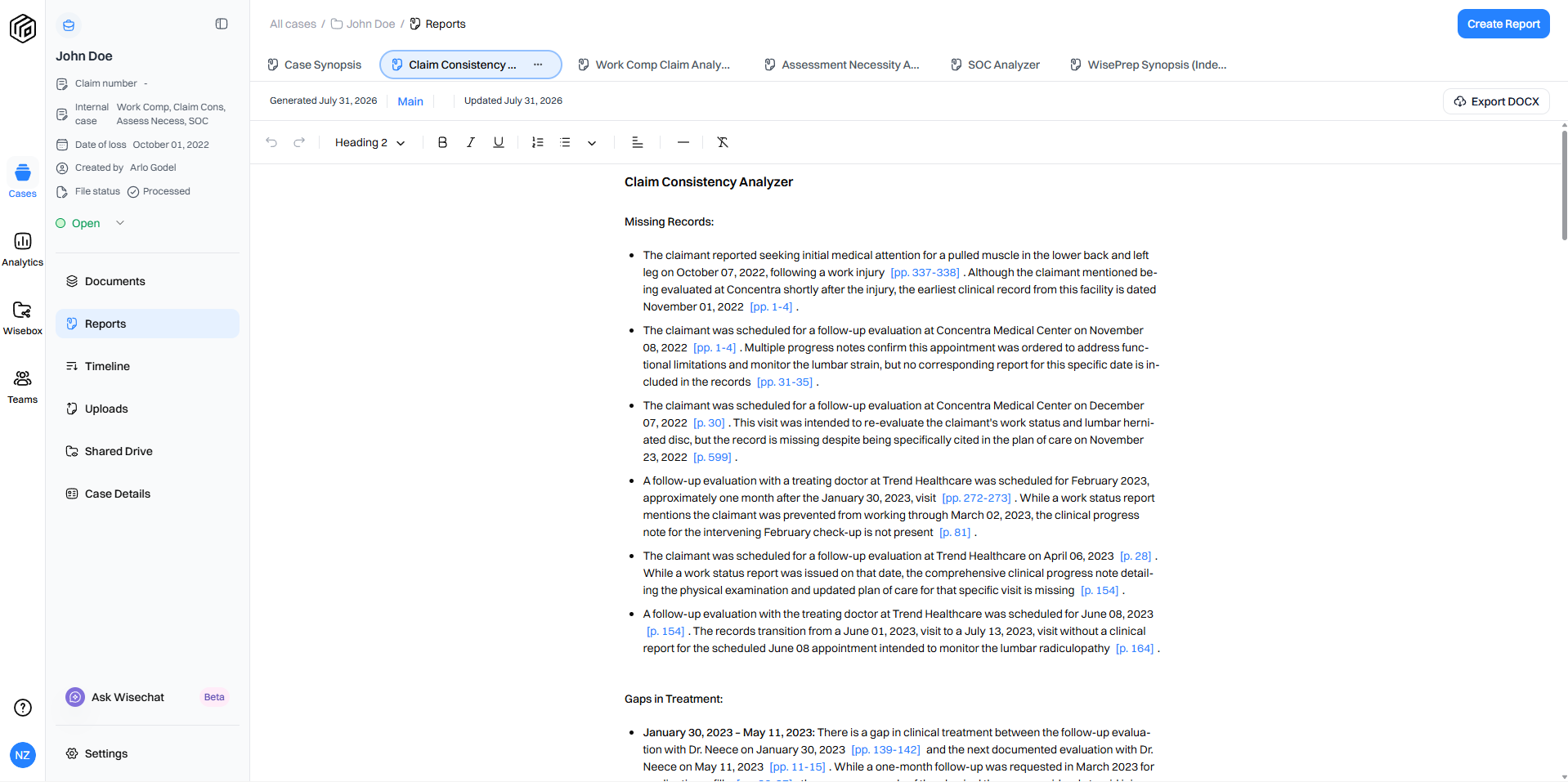
As we’re writing this, we'll start with our own platform. Wisedocs is an insurance claims analytics platform designed to automate medical record reviews for workers' compensation claims processing and provide in-depth AI insights to reach accurate decisions faster.
We combine our AI trained on 150 million medical insurance documents with expert human review to organize and analyze medical files at scale.
Key capabilities include:
- Clean up file clutter automatically: Drop redundant pages instantly with automated deduplication to cut down overall reading volume.
- Generate tailored summaries using AI analyzers: Get reports built specifically for complex workers' comp files using 6 specialty analyzers that allow your team to extract focused clinical data, evaluate demand packages, and audit billing statements against grounded medical evidence for faster report creation & decision making
- Track portfolio trends with claim portfolio insights: Analyze performance patterns, exposure risks, and operational metrics across your entire book of business.
- Build page-cited medical timelines: Convert thousands of mixed pages into an interactive timeline view with every fact tied to its source document.
- Analyze demand letters and medical bills: Cross-reference plaintiff demands against medical records to spot gaps, inconsistencies, or inflated treatment claims.
- Share records securely with external partners: Set custom user permissions to collaborate with defense counsel and evaluators using WiseShare.
Wisedocs isn't built for every single team or workflow. If you only need a basic policy administration system or simple loss-run reporting, another option on this list might suit you better.
CLARA Analytics
CLARA Analytics focuses on casualty claims guidance and early risk alerts for insurance carriers and self-insured teams.
Key capabilities:
- Spot litigation risks early: Use predictive models to identify claims that show signs of legal escalation.
- Evaluate provider networks: Track doctor and facility performance based on past treatment patterns and recovery times.
- Summarize medical files: Extract key treatment events automatically to help adjusters review claims faster.
- Protect sensitive health data: Maintain strict security using SOC 2 Type 2 protocols and HIPAA compliance standards.
Guidewire
Guidewire is a major P&C core system provider that offers embedded claims analytics through its ClaimCenter platform.
Key capabilities:
- Compare team performance against peers: Benchmark claims metrics against anonymized industry data in real time.
- Deliver insights inside daily workflows: Give adjusters predictive guidance directly within their primary claims dashboard.
- Map claim concentration risks: View policyholder locations visually to coordinate catastrophe response plans.
- Adjust reserves with historical data: Use past settlement trends to set accurate reserves on complex files.
Origami Risk
Origami Risk connects claims management, safety tracking, and compliance workflows inside a single software environment.
Key capabilities:
- Automate state reporting forms: Submit electronic FROI and SROI forms across state workers' compensation boards.
- Monitor return-to-work timelines: Use disability duration guidelines to track injured worker recovery goals.
- Maintain compliance guardrails: Run built-in workflows to meet regulatory rules for OSHA, CMS, and HIPAA.
- Unify risk data sources: Connect payroll, HR, and carrier feeds into one central system.
Riskonnect Claims
Riskonnect Claims helps organizations manage the full claim lifecycle from initial intake through final settlement.
Key capabilities:
- Track claim details in one hub: Combine incident reports, medical notes, and payment histories across departments.
- Manage indemnity and payment schedules: Set up benefit schedules with complete audit trails for financial changes.
- Apply predictive risk scoring: Catch high-cost claims early and route them to senior adjusters automatically.
- Guide recovery plans: Use disability guidelines to track treatment milestones and shorten claim duration.
Choose a platform that uses AI technology to streamline entity extraction, decision-making, and investigations
Finding the right claims analytics software comes down to where your organization experiences the most operational friction. While general claims software handles basic file tracking, document-heavy workers' comp cases need specialized tools to prevent reserve errors and settlement delays.
By using a dedicated claims document solution like Wisedocs, insurance carriers can make initial file contact 60% to 80% faster while boosting team capacity. Removing manual record review lets claims professionals focus on what actually matters: helping injured workers recover and making better decisions on every file.
Sources:

.png)